

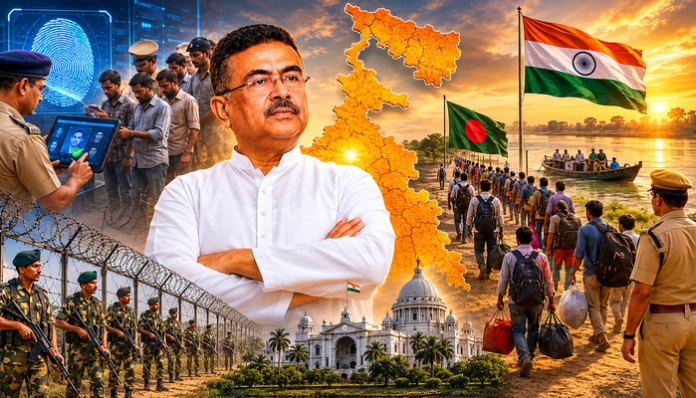
Visuals of large numbers of illegal Bangladeshi immigrants queued up before Border Security Force (BSF) checkposts are emerging in West Bengal. Bangladeshi infiltrators are turning up at the checkposts, accompanied by their families, willing to return to their country as they see the political landscape in the state is no longer conducive to their illegal and unwanted stay.
These Bangladeshi nationals entered India illegally and have been living here comfortably like citizens. Some of them have been residing here for decades, earning a living and, in many cases, availing of the benefits of welfare schemes by forging documents. They settled and mushroomed in the state owing to the wilful negligence of the previous governments, which found a vote bank among them.
However, the situation has now changed with the long-anticipated change in political power in the state following the 2026 Assembly elections. The scale of the ‘reverse migration’ is unprecedented and is a direct result of the newly elected Chief Minister Suvendu Adhikari’s directive to the state officials to immediately commence the deportation proceedings against Bangladeshi infiltrators.
Earlier, such scenes appeared in the state during the Special Intensive Revision (SIR) exercise conducted in the state by the Election Commission of India (ECI) ahead of the assembly elections. During the SIR, the ECI revised the electoral roll in the state to conduct free and fair elections by eliminating bogus and invalid voters. This led to illegal Bangladeshi immigrants, who had been living here without or with forged documents, fleeing to their home country.
The BJP government in West Bengal is fulfilling its election promise
Illegal immigration, border security and demographic change were some of the key issues in the BJP election campaigns in the state. The resounding victory of the BJP in the West Bengal assembly elections proves that the issues raised by the party in its election campaign resonated with the people of the state.
Soon after swearing in, Adhikari, who led the BJP to a sweeping victory in the state, clamped down on illegal immigration, which has plagued the state for decades. In one of the first decisions that Adhikari made as the Chief Minister, he announced the policy of ‘Detect, Delete and Deport’ to uproot the long-standing menace of illegal immigration.
The policy was operationalised this week with the district authorities setting up ‘holding centres’ for undocumented immigrants ahead of deportation as directed by the Chief Minister. Reiterating his government’s zero-tolerance policy towards illegal immigration after an event in Kalyani, CM Adhikari told the illegal immigrants living in West Bengal to leave as soon as possible, warning them of stringent action.
“They should leave. They are Bangladeshis. Their government should accept them. We have instructed the police that they shouldn’t be sent to jails. Are they our in-laws that the country would have to pay for their food, clothes and medicines? Leave at the earliest. Else the government would do what needs to be done,” Adhikari stated in clear terms, addressing the media in Nadia district.
The previous TMC government harboured Bangladeshi infiltrators
The illegal cross-border migration of Bangladeshi nationals into India has been a long-standing challenge in West Bengal. Illegal immigrants not only strained the already scarce resources in the state but also posed a threat to law and order and national security. For several decades, illegal immigration in the state has been associated with communal tensions, resource allocation debates, and national security discussions and has also been an influential factor in the electoral politics.
Over the year, the security agencies raised concerns about illegal immigrants being involved in human trafficking networks, cattle smuggling, criminal syndicates, and even terror activities. Unchecked illegal immigration in West Bengal has altered demographics in several bordering districts, strained public infrastructure, and weakened internal security. However, the state agencies have been unable to effectively deal with the problem due to a lack of political will on the part of the previous Mamata Banerjee government.
The previous TMC government’s unwillingness to put a curb on illegal immigration, despite its direct impact on the people of West Bengal, exposes how the government chose electoral politics over national security and the interests of its own people. While the TMC did not take any independent measures to address illegal immigration, it also failed to cooperate with the central government on the issue. The TMC government’s intent with respect to the issue of illegal immigration became evident when it did not implement the guidelines issued by the Union Ministry of Home Affairs in 2025 to accelerate the verification process of Bangladeshi and Rohingya infiltrators. The number of illegal immigrants grew unchecked under the political patronage of the TMC regime, amplifying the challenge for the security agencies.
However, with a changed political approach regarding illegal immigration, the West Bengal government is finally enforcing long-neglected laws and intensifying verification drives and stricter scrutiny of identity documents. As the vision of the governments at the centre and the state regarding the issue of illegal immigration has aligned, the security agencies are now backed by the necessary political will to take action against the problem.


