


UAPA (Unlawful Activities Prevention Act) accused Sharjeel Imam has repeatedly made headlines for all the wrong reasons. The latest controversy erupted after his interview with The Quint, in which he laid bare his hostility towards the Hindu community and his contempt for the Indian state, its Constitution, democracy and secularism, while defending the Muslim League and glorifying Muhammad Iqbal and Muhammad Ali Jinnah. Now, in yet another similar addition, it has emerged that Imam also co-drafted a statement addressed to the centre in the aftermath of the revocation of Article 370 to push his own agenda.
The document, titled “IITians Against the Brutalisation of Kashmir and Kashmiris,” was released in October 2019, following the Modi government’s landmark decision to revoke Article 370 for the complete constitutional integration of Jammu and Kashmir with the rest of the country.
“The state of Jammu and Kashmir joined the Indian Union with an agreement that manifested itself in Article 370 and Article 35A of the Indian Constitution. Two months ago, the government of India unilaterally abrogated these articles without consulting the elected assembly of the state, dissolved the provincial government, converted the state into a union territory, and imposed a curfew and communication blackout in most of the state,” it read.
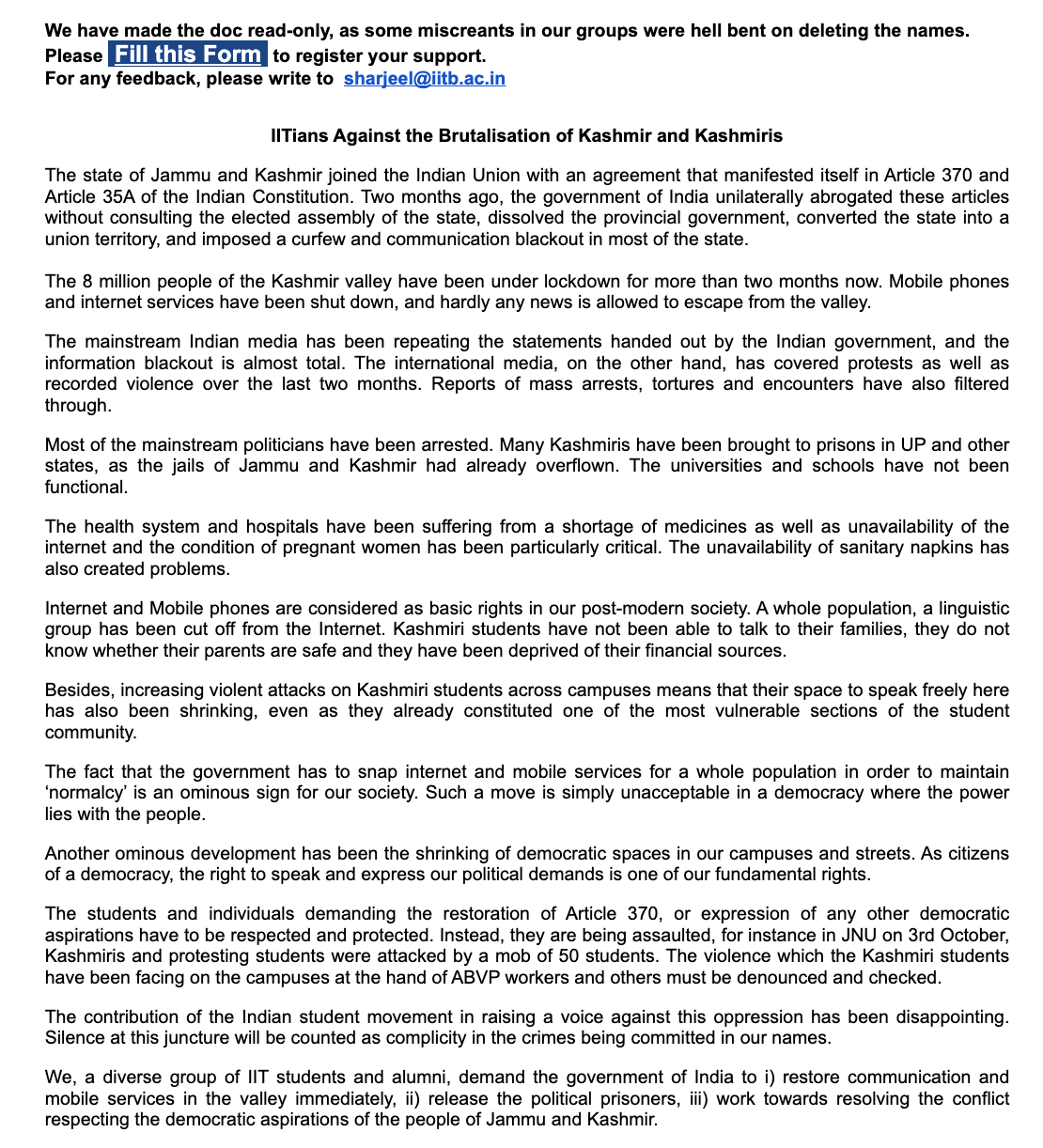
According to the letter, the 8 million residents of the valley have been under lockdown for more than two months. It asserted an information blackout, stating that hardly any news is coming out of the area as internet and mobile phone services have been shut off. Imam and his clique then accused the Indian mainstream media of purportedly parroting the government’s line.
They alleged, “The mainstream Indian media has been repeating the statements handed out by the Indian government, and the information blackout is almost total. The international media, on the other hand, has covered protests as well as recorded violence over the last two months. Reports of mass arrests, torture and encounters have also filtered through.”
Further perpetuating this misleading narrative, the letter charged that most mainstream political leaders were arrested, adding, “Many Kashmiris have been brought to prisons in UP and other states, as the jails of Jammu and Kashmir had already overflown. The universities and schools have not been functional.”
According to the letter, the health system and hospitals were suffering from a lack of medicines as well as an inability to access the internet, and the condition of pregnant women had been especially severe, arguing, “The unavailability of sanitary napkins has also created problems.”
Referring to the internet and mobile phones as “basic rights in post-modern society,” the “IITians” contended that an entire community, a linguistic group, has been blocked off from the internet. They insisted that Kashmiri students have lost their economic resources, are unable to communicate with their family members, and are unsure about the safety of their parents.
“Besides, increasing violent attacks on Kashmiri students across campuses means that their space to speak freely here has also been shrinking, even as they already constituted one of the most vulnerable sections of the student community,” they stated.
The internet shutdown to maintain peace and order was called an “ominous sign for our society” and was deemed inappropriate in a democracy where the people possess the authority. The letter added, “Another ominous development has been the shrinking of democratic spaces in our campuses and streets. As citizens of a democracy, the right to speak and express our political demands is one of our fundamental rights.”
Imam and his peers wanted students and individuals advocating the restoration of Article 370, as well as the “expression of any other democratic aspirations,” to be respected and protected.
“Instead, they are being assaulted; for instance, in JNU on 3rd October, Kashmiris and protesting students were attacked by a mob of 50 students. The violence which the Kashmiri students have been facing on the campuses at the hands of ABVP workers and others must be denounced and checked,” they protested.
The cabal then expressed disappointment with the Indian student movement for failing to lend its voice against what it described as “oppression,” which in reality was another extension of broader anti-India propaganda, threatening, “Silence at this juncture will be counted as complicity in the crimes being committed in our names.”
The letter finally concluded, “We, a diverse group of IIT students and alumni, demand the government of India to i) restore communication and mobile services in the valley immediately, ii) release the political prisoners, iii) work towards resolving the conflict respecting the democratic aspirations of the people of Jammu and Kashmir.”
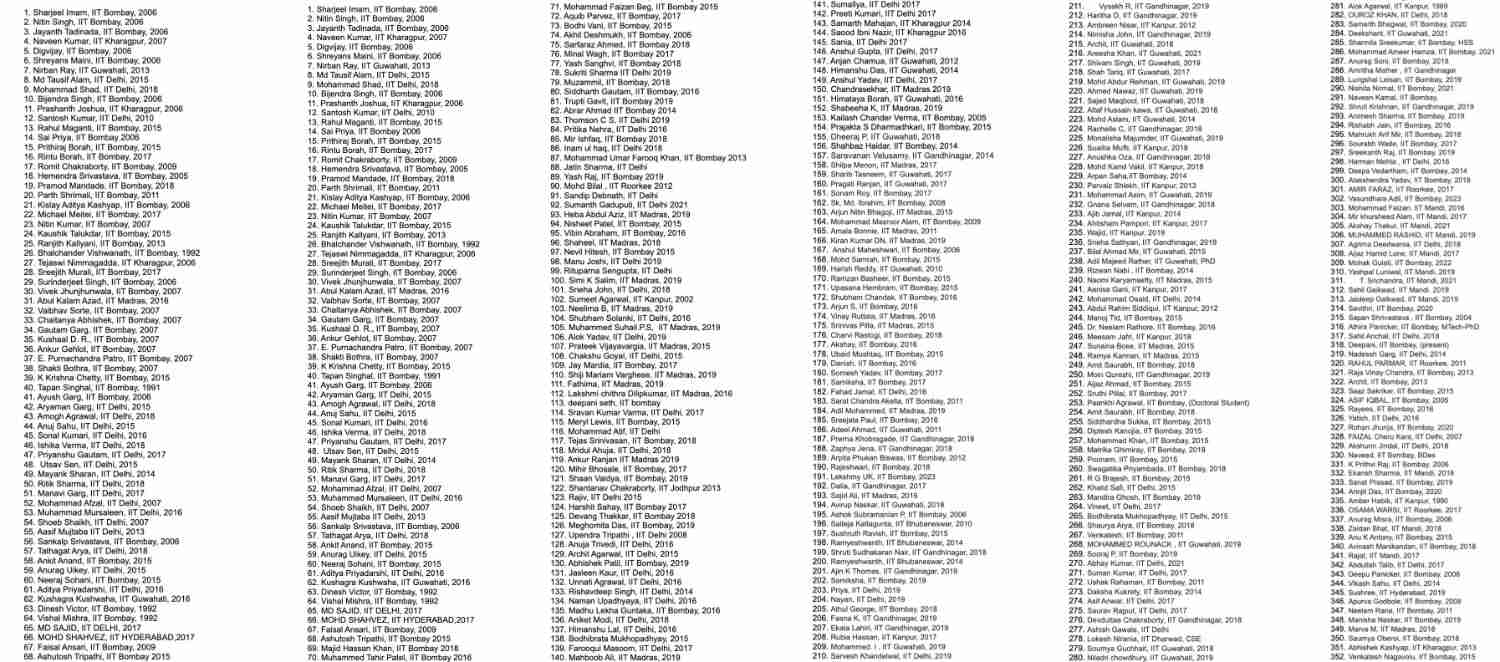
The letter also included a form inviting people to register their “support” along with Imam’s email address to provide feedback. His name appeared at the top of the list of signatories, followed by others.
Predictably, the entire statement was essentially an attack on the measures taken to prevent any untoward incidents during a sensitive period in the valley, which has already endured decades of jihadism and violence. Moreover, Article 370 was not a permanent provision but a temporary one that remained in force far longer than originally envisaged, owing to policies of appeasement.
It also acted as a roadblock to the rights of West Pakistan Refugees (WPR), Scheduled Castes and Scheduled Tribes, refugees, women and other marginalised groups. This is the very group Imam and his coterie claim to champion, but their apparent concern for its rights serves little purpose beyond advancing their own propaganda.
The government’s stringent steps were aimed at averting any incidence of violence and unrest in the region. However, Imam and his IIT brigade seemed to have a problem with these measures, as they deprived them of yet another opportunity to malign the Indian state in the event of any unfortunate occurrence. Their concern was clearly not for the people or the area, but for their own malicious objective.
