

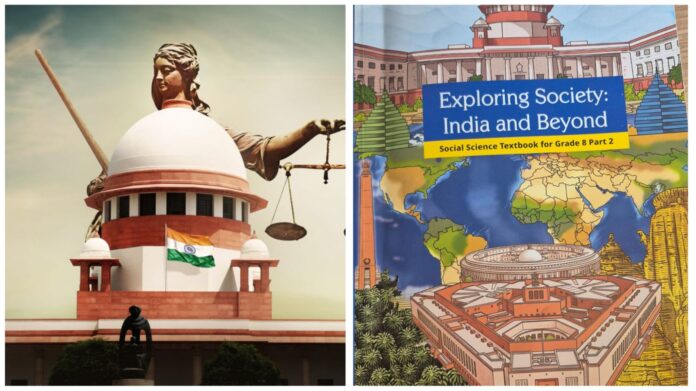
Months after the National Council of Educational Research and Training (NCERT) withdrew its Class 8 Social Science textbook following objections over a chapter discussing alleged judicial corruption, the council’s newly introduced Class 9 Political Science textbook presents the judiciary as an “impartial and independent institution” that protects citizens’ rights and upholds the Constitution.
The revised textbook, developed under the National Curriculum Framework (NCF), explains the constitutional principle of separation of powers and emphasises that the judiciary functions independently of the legislature and the executive. It describes the courts as one of the key pillars of India’s democratic framework, entrusted with protecting constitutional values and ensuring justice.
According to the textbook, “The judiciary is an impartial and independent institution that safeguards the rights of citizens and upholds the spirit of the Constitution.”
The chapter further explains that the judiciary has the authority to review executive actions and constitutional amendments, strike down laws that violate the Constitution, and uphold constitutional principles through judicial review.
“The judiciary reviews executive actions and constitutional amendments, can invalidate laws that violate the Constitution, and upholds the Constitution,” the textbook states.
Highlighting the judiciary’s role in a democracy, the book adds that courts play a crucial role in protecting democratic values and safeguarding the rights of all sections of society. It also notes that the judiciary entertains Public Interest Litigations (PILs) to expand access to justice.
“The judiciary plays a vital role in protecting and promoting democratic values and the rights of all sections of society. The judiciary takes up Public Interest Litigations (PILs) from time to time to ensure access to justice for all,” it says.
The chapter introduces students to the judiciary as a constitutional institution responsible for protecting fundamental rights, interpreting the Constitution, and maintaining the balance of power between the three organs of the state.
Class 9 textbook released months after Class 8 judicial corruption chapter was withdrawn
The publication assumes significance because it comes only months after a major controversy surrounding an NCERT Class 8 Social Science textbook.
Earlier this year, the Class 8 book included a section discussing challenges facing the Indian judiciary, including allegations of corruption, delays in justice due to mounting case backlogs, and concerns over declining public confidence. The contents triggered a legal controversy after the Supreme Court took suo motu cognisance of the chapter.
The apex court reportedly termed portions of the material objectionable and directed that the textbook should not be published, reprinted or circulated digitally.
Following the court’s intervention, NCERT withdrew both physical and digital copies of the Class 8 textbook and issued an unconditional apology. The Supreme Court had observed that the chapter contained “offending” material relating to the judiciary.
NCERT says constitutional values remain part of redesigned curriculum
NCERT has maintained that the newly introduced Class 9 Political Science textbook is part of a broader curricular restructuring undertaken under the National Curriculum Framework.
According to the council, constitutional themes are now distributed progressively across different grades rather than being confined to a single textbook. It has also clarified that concepts such as justice, liberty, equality, secularism and socialism continue to remain part of the school curriculum and are introduced to students in a phased manner as they progress through different classes.
The new Class 9 textbook, therefore, places emphasis on the constitutional role of the judiciary as an independent institution entrusted with protecting rights, preserving democratic values and acting as a check on the legislature and the executive, a marked contrast to the controversy that surrounded the withdrawn Class 8 chapter earlier this year.
