

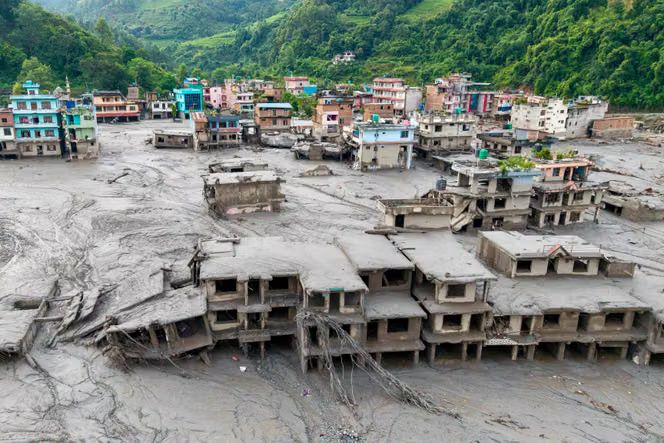
Nepal has launched a diplomatic push for climate compensation from major greenhouse-gas emitters, including India, the United States and China, following a devastating flash flood that tore through communities along the Bhotekoshi River.
The disaster, triggered by a high-altitude glacial collapse near the Tibet-Nepal border, sent a destructive surge of freezing water, rocks and debris downstream. The scale of the devastation has prompted Kathmandu to argue that international assistance should no longer be viewed simply as humanitarian charity, but as compensation for climate-related losses.
Nepal Foreign Minister Shishir Khanal said the country was paying a disproportionate price for a global crisis to which it had contributed very little.
“We are paying the ultimate price for a global crisis we did not create,” Khanal said, arguing that accelerating glacier melt and catastrophic mountain disasters are consequences of global climate change.
From aid to ‘justice and compensation’
Khanal said Kathmandu was changing its diplomatic approach by framing climate-related assistance as a question of justice and liability rather than generosity.
“This is not a matter of charity; it is a matter of legal and moral liability,” he said.
According to the minister, Nepal intends to raise the issue forcefully at international forums and demand compensation for climate-related losses suffered by vulnerable countries.
Nepal’s argument rests on the sharp imbalance between its contribution to global emissions and the consequences it faces from a warming planet. Khanal said the country produces “virtually negligible” greenhouse-gas emissions, yet is increasingly exposed to glacier melt, floods and other extreme mountain disasters.
China, US and India in Nepal’s crosshairs
Khanal specifically identified China, the United States and India as major industrial emitters with what he described as a historical responsibility towards climate-vulnerable nations.
He argued that China, the world’s largest emitter, followed by the United States and India, should compensate countries such as Nepal for climate-related damage.
“The major industrial emitters … have a historical responsibility to compensate vulnerable nations like Nepal,” Khanal said.
Nepal has also formally approached the Fund for Responding to Loss and Damage, seeking urgent financial assistance following the August 26 flash flood in the Bhotekoshi river basin.
The fund was established at COP27 in 2022 and operationalised at COP28.
Nepal says the stakes go beyond its borders
Khanal has sought to broaden the issue beyond Nepal’s immediate losses, warning that the fate of Himalayan glaciers has implications for much of South Asia.
He said the disappearance of Himalayan glaciers could threaten the water security of more than two billion people who depend on rivers originating in the region, including the Ganges and the Trishuli.
“This is a matter of civilisational survival,” Khanal said, arguing that Nepal’s campaign was ultimately about protecting the wider South Asian region.
The Nepalese government has already taken a formal step towards securing financial assistance. Its Finance Ministry has dispatched a climate compensation claim letter to international partners, while a separate appeal has been made to the loss-and-damage fund.
India’s position
India has historically emphasised the principle of climate equity, pointing to its comparatively low per-capita emissions and arguing that climate responsibilities must reflect differences in historical emissions, development requirements and national capacities.
New Delhi has also supported international efforts to address loss and damage suffered by vulnerable developing countries. At the same time, India has maintained that developed countries, which industrialised earlier, bear a larger share of historical responsibility for accumulated greenhouse-gas emissions and should provide financial resources to countries dealing with climate impacts.
Nepal’s latest demand therefore places an already contentious question of climate responsibility at the centre of its diplomatic engagement with its larger neighbours and other major economies.
For Kathmandu, however, the argument is straightforward: a country that has contributed little to global warming is increasingly confronting its most destructive consequences, and it now wants the international community to pay for the damage.
