

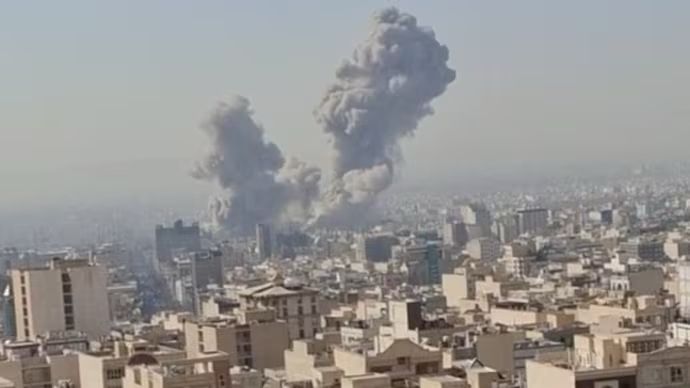
The Middle East edged closer to open war on Saturday after the United States and Israel carried out a preventive missile strike on Iran, triggering powerful explosions across the capital city of Tehran.
#WATCH | Tehran, Iran | Israel has launched a preventative missile attack against Iran, the Israeli defence minister said; visuals of the aftermath of the strike in Iran as a plume of smoke billows into the sky
— ANI (@ANI) February 28, 2026
The U.S. participated in the (Iran) attack and was also carrying out… pic.twitter.com/tzfR1WnDhO
The joint operation, reportedly codenamed Operation Shield of Judah, targeted multiple high-value government and military installations. Among the reported strike locations were the presidential complex, the Ministry of Intelligence, the Ministry of Defence, the Atomic Energy Organisation headquarters, and the strategically significant Parchin military site. Thick columns of smoke rose over central and eastern Tehran as residents scrambled for safety.
Iran’s Supreme Leader, Ali Khamenei, was reportedly shifted to a secure location as a precautionary measure, underscoring the gravity of the situation.
The US President has uploaded an 8-minute video on social media, stating that the United States had begun “major combat operations” in Iran.
Israel calls it a pre-emptive strike
Israeli Defence Minister Israel Katz said the attack was designed to “remove threats to the State of Israel,” describing it as a pre-emptive operation against Iran’s expanding military capabilities. Israeli officials confirmed that the strike was coordinated with Washington.
In anticipation of retaliation, Israel declared a nationwide state of emergency. Air raid sirens were activated across several regions, and authorities imposed sweeping restrictions, suspending educational activities, public gatherings, and most workplaces, with only essential services allowed to function.
Tehran locks down; region braces
In Tehran, mobile networks were partially cut in eastern and western districts, and Iranian authorities closed the national airspace. The US Embassy in Qatar ordered shelter-in-place protocols for its personnel and advised American citizens in the region to do the same.
The strike comes just months after a 12-day aerial confrontation between Israel and Iran in June, one of the most direct military engagements between the two long-standing adversaries. Since then, both Washington and Tel Aviv have repeatedly warned that force remains an option if Iran continues advancing its nuclear and ballistic missile programmes.
Ironically, the escalation unfolded even as diplomatic backchannels had reopened. Washington and Tehran resumed negotiations in February, seeking to avoid precisely this kind of spiral. Israel, however, has insisted that any agreement must dismantle Iran’s nuclear infrastructure entirely, not merely cap enrichment levels, and include limits on missile capabilities.
Iran, for its part, has signalled willingness to discuss nuclear constraints in exchange for sanctions relief but has firmly ruled out negotiations over its missile programme. It has also warned regional states hosting US forces that their territory could become legitimate targets if used to launch attacks.
The result is a region once again perched on the edge, where deterrence, diplomacy, and confrontation are colliding in real time.
