

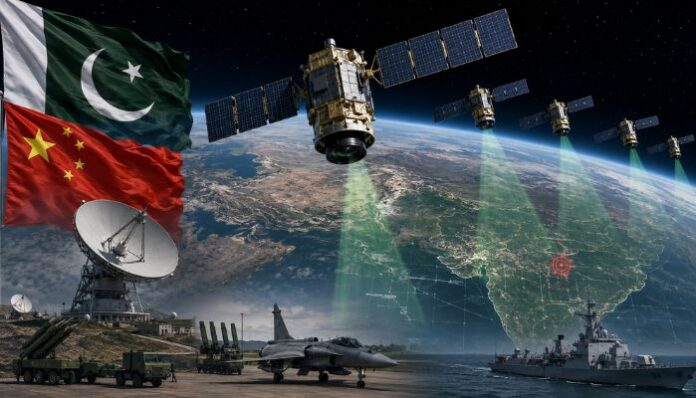
More than a year after India and Pakistan agreed to a ceasefire following Operation Sindoor, concerns are now growing over a China-enabled surveillance network operating through Pakistan. According to a report by The Print, Pakistan has launched six Earth-observation satellites in just 16 months, creating a satellite constellation that is increasingly being viewed not merely as Pakistan’s own space capability but as an extension of Beijing’s growing intelligence and surveillance footprint over South Asia.
The speed of these launches, the extensive Chinese technical assistance involved, and the nature of the satellites themselves have raised questions about whether Pakistan is independently operating this surveillance architecture or whether it is functioning as part of a broader China-Pakistan strategic partnership in space.
The report also noted that the satellites are capable of capturing detailed images of Indian territory, monitoring military deployments, tracking naval movements in the Indian Ocean and identifying strategic assets on the ground, significantly enhancing surveillance capabilities directed towards India.
Pakistan’s spy satellite network watching India has grown faster than ever in just 16 months
— ThePrintIndia (@ThePrintIndia) June 8, 2026
Soumya Pillai @soumya_pillai reports #ThePrintExclusive #ThePrintGroundReport https://t.co/Gicbx2BKSO
Pakistan’s space programme sees unexpected expansion
Pakistan’s space agency, SUPARCO, launched PAUSAT-1, an Earth-observation CubeSat, in January 2025 aboard SpaceX’s Falcon 9 rocket. Just three days later, another Earth-observation satellite, PRSC-EO1, was launched with direct Chinese assistance using a Long March launch vehicle.
Since then, Pakistan has added several more satellites to its growing fleet, including PRSS-2, HS-1, PRSC-EO2 and PRSC-EO3. The pace of these launches has surprised many observers.
For decades after launching its first satellite, Badr-1, in 1990, Pakistan’s space programme remained relatively modest. However, within just 16 months, six new satellites have entered orbit, prompting analysts to question how such a dramatic expansion became possible in such a short period.
Many defence observers believe the answer lies in China‘s increasing involvement. The rapid deployment of satellites, combined with China’s long-standing strategic partnership with Pakistan, has fuelled concerns that these satellites are effectively strengthening Beijing’s surveillance reach over the Indian subcontinent while operating under a Pakistani banner.
Former Indian Navy officer Sudhir Pillai highlighted the significance of this transformation. “Between January 2025 and April 2026, SUPARCO placed roughly half a dozen satellites into orbit. That pace represents a structural discontinuity, not an incremental programme update,” he wrote in a blog post.
He further noted, “Its orbital architecture, its sensor complement, and above all its institutional provenance tell a different and a more consequential story.”
Why the satellite network is raising concerns for India
What has drawn particular attention is not merely the number of satellites but the way they have been positioned in orbit.
Most Earth-observation satellites around the world operate in Sun-synchronous orbits that allow them to capture images of the same location under similar lighting conditions. However, a recent analysis by US-based space tracking company COMSPOC found that Pakistan’s PRSC-EO3 satellite follows an unusual orbit that appears heavily focused on South Asia.
According to COMSPOC, the satellite was placed in a way that allows it to revisit areas between 20°N and 40°N latitude more frequently. This region includes Pakistan, northern India and Jammu and Kashmir.
The company noted, “This sacrifices global coverage and consistent lighting, but increases revisit rates over a specific latitude band: 20-40°N. That’s Pakistan, India, and Kashmir.”
In simple terms, Pakistan may have sacrificed global coverage in favour of getting more frequent images of India and neighbouring regions.
Civilian satellites with strategic value
Officially, these satellites are described as platforms intended for agriculture, disaster management and Earth observation. However, experts argue that in the modern era, almost every Earth-observation satellite possesses dual-use capabilities.
Ashwin Prasad Rao, a space strategy expert at the Takshashila Institution, pointed out that commercial Earth-observation imagery can be used for both civilian and military purposes.
“Effectively, most commercial Earth-observation imagery can be purchased or tasked by paying customers, including foreign governments, to image Indian sites,” Rao said.
The concern for Indian security planners is that a surveillance network developed with extensive Chinese support could potentially serve the strategic interests of both Islamabad and Beijing. This raises the possibility that information collected through these satellites may contribute to a larger intelligence-sharing framework between the two countries.
China’s growing footprint behind Pakistan’s space expansion
Several experts believe Pakistan’s recent progress in space would have been impossible without sustained Chinese support.
A former ISRO official told ThePrint that cooperation between China and Pakistan in the space sector has intensified significantly in recent years.
“The Chinese satellites monitor Indian territory more than even India does. Each inch of our territory is under surveillance,” the former official said.
China already operates one of the world’s most advanced Earth-observation networks through its Yaogan, Gaofen and Ziyuan satellite constellations. Pakistan also relies heavily on China’s BeiDou navigation system, which provides high-precision positioning, navigation and targeting capabilities.
India faces a new surveillance challenge
The emergence of this China-backed surveillance network comes at a time when India has experienced setbacks in several strategic satellite missions.
In the last two years, India suffered failures involving EOS-N1, EOS-09 and the NavIC-related NVS-02 mission. These satellites were designed for critical surveillance, border monitoring and navigation functions.
Experts argue that while Pakistan is rapidly strengthening its space-based surveillance capabilities with Chinese support, India needs to accelerate its own strategic space programmes.
As one former ISRO official put it, “Information is everything in a conflict situation. We saw that during Operation Sindoor and we are seeing that in the US-Iran war too. The only way to counter surveillance is through surveillance.”
The rapid expansion of Pakistan’s satellite fleet, the specialised orbits focused on South Asia and the deepening China-Pakistan space partnership have therefore intensified concerns that a new intelligence and surveillance challenge is emerging in the region, one that may be driven as much by Beijing’s strategic objectives as by Islamabad’s own ambitions.
