

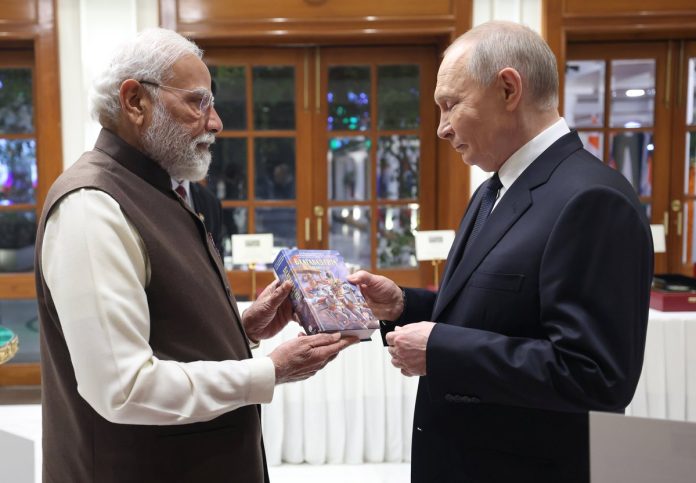
PM Modi has gifted a Russian translation of the Bhagavad Gita to Russian President Vladimir Putin who arrived in India on the evening of 4 December.
“Presented a copy of the Gita in Russian to President Putin. The teachings of the Gita give inspiration to millions across the world”, PM Modi had posted, along with an image of the two world leaders.
Replying to PM Modi’s post, International Society for Krishna Consciousness (ISKCON)’s Kolkata spokesperson Radharaman Das thanked him for gifting the Russian edition of the Bhagavad Gita authored by ISKCON founder Srila Prabhupada, titled ‘Bhagavad Gita As It Is’, to the President of Russia. Das further informed that ISKCON has so far distributed over 60 crore copies of the Gita worldwide in over 110 languages.
Thank you, Shri @narendramodi ji, for gifting ISKCON’s Russian edition of the Bhagavad Gita to @KremlinRussia_E. To date, ISKCON has distributed more than 60 crore copies of the Gita worldwide in over 110 languages. We would be happy to supply copies in all available languages…
— Radharamn Das राधारमण दास (@RadharamnDas) December 5, 2025
The very same book had once faced a lawsuit calling for ban
The significance of the special gift has another aspect. In Russia, back in 2011, some groups had once tried to ban the very same Russian version of the Bhagavad Gita published by ISKCON.
In 2011, some prosecutors in Tomsk, Siberia had filed a lawsuit to declare the Russian translation of ‘Bhagavad Gita As It Is’ by ISKCON founder Srila Prabhupada an “extremist text” and ban it in entire Russia. The lawsuit claimed that the book’s commentaries incited religious hatred and promoted social discord.
In June 2011, the court in Tomsk accepted the case, triggering fear that a ban might be coming against distribution of the Bhagavad Gita in Russia.
However, ISKCON launched a global campaign to gather support. The ‘save bhagavad Gita’ campaign garnered widespread support amoong Hindus around the world, even many Russian devotees associated with ISKCON.
The government of India finally intervened diplomatically. Then Prime Minister Manmohan Singh and External Affairs Minister S.M. Krishna raised the issue with Russian authorities. Politicians across party lines also gathered and passed an unanimous resolution in the parliament, calling the lawsuit an ‘attack on Indian culture’.
On 28 December 2011, the Tomsk Regional Court dismissed the case entirely, ruling that ‘Bhagavad Gita As It Is’ is not an extremist book. The judge in the court gave a verdict stating that the Bhagavad Gita is a classic religious scripture and the specific edition, with commentary and explanations by Srila Prabhupada falls under freedom of religious expression, and it is not extremist in nature.
ISKCON has a significant follower base in Russia, with over 50,000 active devotees and many more people showing interest. ISKCON in Russia has over 100 registered communities and 31 affiliated centres in dozens of Russian cities.
ISKCON started gaining popularity in Russia in the 1970s. However, it faced significant challenges in the Soviet Union, where many Soviet leaders termed ISKCON’s Hare Krishna movement as one of the ‘major threats’ to their society, along with Pop music and Western Culture. However, ISKCON has managed to survive and even slowly thrive in the country.
