

The proposed partnership is aimed at giving India a stronger presence in Indonesia’s downstream processing industry, which has grown rapidly over the past few years and is currently dominated by Chinese investments. By participating in processing activities closer to the source, India hopes to build a more reliable supply chain for key minerals used in electric vehicles, renewable energy, electronics, batteries and defence manufacturing.
India looks beyond China for critical minerals
Indonesia has become one of the world’s most important suppliers of critical minerals, especially nickel. According to the U.S. Geological Survey, the country holds around 55 million tonnes of nickel reserves, nearly 42% of the global total, and produces close to 60% of the world’s nickel.
To increase the value of its mineral resources, Indonesia stopped exporting unprocessed nickel ore in 2020. Since then, it has focused on refining and processing the metal within the country, helping build one of the world’s largest downstream mineral industries.
Over the past decade, Chinese companies have invested more than $65 billion in Indonesia’s downstream critical-minerals sector, primarily in nickel processing. They are estimated to control nearly 75% of the country’s nickel-refining capacity, giving China a major position in the global supply chain for electric-vehicle battery materials and stainless-steel production.
Why the partnership matters for India
India has limited domestic nickel reserves and depends almost entirely on imports. Industry estimates suggest the country currently requires around 85,000 metric tonnes of refined nickel every year, with Indonesia supplying nearly all of India’s ferronickel imports.
As demand from India’s electric vehicle and stainless steel industries continues to grow, the country’s nickel requirement is expected to cross 170,000 metric tonnes annually within the next five years. Through the proposed joint ventures, New Delhi aims to secure stable long-term access to these minerals while reducing dependence on processing networks dominated by China.
Officials believe the partnership will improve India’s supply-chain resilience and support its long-term plans for clean energy, battery manufacturing, advanced industries and defence production.
Leaders to discuss trade and defence
Apart from critical minerals, Modi and Prabowo will also review overall bilateral ties, including trade, investment and defence cooperation. Indonesia has become India’s second-largest trading partner in the ASEAN region, with bilateral trade reaching $24.78 billion in 2025-26, according to official sources.
Defence cooperation is also expected to be a major topic during the talks. The two leaders are likely to discuss Indonesia’s proposed purchase of the Made-in-India BrahMos supersonic cruise missile. Sources in New Delhi said negotiations are at an advanced stage. If the deal moves forward, Indonesia could become the third Southeast Asian country to acquire the missile after the Philippines, while India is also negotiating a similar agreement with Vietnam.
The BrahMos missile is designed and manufactured by BrahMos Aerospace Private Limited, a joint venture between India’s Defence Research and Development Organisation (DRDO) and Russia’s NPO Mashinostroyeniya (NPOM). India signed a $375 million agreement with the Philippines in January 2022 for the missile system.
PM Modi begins three-nation tour
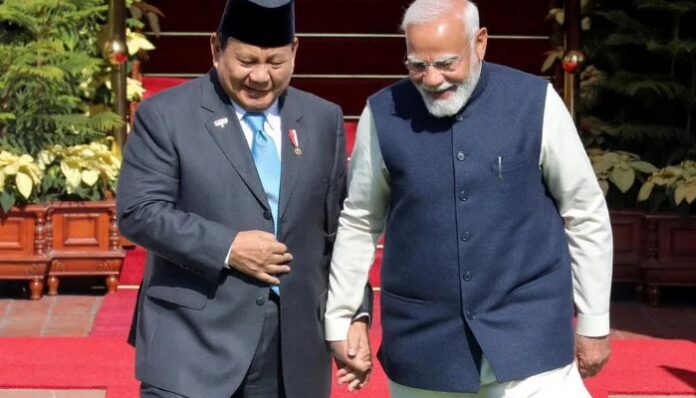
Prime Minister Modi arrived in Jakarta on Monday, 6th June, as part of his three-nation tour, which also includes Australia and New Zealand before he returns to New Delhi on 11th July. His aircraft was escorted by Indonesian Air Force fighter jets after entering the country’s airspace, and President Prabowo personally welcomed him at the airport.
Several agreements are expected to be signed after the leaders’ meeting on Tuesday, 7th June, with the critical minerals partnership emerging as one of the key outcomes of the visit. The agreement is expected to strengthen economic ties while helping India secure essential raw materials needed for its future industrial and energy goals.
