

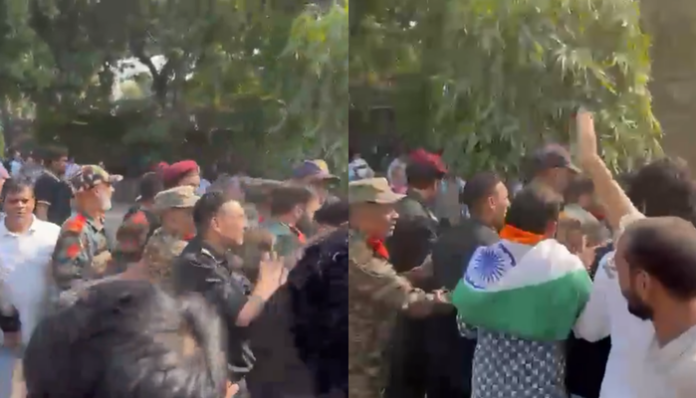
The situation continued to be tense amid the ongoing agitation at Jamia Millia Islamia University in Delhi as protesters on Saturday (October 24, 2026) clashed with university guards after they tried to remove the tents erected by protesting students on the campus. Left-wing group All India Students’ Association (AISA) has been involved in the demonstration. It is associated with the Communist Party of India (Marxist–Leninist) Liberation.
Jamia Millia Islamia’s student protest has entered its 12th day, with students alleging that hunger strikers and the protest site were targeted during ongoing negotiations with the administration. Protesters are demanding the restoration of the Jamia Millia Islamia Students’ Union (JMISU), action against the Chief Proctor and Security Advisor over their handling of the agitation, and the withdrawal of disciplinary action against protesters. The university has shifted classes online until the situation improves, while talks between students and university representatives continue amid a heavy police presence on campus. #JamiaMilliaIslamia #JamiaProtest #DelhiNews #StudentUnion #DelhiPolice
— News18 (@CNNnews18) October 24, 2026
According to reports, guards who had been keeping an eye on the situation tried to remove tents where the protestors had assembled, leading to the development. The university’s registrar highlighted that two Congress politicians who visited the campus incited the students and turned them into fodder for a political narrative.
The occurrence, according to Jamia Registrar Mahtab Alam Rizvi, occurred a day after Congress MPs Imran Pratapgarhi and Imran Masood disrupted the campus environment by sneaking in by hopping over a wall. He informed that the Delhi Police have received a complaint over the matter. On the other hand, AISA has alleged that the university’s administration began “assaulting students” during negotiations.
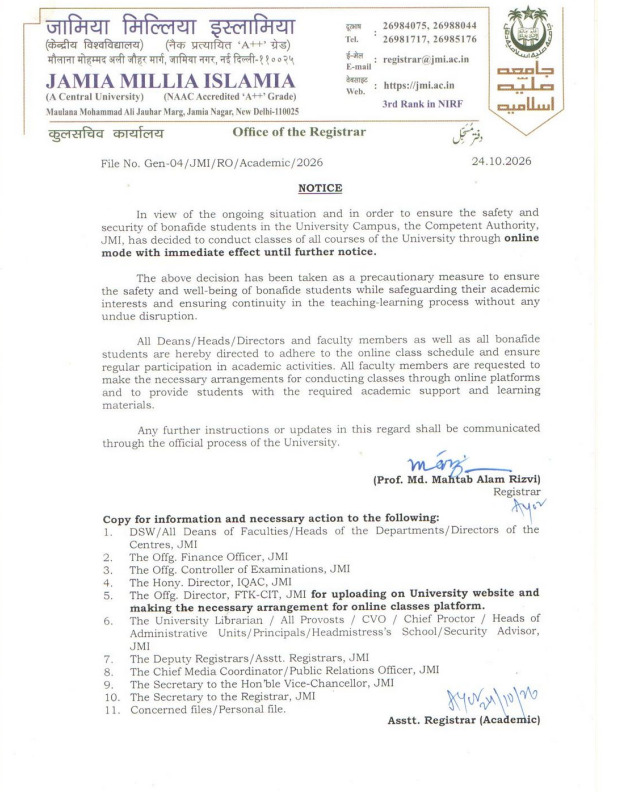
In view of the disturbance, the university administration directed classes to be conducted in online mode for the safety and security of bona fide students. “The above decision has been taken as a precautionary measure to ensure the safety and well-being of bona fide students while safeguarding their academic interests and ensuring continuity in the teaching-learning process without any undue disruptions,” the university statement said.
The protests at JMI University entered their 12th day today as the protesters continue to demand the restoration of elections to the Jamia Millia Islamia Students’ Union (JMISU). The protests began on October 12, 2026, demanding the reintroduction of the elections of the student body that were disbanded in 2006 after incidents of campus violence that led to academic disruptions.
The protests stirred a controversy after posters carrying slogans of “Free Kashmir,” “Free Palestine” and “Free Sharjeel Imam” appeared during the protests on the campus. Some of the students launched a hunger strike on the campus, triggering a strong response from the university administration. On 12th October, five students started a hunger strike to call for the university’s student union to be reinstated. The university management suspended two students and rusticated an LLB student, Ebin Basil, and banned all three from the university for a year for initiating an unapproved, indefinite hunger strike.
The university administration has accused two Congress leaders of inciting the protests on the campus. Jamia Registrar Mahtab Alam Rizvi said that Congress MPs Imran Pratapgarhi and Imran Masood visited the campus and triggered the disturbance.
Congress MP Imran Masood visited the university campus on Friday (October 23, 2026), supporting the demands of the protesting students. He also called for “justice” for Islamist Sharjeel Imam, who is facing charges in the larger conspiracy case linked to the February 2020 anti-Hindu Delhi riots.
Jamia formed a committee earlier this week to revise the constitution of the 2006-dissolved students’ union. Zubair Meenai, dean of the Faculty of Social Sciences, will chair the five-person committee. It will review pertinent court decisions, the Lyngdoh Committee’s recommendations (2007), and the events leading up to the union’s dissolution in 2006. It has been requested to provide a draft by 20th December after consulting with all relevant parties, including students.
This came after a high-level committee was created on 18th October to discuss the demands of the protesters. The university administration charged that panel members met with student representatives on 19th and 20th October, but they refused to sign the meeting minutes.
