

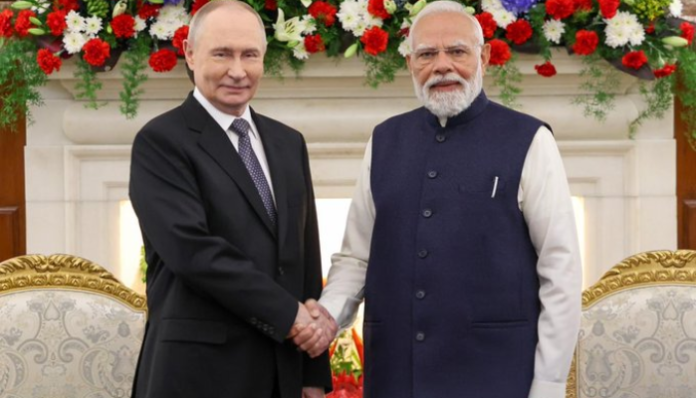
On 5th December, Russian President Vladimir Putin and Prime Minister Narendra Modi had bilateral meetings in Delhi as part of Putin’s India visit. Afterward, they released a joint statement, covering several vital agreements including trade, economy, counter terrorism and defence, among others. Notably, Putin’s first official visit to India since 2021 took place during the 23rd India–Russia Annual Summit.
“The Leaders reaffirmed their support for further strengthening of the Special and Privileged Strategic Partnership between India and Russia. This year marks the 25th anniversary of the Declaration on Strategic Partnership between India and Russia, established during the first State Visit of H.E. President Vladimir Putin to India in October 2000,” read the official statement released by Ministry of External Affairs.
PM @narendramodi and President Vladimir Putin held extensive talks at Hyderabad House today during the 23rd India-Russia Annual Summit.
— DD News (@DDNewslive) December 5, 2025
The leaders reviewed all aspects of the deep-rooted and multifaceted India-Russia relationship, reaffirming their commitment to further… pic.twitter.com/jqFGuEjWF2
Trade and Economic partnership
The two parties reaffirmed their commitment to growing bilateral trade in a sustainable and balanced way, including by boosting India’s exports to Russia, bolstering industrial cooperation, establishing new investment and technological partnerships, particularly in cutting-edge high-technology fields, and discovering new channels and forms of cooperation.
In order to guarantee the continuous maintenance of bilateral trade, Russia and India have also decided to keep working together to establish bilateral payment systems using their own currencies.
The statement further informed, “Additionally, the Sides have agreed to continue their consultations on enabling the interoperability of the national payment systems, financial messaging systems, as well as central bank digital currency platforms. The Sides welcomed steps to ensure long-term supply of fertilizers to India and discussed the potential establishment of joint ventures in this area. The Sides welcomed the signing of agreements related to mobility of skilled workers.”
The leaders also highlighted the vitality of profitable and mutually beneficial bilateral commerce in mineral resources, such as metals, energy sources, and precious stones, as well as essential raw materials for the stability of global supply chains.
Energy partnership
As a key component of the Special and Privileged Strategic Partnership, the two nations also discussed their deep cooperation in the energy sector.
The statement mentioned, “The Sides noted the current and potential cooperation between Indian and Russian companies in fields such as oil and oil products, oil refining and petrochemical technologies, oilfield services and upstream technologies and related infrastructure, LNG and LPG related infrastructure, various existing projects in their countries, underground coal gasification (UCG) technology, nuclear projects, etc.”
Transport and Connectivity, Cooperation in the Russian Far East and Arctic
The two sides decided to strengthen their cooperation in creating reliable and effective transport corridors to support the crucial International North-South Transport Corridor (INSTC), the Chennai–Vladivostok (Eastern Maritime) Corridor and the Northern Sea Route. They emphasised on growing logistics links for better connectivity and boosting infrastructure capacity.
The statement conveyed, “The two Sides confirmed their readiness to intensify trade and investment cooperation in the Far East and the Arctic zone of the Russian Federation.” It added, “The Russian Side appreciated the participation of the Indian delegation in the 6th International Arctic Forum held in Murmansk in March 2025. The Indian Side expressed its readiness to play an active role as an Observer in the Arctic Council.”
Civil Nuclear and Space Cooperation
Russia and India confirmed their intention to expand cooperation in nuclear energy, including fuel cycle, life cycle support for operating Kudankulam Nuclear Power Plant (KKNPP), and non-power applications. The countries aim to develop a new agenda for interaction in the area of peaceful use of atomic energy and related high technologies.
“The Sides noted the importance of the cooperation in the peaceful uses of nuclear energy as a significant component of the strategic partnership taking into account the plans of the Government of India to increase India’s nuclear energy capacity to 100 GW by 2047,” the statement noted.
“Noting the importance of cooperation in Space, the two Sides welcomed the enhanced partnership between the Indian Space Research Organisation and the Russian State Space Corporation (Roscosmos) in the use of outer space for peaceful purposes, including in the human spaceflight programs, satellite navigation and planetary exploration,” it further mentioned.
Boost to “Make in India” in Military Technical Cooperation
Through technology transfer and the formation of joint ventures to meet the needs of the Indian Armed Forces, both sides agreed to promote joint manufacturing in India of spare parts, components, aggregates, and other products for maintenance of Russian origin arms and defence equipment under the Make-in-India program. These products would then be exported to third countries that are friendly to both parties.
The statement pointed out, “The Leaders welcomed the outcomes of the 22nd Session of the IRIGC-M&MTC (India-Russia Inter-Governmental Commission on Military & Military Technical Cooperation) held in New Delhi on December 4, 2025. Responding to India’s quest for self-reliance, the partnership is reorienting presently to joint research and development, co-development and co-production of advanced defence technology and systems.”
Counter Terrorism
Russia and India restated their dedication to bolstering bilateral and multilateral collaboration in the fight against mutual dangers and challenges such as money laundering, terrorist funding, terrorism, extremism, transnational organised crime, and illegal drug trafficking.
The official statement npted, “The two Leaders reaffirmed their strong commitment to preventing and countering terrorism in all its forms and manifestations including cross-border movement of terrorists and terrorist financing networks and safe havens.”
Pahalgam terror attack of 22nd April this year and Crocus City Hall terror strike in Moscow which happened on 22nd March 2024 were denounced by the two nations. The two leaders also categorically denounced all acts of terrorism as illegal and unacceptable, regardless of whether they are carried out by anybody, anywhere, at any time, or under any kind of religious or ideological pretext.
Additionally, they demanded coordinated actions against all UN-listed terrorist organisations and groups, such as Al Qaeda, ISIS/Daesh, as well as their affiliates to eliminate terrorist safe havens, prevent the spread of terrorist ideology, cut off terrorist financing channels and their connections to transnational crime, alongside stopping the cross-border movement of terrorists, including foreign terrorist fighters.
The statement outlined, “Both Sides emphasized the primary responsibility of States and their competent authorities in combating terrorism. They called for a zero-tolerance policy on terrorism and expeditious finalization and adoption of the Comprehensive Convention on International Terrorism in the UN framework, as well as implementation of the UNGA and the UNSC resolutions on countering terrorism and violent extremism conducive to terrorism.”
Furthermore, both nations stated that they are prepared to work together more in this area, with a particular emphasis on stopping radicalisation and the dissemination of extremist ideas online.
Moreover, multiple such agreements transpired between the two nations, encompassing areas such as science, tourism, cultural exchange and even multilateral forums. Notably, “Vision 2030,” intended to increase collaboration in crucial areas like energy, technology, defence production, and labour mobility, was unveiled at the conclusion of the meeting between President Putin and PM Modi.
Read the complete text of the joint statement here.
