

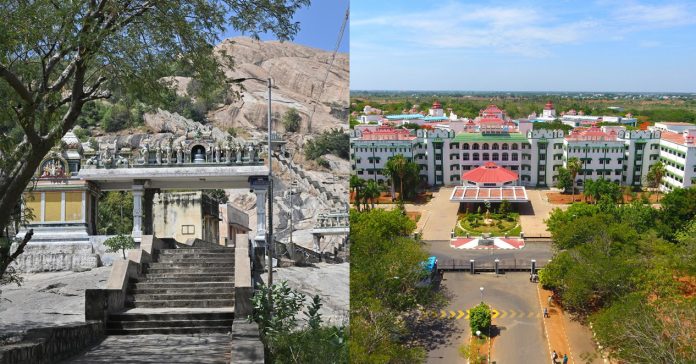
The Madurai Bench of the Madras High Court adopted a stern approach on Wednesday (3rd December) while hearing two separate contempt petitions filed against the district administrations of Dindigul and Madurai. The contempt petitions were filed after the district administrations failed to comply with the orders of the High Court, which allowed Hindu devotees to light Karthigai Deepam at the Mandu Kovil (Dindigul) and the Deepathoon pillar at Thiruparankundram hill in Madurai.
In the case relating to the Mandu Kovil, located in Perumal Kovilpatti village in Dindigul, the High Court had passed an order permitting the local Hindu community to celebrate Karthigai Deepam festival at Mandu Karuppasamy temple. But the district administration prohibited the celebration in the name of law and order. In the other case relating to the Thiruparankundram hill, the High Court had ruled that the Karthigai Deepam lamp can be lit on the ancient stone pillar located on Thiruparankundram hill in Madurai. Despite the court’s clear warning that a non-compliance of its order would attract contempt proceedings, the district authorities failed to implement the order. As a result, the High Court accepted a contempt petition against the Madurai district authorities. Here is what the High Court said in both cases:
HC’s observations in contempt hearing relating to Mandu Kovil order
While considering the contempt petition against the Dindigul district authorities, Justice G R Swaminathan ruled that the District Collector wilfully defied the High Court order by passing an order prohibiting the assembly of five or more persons in the Perumal Kovilpatti Village, which houses the Mandu Kovil site where the High Court had allowed the celebration in its order dated December 2, 2025. “I specifically mandated the jurisdictional police to ensure that the devotees’ right to celebrate the event and offer worship at the petition-mentioned site is upheld. The order of this Court was not only not complied with but brazenly defied,” Justice G R Swaminathan strongly remarked, pulling up the District Collector.
The District Collector dare not pass an order defying an order of this court: HC
“I had passed the order sitting in the Single Bench. So long as my order is not stayed or set aside by the Hon’ble Division Bench of this Court or by the Hon’ble Supreme Court, it has to be complied with in letter and spirit. The Executive cannot sit in judgment over the order I had passed. The District Collector does not exercise appellate jurisdiction over me. He cannot, and he dare not pass an order which would have the effect of nullifying my order. When I use the words “I” or “my”, they are not to be taken in any personal sense. I am only referring to this august institution,” said Justice G R Swaminathan, slamming the District Collector.
Administration preventing persons from exercising their rights in the name of law and order is a confession of impotence: HC
The High Court laid down in clear terms that the district authorities cannot defy or refuse to implement its order in the name of maintaining law and order. “Public order or law and order or public tranquillity cannot be used as a fig leaf to stifle the legitimate rights of the citizens. The police exist to uphold rights. Those who create trouble must be put down. If the administration and the police prevent persons from exercising their legitimate rights on the ground that it would give rise to law and order issues, that would be a confession of impotence,” said the High Court, quoting the remarks made by Justice Phillips in Venkata Subbaya v. Muhammad Falauddin Khaji (1927).
Nothing can be a grosser breach of the fundamental rights of local Hindus: HC
Criticising the district authorities for violating the religious rights of Hindus, Justice Swaminathan said, “The right of any Hindu of Perumalkovilpatti to offer worship and celebrate the religious festival is definitely a fundamental right recognised by Article 25 of the Constitution of India. The District Collector has forbidden the usual religious celebrations even. Nothing can be a grosser breach of the fundamental rights of the individual Hindus of Perumalkovilpatti”.
The Court ordered Thiru S. Saravanan, IAS, District Collector, Dindigul, and Pratheep, IPS, Superintendent of Police, Dindigul District, to appear in person on 4th December and explain what led them to defy the order of this court. The Court added that it would decide on whether a contempt was committed after hearing the district officials.
HC’s observations in contempt hearing relating to Thiruparankundram hill
In an order passed on Monday (1st December), the High Court had directed the executive officer of the Subramaniya Swamy temple to light the Karthigai Deepam at the Deepathoon pillar atop Thiruparankundram hill on 3rd December, 2025 by 6:00 pm, under the protection of Central Industrial Security Force (CISF). The hill has two peaks- the higher one housing a dargah and the lower where the Deepathoon is located. The High Court order allowed the lighting of the lamp at the lower peak, saying that it would not affect the rights of the dargah or Muslims. An appeal was filed by the temple administration against the High Court order, the same day.
On 3rd December, when the order was to be implemented, a contempt petition was filed before the High Court, in which the petitioner stated that no arrangements were made by the temple authorities until 1 pm for lighting the lamp at 6:00 pm as directed by the Court. On the other hand, clashes erupted between Hindu devotees and the police at the hill site. The devotees demanded that they be allowed to light the lamp at the court-mandated spot, but the police personnel stopped them. This was followed by the Madurai District Magistrate ordering prohibitory orders.
Temple’s appeal against the HC order was a ruse to diobey the order: HC
While hearing the contempt petition, the High Court pointed out the oddity of the temple administration going in appeal against its previous order. The High Court noted that the only person who could have been aggrieved by the court’s order would be the dargah and not the temple. The Court added that the temple’s appeal was a ruse to avoid the implementation of its order. “It appears that the Executive Officer representing the temple alone had filed the writ appeal yesterday (02.12.2025) and that too in a defective format. Registry informs me that the papers have been taken by the temple’s counsel. The Dargha, which alone can be said to be the aggrieved person, does not appear to have filed any appeal. The temple cannot be said to be aggrieved by the order of this Court at all. That is why I am impelled to think that the filing of the appeal by the temple in a defective format is a ruse to disobey the order of this Court,” the High Court noted.
The High Court pulled up the Madurai district administration for its contemptuous conduct and clarified that the state cannot defy an order of the court. “In a country, the Constitution of which is built on the principle of rule of law, if the State does not implement the directions of the court, that will be the end of the rule of law and there would be a constitutional stalemate. The Constitution fastens on all authorities a non-negotiable obligation to enforce orders of the court and the authorities who are bound to be comply with the orders have no discretion whether or not to abide by the decision of the Court, whatever be the reasons for the same,” the Court explained
HC reordered the lighting of lamp at the same spot as a symbolic gesture
However, instead of punishing the district officials responsible for disobeying its order, the High Court adopted a unique approach by ordering the implementation of its previous order. As a symbolic gesture to uphold the religious rights of Hindus as well as its judicial authority, the High Court allowed the petitioner to light a lamp at the Deepathoon and take 10 other persons with him, under protection.
“I, therefore, permit the petitioner to go up the Hill and light at the Deepathoon. I am conscious that this is only a symbolic gesture. But the importance of symbolism cannot be lost sight of. The petitioner can take ten other persons along with him, including the other petitioners. Such assistance is required to carry the articles. I direct the Commandant, CISF Unit, Madurai Bench of the Madras High Court to send a team of CISF Personnel to offer protection to the petitioner and his associates in carrying out this court’s order,” the High Court stated in the order.
