

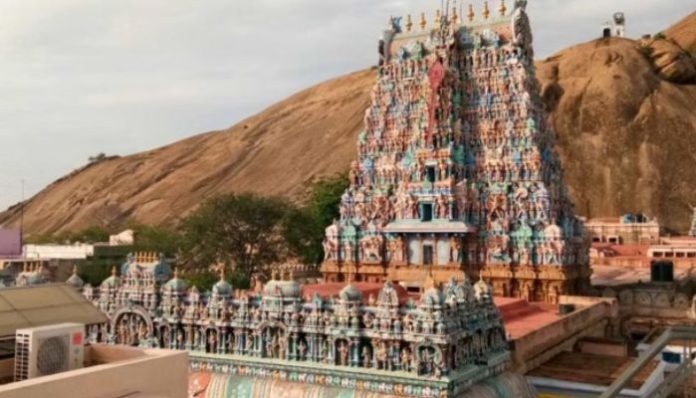
The Madurai Bench of the Madras High Court has ruled that the Karthigai Deepam lamp can be lit on the ancient stone pillar located on Thiruparankundram hill in Madurai. The order came on Monday (1st December) after the court heard four petitions requesting permission to light the lamp at this traditional spot, known locally as the Deepathoon.
Justice G.R. Swaminathan said that lighting the Deepam on a hilltop is an old Tamil practice, and the very purpose of the Deepam is to hold a ceremonial flame.
Some groups had opposed using the pillar this year because it is close to the Sikandar Badusha Dargah and because the lamp is usually lit at another spot near the Uchipillaiyar temple. However, the judge dismissed these objections and emphasised that lighting the lamp at the Deepathoon would not harm the rights of the dargah or the Muslim community in any way.
HINDUS EPITOME OF TOLERANCE.
— Rahul Shivshankar (@RShivshankar) December 2, 2025
IMAGINE WAGING A CENTURY LONG BATTLE IN YOUR OWN LAND TO RESTORE YOUR OWN RELIGIOUS RIGHTS.
Finally, Madurai Bench of the Madras HC permits lighting of the Karthigai Deepam at the original summit-lamp pillar atop Thirupparankundram hill on Dec 3. pic.twitter.com/FJsg0ImrxA
Justice Swaminathan also pointed out that refusing to light the lamp there could actually weaken the rights of the Subramaniya Swamy temple over parts of the hill that are currently unoccupied. The court noted that there have been attempts by the mosque trustees to expand into these areas, and practising the tradition at the Deepathoon would help maintain the temple’s claim over the land.
The court has now directed the temple administration to light the Deepam at the Deepathoon from this year onwards, in addition to the usual locations. It also ordered the police to protect to ensure that the ritual is carried out peacefully. At the same time, the judge cancelled an earlier decision taken by the temple’s Executive Officer, who had decided to hold the ritual only at the usual Deepa Mandapam. The court said such decisions should be made by the temple trustees, not by the Executive Officer.
Court says Devasthanam owns most of the hill
Justice Swaminathan referred to a 1923 civil court ruling that was later upheld by the Privy Council. According to that judgment, the Muslim community has ownership only over three specific parts of the hill: the Nellithope area, the carved flight of steps leading to the mosque, and the exact location where the mosque stands.
The rest of the hill belongs to the temple’s devasthanam. The judge stressed that the entire upper portion of the hill does not belong to the dargah, as some had claimed. He added that Nellithope has already been clearly demarcated, and the Deepathoon is not located in that area, so the matter does not need to go back to the civil court.
He also addressed the claim that the matter had been settled by the High Court in 2014 and confirmed by a division bench in 2017. The judge said those earlier cases dealt with ownership of the hilltop, not the question of lighting the Deepam. Thiruparankundram hill has two peaks; the mosque sits on the higher peak, while the Deepathoon is on the lower one, at least 50 metres away. The dargah area also has a compound wall, and the Deepathoon lies outside it in temple-owned land.
Justice Swaminathan concluded that lighting the Deepam at the Deepathoon is not just a matter of tradition but also a necessary step to assert and protect the temple’s rights. He said that although the ownership of various parts of the hill was settled more than a century ago, the temple trustees must stay alert to prevent any encroachment attempts in the future.
Background: How the dispute over Karthigai Deepam reached the court
The disagreement began when Raman Ravikumar, a Hindu activist, challenged the temple administration’s plan to light the Deepam at the regular spot instead of the Deepathoon. Three others and several impleading petitioners supported his argument. On the other side, one petitioner, the Tamil Nadu Waqf Board, and representatives of the Sikandar Badusha Dargah argued in favour of keeping the ritual at the usual location.
Those opposing the Deepathoon location said the matter could only be settled through a civil court by deciding who owns which parts of the hill. But the High Court rejected this argument and explained that the issue of land ownership had already been settled long ago.
