

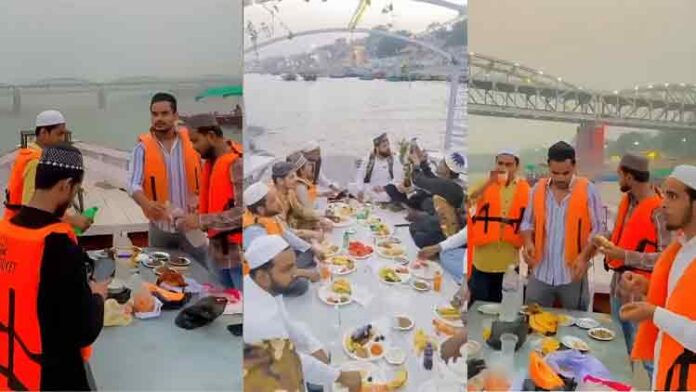
A sessions court in Varanasi on Wednesday rejected bail applications from all 14 accused in the controversial “Ganga Iftar” case, observing that the alleged act appeared prima facie intended to disrupt communal harmony.
Sessions Judge Alok Kumar dismissed the bail pleas after perusing the case diary. The court noted that the act of recording and posting the video on social media prima facie indicated an intention to affect social harmony. “Posting the said video on social media prima facie proves that the said incident was committed with the objective of affecting social harmony,” the judge observed. The court further held that circulating such content, particularly in the period following Eid and other festivals, aggravated the offence and increased its gravity.
The prosecution argued that the gathering was pre-planned to threaten public peace and communal amity, pointing to eyewitness accounts and the deliberate dissemination of the video. It also claimed that the informant and his lawyer had received threats from supporters of the accused.
The defence contended that the accused had been falsely implicated due to political vendetta. They argued that the informant was not an eyewitness, no physical evidence such as chicken bones had been recovered, and the FIR lacked a specific time for the incident. Counsel maintained that the case, at best, attracted only minor charges under the BNS.
However, the sessions judge found insufficient grounds for granting bail, emphasising the serious nature of the allegations and the potential impact on communal harmony.
The accused had previously sought regular bail before the Chief Judicial Magistrate’s court, which was also denied. They remain in judicial custody.
The incident occurred on 15 March 2026, when the group reportedly organised an Iftar gathering on a motorboat on the River Ganga in Varanasi. According to the First Information Report (FIR) filed by Bharatiya Janata Yuva Morcha district president Rajat Jaiswal, the accused consumed chicken biryani, a non-vegetarian dish, and allegedly discarded bones and food waste into the holy river. Eyewitness statements from boatmen Anil Sahani and Ranjan Sahani supported claims that non-vegetarian food was consumed on board. A video of the gathering circulated widely on social media, sparking public outrage and accusations that the act was designed to hurt the religious sentiments of Sanatan Dharma followers.
The 14 accused, Azad Ali, Aamir Kaifi, Danish Saifi, Mohd. Ahmed, Nehal Afridi, Mahfooz Alam, Mohd. Anas, Mohd. Awwal, Mohd. Tehseem, Mohd. Ahmed alias Raja, Mohd. Noor Ismail, Mohd. Tauseef Ahmed, Mohd. Faizan, and Mohd. Sameer, were arrested on 17 March. They face charges under several sections of the Bharatiya Nyaya Sanhita (BNS), including Section 196(1)(b) (promoting enmity between groups), 270 (public nuisance), 279 (fouling water of a public spring or reservoir), 298 (injuring or defiling a place of worship), and 299 (deliberate and malicious acts intended to outrage religious feelings). They have also been charged under Section 24 of the Water (Prevention and Control of Pollution) Act, 1974.
Earlier on 23rd March, the court of Additional Chief Judicial Magistrate Amit Kumar Yadav had denied bail to the 14 accused in the case, saying that the offences attributed to the accused were “serious in nature” and non-bailable, making them ineligible for bail at this stage.
