

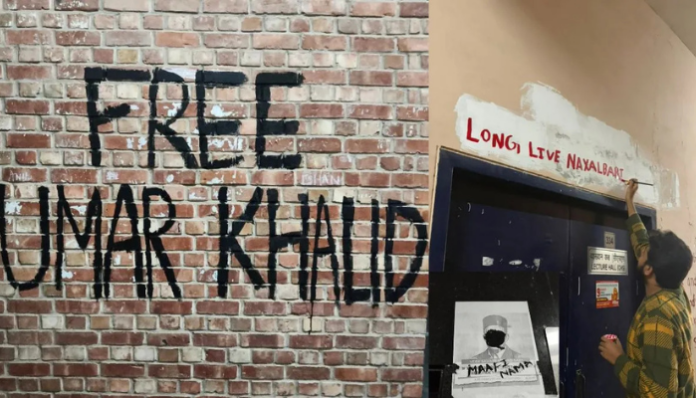
On Sunday, 24 October 2026, Graffiti demanding the release of Umar Khalid and hailing the Naxalbari movement appeared on the walls of Jawaharlal Nehru University (JNU). It triggered a fresh political row on the campus and prompted the university administration to launch a probe.
The slogans, including “Free Umar Khalid” and “Long Live Naxalbari,” appeared on campus walls, a day after similar graffiti ‘Free Kashmir’ and ‘Free Sharjeel Imam’ surfaced at Jamia Millia Islamia.
The JNU administration confirmed it had noted the incident. “Such graffiti will not be tolerated,” adding that “we won’t let vested interests disturb peace on campus”. An official stated that an internal inquiry is underway and that those who attempt to disturb campus peace would not be tolerated.
JNU wing of the Akhil Bharatiya Vidyarthi Parishad (ABVP) objected strongly to the graffiti and said, Left-wing student groups are attempting to disrupt the academic environment on campus.
According to ABVP, photographs circulating online showed members of the All India Students’ Association (AISA) writing ‘Long Live Naxalbari’ alongside a portrait of Hindutva ideologue Veer Savarkar. The student organisation urged the JNU administration to identify those responsible and initiate appropriate action.
ABVP JNU president Mayank Panchal argued that freedom of expression could not be used to justify “disrespect towards national figures or damage to public property,” while unit secretary Praveen Piyush stated that the university did not belong to any one ideology and that the dignity of its academic environment must be protected.
The crimes of Umar Khalid
Umar Khalid, a separatist & pseudo-secular, has been in judicial custody since September 2020. He is the principal accused in the “larger conspiracy” case related to the February 2020 anti-Hindu riots in northeast Delhi, which erupted during protests against the Citizenship (Amendment) Act (CAA) and the National Register of Citizens (NRC). The violence left 53 people dead and more than 700 injured.
Khalid has been booked under the stringent Unlawful Activities (Prevention) Act (UAPA), along with provisions of the Indian Penal Code, the Prevention of Damage to Public Property Act, and the Arms Act. The Delhi Police have said that he was one of the “masterminds” of the riots. Specifically, he has been charged under “Section 15 of the UAPA”, which defines a “terrorist act.”
According to the prosecution, Khalid delivered anti-India and Hinduphobic speeches, most notably at an anti-CAA protest rally in Amravati in February 2020. He called upon people to come out on the streets and block roads during the visit of then-US President Donald Trump, to internationalise a fake narrative that minorities in India were being ill-treated.
While denying him bail, the Delhi High Court had termed the Amravati speech “inflammatory”. The police have further said that Khalid played a leading role in “drawing sinister communal objectives at the cost of human lives”.
