

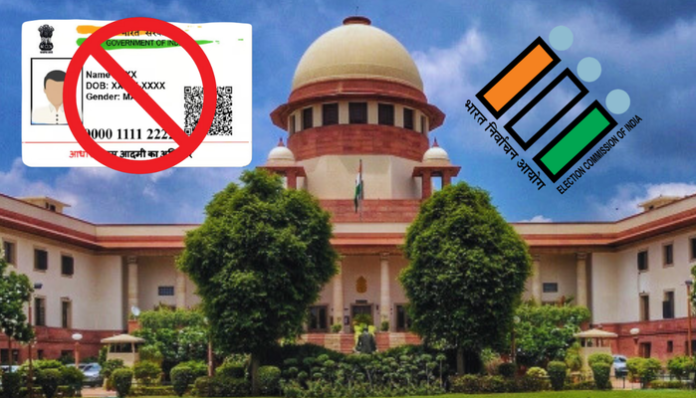
The Supreme Court on Thursday (10th July) rejected a slew of petitions challenging the ongoing Special Intensive Revision (SIR) exercise in Bihar ahead of the assembly elections in October-November. The court allowed the ECI to continue the SIR in Bihar, but asked the commission to consider Aadhaar, voter ID cards, and ration cards as valid documents during the verification drive.
TMC MP Mahua Moitra, former AAP co-founder Yogendra Yadav, RJD MP Manoj Jha, and Association for Democratic Reforms (ADR) were among the petitioners. The petitions, inter alia, argued against the exclusion of Aadhaar cards and Ration cards by the Election Commission of India (ECI) from the list of documents required to be submitted as proof of citizenship to be enrolled as a voter in the electoral roll.
It was the argument of the petitioners that the identification process laid down by the ECI shifts the burden of proof onto citizens and that, considering the high rates of migration and poverty in the state, the requirement of documents specified by the ECI might disenfranchise millions of voters.
After hearing the petitions, a bench of Justices Dhulia and Joymala Bagchi refused to stay the SIR. However, the judges asked the ECI why the said documents could not be accepted under the ongoing SIR exercise, to which Senior Advocate Rakesh Dwivedi, counsel for the ECI, replied, “Aadhar Card cannot be used as proof of citizenship.” Dwivedi said that the Aadhaar card is only proof of one’s identity and not citizenship. “It only shows I am I and you are you,” Dwivedi said.
Noting that the ECI is empowered to conduct an SIR, the Supreme Court expressed concerns over the timing of the exercise as the elections are to be held in a few months. The Court suggested that the Aadhaar Card, the Electronic Electoral Photo Identity Card and the Ration Card should be included by the ECI in the list of required documents under the SIR. However, it left the decision to the discretion of the ECI. The next date of the hearing has been set for 28th July.
Why Aadhaar Card is not a proof of citizenship
Aadhaar Card is not considered proof of citizenship by the government of India. In fact, it is expressly mentioned on the card itself that it is not proof of citizenship. According to the Unique Identification Authority of India (UIDAI), “Aadhaar number is devoid of any intelligence and does not profile people based on caste, religion, income, health and geography. The Aadhaar number is a proof of identity; however, it does not confer any right of citizenship or domicile in respect of an Aadhaar number holder.”
The authority describes Aadhaar as a strategic policy tool for social and financial inclusion, public sector delivery reforms, managing fiscal budgets, increasing convenience and promoting people-centric governance. Notably, foreigners legally living in India can obtain Aadhaar number, and therefore it is not linked with citizenship.
In 2022, the Bombay High Court clarified in the case of State of Maharashtra vs UIDAI, that Aadhaar Card was only a proof od indentity and residence and not of citizenship or date of birth. Earlier in 2018, the Supreme Court, in the case of Justice K.S. Puttaswamy (Retd.) and Anr. vs Union Of India, also held that Aadhaar Card was an identity document quoting section 9 of the Aadhaar (Targeted Delivery of Financial and Other Subsidies, Benefits and Services) Act, 2016. The provision states that “the Aadhaar number or the authentication thereof shall not, by itself, confer any right of, or be proof of, citizenship or domicile in respect of an Aadhaar number holder”.
The documents recognised by the government of India as proof of citizenship are birth certificates, domicile certificates, and passports. A birth certificate certifies that a person was born in India, and a domicile certificate verifies that a person has resided in a particular state or Union Territory in India.
However, the apec court today asked ECI to consider Aadhaar also for the ongoing Special Intensive Revision process.
Why the ECI is undertaking an SIR
As the Bihar Assembly elections are approaching, the EC is undertaking a Special Intensive Revision (SIR) to eliminate bogus voters and ensure fair and transparent elections. Under the SIR, the EC is rectifying the electoral rolls by removing ineligible, deceased or those voters who might have lost their right to vote due to other valid reasons, and upgrading the voter list by adding new verified eligible voters.
The opposition has been attributing malice to the ECI for conducting the SIR, alleging that the exercise is meant to disenfranchise valid voters. It organised ‘Bihar Bandh’ on 9th July protest in Patna against the SIR. However, this is a routine, regular exercise conducted by the ECI across the country for the upkeep of the electoral rolls. SIR is essential to address issues like rapid urbanisation, unreported deaths, new voters, the potential inclusion of ineligible foreign nationals, particularly, Rohingya and Bangladeshi infiltrators. The verification process began on 25 June 2025 and will continue till 26th July. The last SIR was conducted in Bihar in 2003.


