

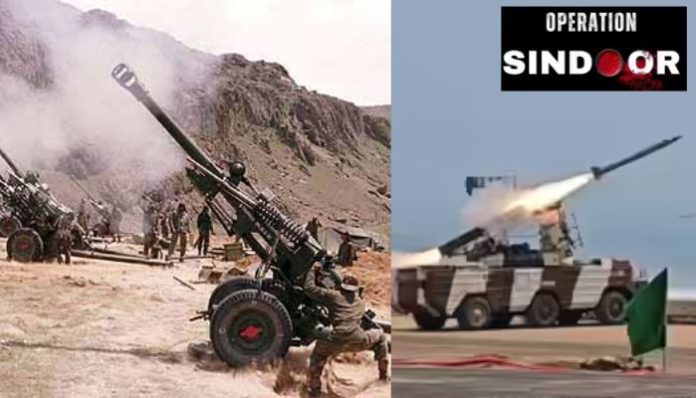
India celebrates 26 years of its victory in the Kargil War this year, but the festivities have a deeper significance now. It has been almost three decades since India gave a strong response to Pakistan, only this time with a powerful retaliatory attack known as Operation Sindoor, which followed the Pahalgam terror attack. The courage of our soldiers remains unchanged, but the methods and means of war have changed totally.
In 1999, the Indian Army battled a hard war at the high-altitude mountains of Kargil, where Pakistani intruders had taken control of strategic positions surreptitiously. The war raged on for almost three months, from 3rd May to 26th July, and resulted in India re-taking all the areas along a 150-kilometre length.
India lost 527 men during that battle. The war was mainly fought by infantry troops, artillery regiments, and a few air strikes, making it one of the most intense face-to-face battles in recent memory.
Fast forward to 2025: Operation Sindoor
On 26th July 2025, while celebrating 26th Kargil Vijay Diwas, just a few months back, India achieved a new victory, Operation Sindoor. This operation was initiated after the horrific terror strike in Pahalgam, where terrorists sponsored by Pakistan martyred some Indian civilians. India responded by carrying out targeted attacks on terror bases within Pakistan and PoK.
This differed from Kargil in that it was not an infantryman’s war in close combat. This was a high-tech, no-contact war by means of missiles, drones, and air defence. But the message sent to Pakistan was the same: India would not accept terrorism or invasion. Same Enemy, Different Style of Response
Both Kargil and Sindoor were concerning halting Pakistan’s efforts to upset peace in Jammu and Kashmir. In 1999, Pakistan sought to internationalise the Kashmir dispute through the capture of territory. In 2025, the aim was to incite terrorism and goad India.
But in both instances, the Indian Armed Forces retaliated with a vengeance. Following Indian troops laying waste to nine terror camps in Pakistan in May 2025, Pakistan attempted to strike back by attacking Indian civilian and military establishments. But India struck back even more vigorously, attacking several Pakistani airbases and defence installations.
From defence to offence
One of the largest transformations between Operation Vijay and Operation Sindoor is India’s strategy. India fought primarily a defensive war in 1999, repelling Pakistani troops.
While Kargil was a protracted, gradual war with open combat, Operation Sindoor was swift and targeted. The main attacks took place in 25 minutes. And within four days, Pakistan requested a ceasefire, although India maintains that the operation continues.
Understanding the generations of war
Experts state that wars have evolved through the ages. The Kargil War was a Fourth Generation War, where technology was involved, but the bulk of the fighting was still direct on the ground. There were snipers, artillery, and close combat.
But Operation Sindoor was even more sophisticated, what some describe as Generation 4.5 warfare. That is, employing advanced high-tech weapons, drone aircraft, and precision-guided missiles to attack from a distance, without committing large forces to combat.
The Weapons that made the difference
In the Kargil War, the Indian Army used the Bofors FH-77B howitzer to devastating effect, employing its precision and firing range to drive competitors out of mountain posts. Infantry troops used the INSAS rifles, LMGs, SLRs, and support weapons like the Carl Gustav rocket launcher. MiG-21s and Mirage 2000 fighter aircraft of the Indian Air Force offered critical air cover and precision bombing, particularly during the recapture of key positions like Tiger Hill.
Times have changed by leaps and bounds today. The army now employs sophisticated rifles such as the SIG716i and AK-203, and sophisticated artillery such as the Dhanush and M777 ultra-light howitzers, ideal for mountainous terrain. The K9 Vajra self-propelled gun has also been included in India’s arsenal.
India also employed the BrahMos supersonic missile in a live combat scenario for the first time, targeting important Pakistani establishments like Rafiqui, Murid, and Rahim Yar Khan deep within enemy lines.
Drones, missiles, and anti-air defence
One of the largest highlights of Operation Sindoor was the employment of drones and anti-drone systems. India’s indigenous D4 Anti-Drone System, produced by DRDO, detected and destroyed enemy drones. Surface-to-air missiles and guns were employed by air defence teams to destroy projectiles from the other side of the border.
India’s Akash missile system, also developed by DRDO, was used to protect the skies. It can destroy enemy aircraft and drones from a distance of up to 30 km.
India has also used the MRSAM system in this attack. This is also a surface-to-air missile (SAM) system, but it is capable of hitting a longer distance than the AKASH system. This has also been developed by DRDO. It has been made in collaboration with Israel. MRSAM consists of supersonic missiles.
Suicide drones and smart warfare
One of the new missiles used was the Nagastra-1, a suicidal drone manufactured by an Indian company. It can travel for one hour and attack targets 20 km away. The drones are portable, compact, and lethal—ideal for present-day warfare.
India also employed L-70 anti-aircraft guns to destroy Pakistani drones. The guns, initially produced in Sweden but now produced in India, were used extensively during the operation.
The immense success of Akash, BraMos, C-UAS and other indigenous systems gives a major boost to the Indian defence sector and bolsters confidence in the capabilities of native manufacturers to increase self-reliance in the defence arena. With indigenous defence systems outclassing Chinese and Turkish technology, as seen in Operation Sindoor, these systems would play a significant role in curbing India’s dependence on foreign suppliers.
With Operation Sindoor’s success, India has made a giant leap towards self-reliance in defence and less reliance on foreign defence suppliers.
But how India wages its wars has changed entirely. With more intelligent weapons, quicker reactions, and smarter planning, India is better equipped than ever to address any danger. And right at the centre of it all, the bravery and sacrifice of our soldiers is still the same, always prepared, always without fear.


