

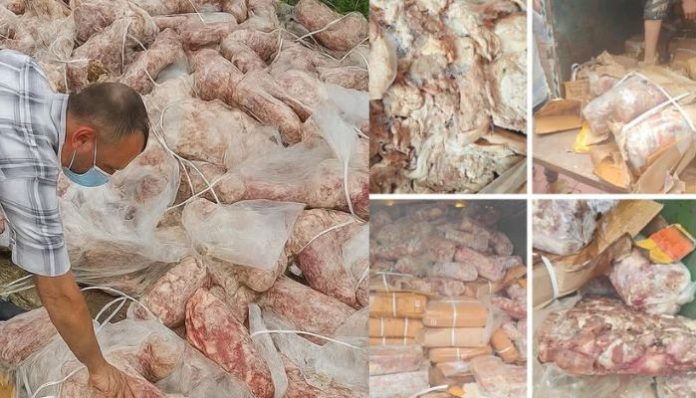
In Jammu and Kashmir, a massive row has erupted after it was found that rotten meat, synthetic paneer, and expired Rasgulla were being sold. Earlier this month, the authorities seized tonnes of rotten and stale meat which was to be distributed to restaurants ahead of the festive season.
Since the first week of August, more than 12,000 kg of expired fish and chicken have been seized and destroyed by the J&K Food and Drug Administration (FDA).
The incident has raised serious concerns over food safety and now locals and tourists are avoiding meat dishes like wazwan at restaurants and preferring vegetarian dishes like dosas, rajma chawal etc. While hoteliers profited from serving meat dishes, the rotten meat scandal has triggered outrage, leading to people avoiding meat dishes.
How the rotten meat scandal came to light in Kashmir
The crackdown against rotten meat supply in Kashmir started in early August, when an insider in the meat trade informed a local news outlet about rotten meat making its way into Jammu and Kashmir markets from Delhi’s Ghazipur mandi. Notably, the Ghazipur mandi is Asia’s largest livestock market.
The whistleblower revealed that chicken, mutton and beef rejected by restaurants for not meeting FSSAI standards catch the eye of ‘meat mafia’ who collect the rotten meat in Ghazipur. The rejected meat is then treated with chemicals like chloride, ammonium hydroxide, and nitrate acids to give it a fresh and reddish appearance.
Subsequently, the treated meat is packed into ice boxes and supplied to Jammu and Kashmir markets in trucks. There, meat is supplied to food business operators and they sell it to restaurants, hotels and small eateries. Eventually, unsuspecting customers both locals and tourists, end up consuming rotten and chemically treated meat believing that it is fresh and probably healthy.
As the matter came to light, the food department swung into action and launched raids on restaurant, hotels, dhabas and roadside carts. It turned out that the rotten meat trade was going on at a massive scale.
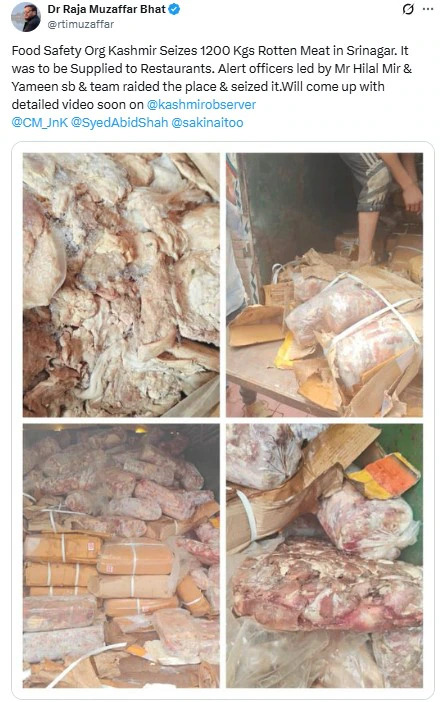
In no time, the local police recovered thousands of kilos of rotten meat storage facilities and markets. It was found that the meat had no labels and was covered in synthetic colours to make it look fresh.
As the crackdown intensified, decomposed meat was found in water bodies as local shopkeepers dumped the stock to avoid getting caught by the police.
सड़े हुए मांस कांड ने कश्मीर के रेस्टोरेंट व्यवसाय को हिलाकर रख दिया है। लोगों के रेस्टोरेंट से दूर रहने से ग्राहकों की संख्या में 80 प्रतिशत की गिरावट आई है. देखें, रिपोर्ट #ReporterDiary | @mirfareed2 pic.twitter.com/G1GLIbFF0K
— AajTak (@aajtak) August 25, 2025
Meanwhile, Chief Minister Omar Abdullah held a high-level meeting with food safety officials recently and issued necessary guidelines. The police is taking punitive action against those found storing or selling rotten meat. Laboratories have been set up near border check posts to test the meat being brought for sale in Jammu and Kashmir. In addition, mobile food testing vans have also been deployed in marketplaces where there are eateries, to screen meat.
After this disturbing incident, the meat market supply is expected to get more organized and transparent as food distributors, vendors and traders have been ordered to get formal registration with the government.
To ensure further transparency, the FDA has directed that packaged meat products must clearly display manufacturing date, batch number, expiry date, and details of the manufacturer. The FDA also instructed that frozen meat must be stored in -18 degrees. The authorities have warned that those found violating FDA directions and violating the laws will have to pay penalties of up to Rs 5 to 10 lakh or six years jail terms.
As per Hilal Ahmad Mir, Assistant Commissioner Food Safety Kashmir, they recovered over 3000 kgs of rotten meat from Ganderbal, Pulwama and Srinagar in a week.
“We are now recovering rotten meat from roadsides, nallahs and rivers. As surveillance has been increased, the unscrupulous elements are now throwing rotten meat on roadside and nallahs,” the officer said.
In addition to rotten meat, the Food Safety Department has also confiscated and destroyed 2,500 kebabs which were processed using frozen meat which contained unpermittedbfood colour and 150 kilograms of meatballs (Gushtaba) in Srinagar.
Jammu and Kashmir High Court takes note of the rotten meat scandal
On 26th August, the Jammu and Kashmir High Court appointed Senior Advocate Jehangir Iqbal Ganaie as Amicus Curiae in the PIL moved by advocate Mir Umar. The supplementary affidavit filed by the petitioners alleged that the practice of smuggling rotten, unhygienic and diseased poultry and meat into Jammu and Kashmir, especially the Kashmir Valley has been going on for years.
The court took serious note of the PIL and the supplementary affidavit and observed that the sale of rotten meat and poultry, in addition, other unregulated food items is a matter of public concern with serious health implications.
The petitioner referred to a 2017 order by Divisional Commissioner Kashmir, which directed that there should be a blanket ban on the import of rotten poultry and meat in the Kashmir Valley. He added that despite court orders, the illegal import of rotten and diseased poultry and meat products has been going on for years with the concerned authorities failing to take any “concrete or pre-emptive measures to curb such unlawful and unethical practices.”
Asserting that an alarming lack of manpower and resources have prevented the department from ensuring an effective implementation of food safety laws, the petitioner claimed that the UT government led by CM Omar Abdullah also showed gross negligence in conducting recruitments for important posts of Food Safety Officers across Jammu and Kashmir.
Meanwhile, Smita Sethi, Commissioner, Food & Drugs Administration, J&K informed the court that frequent raids are being conducted and the FDA has confiscated 12,000 kg of meat, 21 quintals of synthetic cheese, and 440 quintals of Rasgulla ahead of the festival season.
“Yesterday, a big raid was carried out in Jammu. Today, around 100 kg of synthetic cheese was seized, bringing the total seized products to 12,000 kg of meat, 21 quintals of cheese, and 440 quintals of Rasgulla. The Rasgullas were expired, torn, kept in cold storage in tins without packaging or labelling, and likely to flood markets. They had no proper storage solution, so we destroyed them,” Sethi said.
The authorities have suspended licenses of several establishments found violating the rules and serving rotten meat to customers. These include: M/S Al-Taqwa Foods (Lasjan, Srinagar, Altaf Ahmad Chadinoo); M/S Aarif Enterprises (Bulbul Bagh, Tengpora, Srinagar); M/S Sunshine Foods (Industrial Estate, Zakura, Srinagar); M/S Anmol Foods (Parimpora Ghat, Qamarwari, Srinagar); M/S Jubilant Food Works Ltd. (Domino’s Pizza, KP Road, Anantnag); M/S Shaun Shahi Biryani (KP Road, Anantnag); M/S Shan Fish Fry (Achabal Adda, Anantnag); M/S Bismillah Sweets (Industrial Estate, Anantnag); and M/S Khanday Poultry (Kadipora, Anantnag).
J&K eateries reel from declining customers due to rotten meat scandal
In April this year, the Pakistan-sponsored Islamic terror attack in Pahalgam killed 26 Hindu tourists who were singled out and shot dead by Jihadi terrorists for simply being Hindus. While Jammu and Kashmir were witnessing sharp increase in tourist footfalls and overall development, the jihadist attack caused a massive setback to tourism sector as hotel bookings and planned trips began to be cancelled by people across the country. It is notable that Kashmir’s economy is mostly dependent on tourism.
Gradually, tourists began to flock in to Kashmir and normalcy returned to the region. However, the rotten meat scandal has severely tainted the image of tourism industry, fuelled distrust among tourists. To deal with the decline in customers and To deal with the decline in customers and win back the trust of visitors, the restaurants in Kashmir are roping in famous food vloggers to articulate their source of meat and hygiene standard-related information.


