

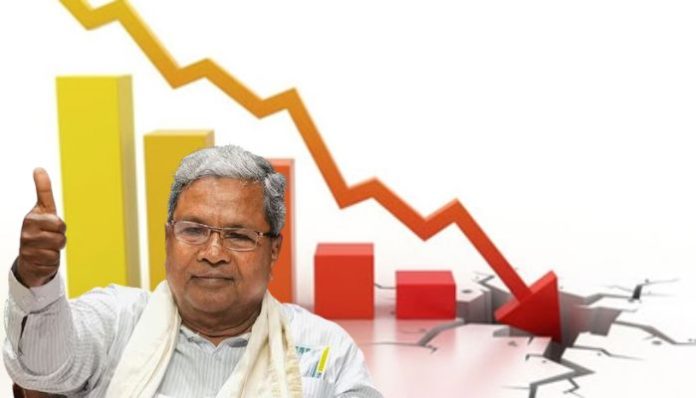
Karnataka’s financial situation has taken a turn to the worse within two years. Having had a revenue surplus budget of 2023 under the BJP government, the state is now facing debt, growing fiscal deficits, and decreasing development project funds under the Congress rule.
The Comptroller and Auditor General (CAG), in its recent state finance audit report for the 31st March, 2024, year, has sounded a dire warning: The Congress government’s five “guarantee” schemes launched with great pomp are imposing unsustainable pressure on the state economy.
CAG’s recent report raises concern
The CAG report, which was tabled in the Karnataka Assembly this week, is the first government audit to test the impact of the Congress government’s guarantee of five welfare programmes: Gruha Lakshmi, Gruha Jyoti, Anna Bhagya, Shakti, and Yuva Nidhi.
The audit says that these guarantees alone had a budgetary provision of ₹36,538 crore in 2023-24, which was equal to a whopping 15% of the state’s overall revenue expenditure.
The fallout is already evident. While the revenue of Karnataka increased by just 1.86% in the last year, expenditure increased by as much as 12.54%, due to these schemes. This imbalance has left the state with a revenue deficit of ₹9,271 crore, undoing the recovery that Karnataka had experienced following the COVID-19 slowdown in 2022-23.
The fiscal deficit of the state also increased from ₹46,623 crore during 2022-23 to ₹65,522 crore in 2023-24. In a bid to fill the gap, the government borrowed excessively from the market, ₹63,000 crore, almost two and a half times of what it had borrowed last year. The CAG has warned that this will result in a larger repayment burden and an exploding interest expenditure soon.
In contrast, capital spending on infrastructure plummeted by ₹5,229 crore. This has brought most projects to a halt and raised the number of unfinished works by a whopping 68%. The CAG outrightly commented that this type of compression in productive capital generation will hurt the future growth prospects of Karnataka.
Karnataka state government has borrowed Rs 63,000 Crore to finance the guarantee schemes and the resulting deficits. This is Rs 37,000 crore higher than last year's net debt of Rs 26,000 crore, a CAG report stated.
— ANI (@ANI) August 20, 2025
Of the capital expenditure earmarked for infrastructure in…
Meanwhile, the Congress government has contended that the schemes minimise inequality, stimulate local economies, and promote human capital development. However, the CAG cautioned that unless other subsidies are reduced or rationalised, the guarantees will “strain the financial economy of the state.”
Since rolling out these schemes, Karnataka has moved from relative stability to a situation where debt and fiscal stress loom large over the financial horizon.
BJP’s balanced ‘surplus’ budget in 2023
The current scenario is just the opposite of February 2023, when BJP Chief Minister Basavaraj Bommai had presented a surplus budget. There was expectation from many that the BJP, being up for assembly elections, would go big with populist commitments. However, Bommai government took everyone by surprise by balancing populist announcements with financial responsibility.
The budget hit every department without bursting the state’s finances. Farmers, youth, and women were at the centre of the schemes announced. Agriculture received a substantial increase in allocations, and the zero-interest loan limit for farmers was raised. As anticipated, no new taxes were levied, and liquor prices remained out of bounds.
Education was the largest beneficiary with an allotment of more than ₹37,000 crore. Bommai also announced free education, free bus passes, and student subsidies for women and students.
Infrastructure was also on the list in Bommai’s budget. The Upper Bhadra water project was allotted ₹5,300 crore, and the Kalasa Banduri project got ₹1,000 crore. As sensitive as issues of water are in Karnataka, these allocations figured prominently in the BJP’s plans. Bengaluru also saw pledges of enhanced mobility and improved traffic management through infrastructure funding.
Opposition still claimed that Bommai might have done more with populist initiatives, particularly given the aggressive guarantees of free power and monetary rewards by the Congress. Yet, in spite of pressures, the BJP government was able to table a budget that was people-oriented as well as financially prudent. The state even ended up having a revenue surplus that year. This delicate balancing act is being unraveled as the current figures eloquently depict.
How Siddaramaiah’s freebies are sinking Karnataka’s economy
As soon as the Congress took office in 2023, under the stewardship of CM Siddaramaiah, it launched its five guarantee schemes. They were the keystone of Congress election campaign and are believed to have helped the party to a landslide victory. Their cost to the economy is, however, now brutally evident.
Just two months after the Congress took charge, in July 2024, Siddaramaiah’s economic advisor, Basavaraj Rayareddy, confessed that the state just doesn’t have funds for development projects, as a huge chunk of money is being reserved for these guarantees.
He disclosed that cost of about ₹65,000 crore is being incurred on these schemes. “People want development. But believe me, there is absolutely no money. Since I am the financial advisor, I managed to get funds for the lake development project here,” Rayareddy shared.
#BREAKING | Karnataka CM Siddaramaiah's economic advisor Basavaraj Rayareddy states that guarantees have become a huge burden.
— Republic (@republic) January 9, 2024
"As we have directed Rs 58,000 Cr for guarantees it has become a huge financial burden to us. We are holding discussions on what to do. In the primary… pic.twitter.com/AkiiffHNps
MLAs from all over Karnataka are finding it impossible to source funds for projects in their constituencies. Even Congress leaders have discreetly conceded that the guarantees are crowding out the funds that are required for roads, irrigation, and infrastructure.
BJP MLA Ramesh Jarkiholi blamed the Congress government for concentrating on Bengaluru with whatever meagre money is left, leaving the rest of the state in a lurch. He also said that most projects initiated under the BJP government, such as the Basaveshwar and Ammajeshwari irrigation projects in Athani, have completely stalled.
Congress’s freebies have even resulted in internal strife. There are some Congress leaders who claim that the schemes failed to provide the electoral returns anticipated, and there are doubts about whether such lavish expenditure was worth the price.
The financial strain has been acknowledged on several occasions by senior Congress leaders themselves. Deputy CM DK Shivakumar admitted in July 2023 that the government was finding it difficult to have funds for development because ₹40,000 crore had to be kept aside for party’s guarantees.
Freebies impacting state infrastructure development
On 24th June, 2025, Karnataka Home Minister G Parameshwara openly stated that the state government under Chief Minister Siddaramaiah, who also holds the Finance portfolio, doesn’t have sufficient funds to support large-scale development projects.
“We don’t have money, even Siddaramaiah doesn’t have funds now. We’ve already given everything to the people in the form of rice, dal, and oil, yes even oil,” the Home Minister said at a public event in Bagalkot district.
According to Parameshwara, the Congress-led government already spent heavily on welfare schemes, referring to the Congress government’s ‘guarantees’, thus leaving little room in the budget for new capital-intensive projects.
Earlier, Karnataka Minister for Small-Scale Industries and Public Enterprises Sharanabasappa Darshanapur said that the development of infrastructure in the state would be hit to some degree in the first year of the Congress government in power. He asserted that this would occur due to the guarantee schemes initiated by the Siddaramaiah government.
The minister highlighted that an amount of Rs 40,000 crore to Rs 50,000 crore will be the financial cost on the exchequer from these guarantee schemes.
Darshanapur expressed, “We require more than ₹50,000 crores every year for the execution of our five guaranteed schemes. This might impact development works partially.”
Electricity tariffs were hiked by ₹2.89 per unit to fund the ‘Gruha Jyoti’ scheme
While the corporation made a splash with the scheme, citizens have started to feel the sting. In order to finance the Gruha Jyoti scheme of free power, electricity rates were increased by ₹2.89 per unit for above-200-unit consumption. Rather than providing respite, many households have found themselves paying more in bills when consumption goes over the free slab.
Congress government also accused of diverting the funds meant for SC/ST development
The Congress government diverted around 37% of the funds allocated under the Karnataka Scheduled Castes Sub-Plan and Tribal-Sub-Plan (SCSP-TSP) for the implementation of its five guarantee schemes. BJP has said that the Congress party was diverting funds meant for the welfare of downtrodden communities.
The Congress government has reportedly decided to utilise Rs 7,881.91 crore of SCSP-TSP for ‘Gruhalakshmi’ scheme, Rs 70.28 crore for ‘Bhagyalakshmi’ scheme, Rs 2585.93 crore for ‘Gruhajyoti’ scheme, Rs 448.15 crore for ‘Annabhagya’ scheme, Rs 2,187 crore for the direct benefit transfer of ‘Annabhagya’ scheme, and Rs 1,451.45 crore for ‘Shakti’ scheme and Rs 175.50 crore for ‘Yuva Nidhi’ scheme.
KSRTC salary crisis: how ‘Shakti’ broke public transport
Earlier, on 5th August, workers of the Karnataka State Road Transport Corporation (KSRTC) and Bengaluru Metropolitan Transport Corporation (BMTC) went on a strike against unpaid salary revisions and arrears.
They were demanding a 25% hike in salary and payment of arrears for 38 months, which totals ₹1,800 crore. The state government, however, proposed to settle arrears of just 14 months due to financial constraints.
What infuriated workers was that their salaries were being withheld even while the government was spending thousands of crores on the Shakti scheme, under which women get free bus travel. The Congress government owes ₹1,600 crore by the four state-owned transport corporations (KSRTC, BMTC, NWKRTC, KKRTC) for carrying out Shakti.
With the companies already burdened with ₹6,330 crore in liabilities, the freebie has crippled their finances. Salaries have been halted, and employees are now out on the streets seeking justice. Thousands of commuters in Karnataka have meanwhile been left stranded as buses went off the roads.
Conclusion
Karnataka’s two-year experience is a lesson in caution. While welfare schemes can be a shot in the arm for political purposes in the short term, unfettered populism without fiscal prudence can weaken an economy. The BJP’s 2023 surplus budget demonstrated that welfare and growth can indeed be balanced, but the Congress government’s hasty guarantees reversed the gains in record time.
From revenue surplus to revenue deficit, from halted infrastructure to planned projects, and from fiscal prudence to piling debt, the economy of Karnataka today is suffering from the costs of populism-based politics. Unless some correcting actions are taken, such as rationalising subsidies and development-led priorities, the state stands to be pushed deeper into economic crisis.


