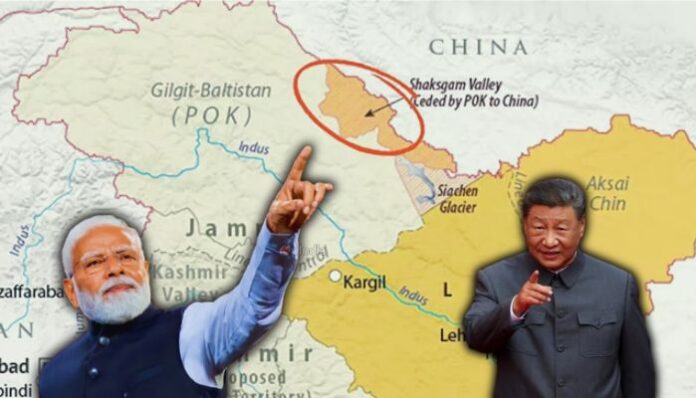
Even as efforts are being made to improve bilateral relations between India and China, territorial claims continue to cause friction between the two countries. The fresh tensions are triggered by China’s construction of infrastructure, including a new road, in the Shaksgam Valley. While China is asserting that the region is a part of its ‘sovereign territory’, India has called this a blatant violation of its territorial integrity.
India and China engage in a war of words over territorial claims on the Shaksgam Valley
Days after China made a delusional claim that the Indian state of Arunachal Pradesh is a Chinese territory named ‘Zangnan’, China provoked India again by asserting its illegal claim over the Shaksgam Valley, which is a part of Pakistan-occupied-Kashmir (PoK) illegally ceded to China in 1963.
In response to a question during a press meet on 12th January, Mao Ning, the Chinese Foreign Ministry spokesperson, said, “First of all, the territory you mentioned is part of China’s territory. The Chinese side has been implementing infrastructure and construction activities in its own territory. China signed a border agreement with Pakistan in the 1960s, which determined the borders between the two countries as an authority for Central Asia as their sovereign state in the 1970s.”
Regarding India’s objections to the China-Pakistan Economic Corridor, which passes through the Indian territory illegally occupied by Pakistan, Ning said, “You mentioned China-Pakistan Economic Corridor, as an initiative to promote local economic development and improvement. The border agreement between China does affect its position on Kashmir, and China’s position remains unchanged in this regard.”
#BREAKING: China provoked India yet again, claiming Indian territory as their own. Chinese Foreign Minister Spokesperson has rejected India's claim to the Shaksgam Valley in Jammu & Kashmir.
— Aditya Raj Kaul (@AdityaRajKaul) January 13, 2026
"The territory you mentioned belongs to China. It’s fully justified for China to conduct… pic.twitter.com/HY2yBekBZ7
China’s provocative remarks come after India rejected China’s “efforts to change the ground reality in the Shaksgam Valley”. New Delhi stated that it reserves the right to take requisite measures to protect its interests in the region.
During a press conference on January 9, Randhir Jaiswal, the spokesperson of the Ministry of External Affairs, stated that India has never recognised the illegal and invalid 1963 Sino-Pakistan Agreement, under which Pakistan ceded the Shaksgam Valley to China. He added that India has also rejected the China-Pakistan Economic Corridor (CPEC), which passes through territory that is “forcibly and illegally occupied” by Pakistan.
“Regarding Chinese infrastructure buildup via CPEC, as also in the Shaksgam Valley, which is Indian territory. We have never recognised the so-called China-Pakistan boundary agreement of 1963. We have consistently maintained that the agreement is illegal and invalid. We do not recognise the so-called China-Pakistan Economic Corridor (CPEC) either, which passes through Indian territory that is under forcible and illegal occupation of Pakistan,” the MEA spokesperson said.
#MEABriefing ||
— All India Radio News (@airnewsalerts) January 9, 2026
The Ministry of External Affairs (@MEAIndia) spokesperson Randhir Jaiswal expresses concerns over Chinese infra development in the Shaksgam Valley.
He says, 'Shaksgam valley is Indian territory' & 'We have consistently protested with the Chinese side against… pic.twitter.com/T3ZAmF7Pty
The MEA spokesperson reiterated India’s position that the entire Union Territories of Jammu and Kashmir and Ladakh are “an integral and inalienable part of India.”
“We have consistently protested with the Chinese side against attempts to alter the ground reality in the Shaksgam Valley. We further reserve the right to take necessary measures to safeguard our interests,” he said.
China has been building infrastructure in the Shaksgam Valley over the years
Various media reports claim that around 75 kilometres of a 10-meter-wide road has already been constructed by China in the Shaksgam Valley, while further construction continues. Earlier, the Chinese People’s Liberation Army (PLA) built a 36-kilometre stretch of the road. With the continuous construction of this road, China is inching closer to India’s Siachen.
Satellite Imagery shows that this road is connected to two Chinese military posts outside the Shaksgam Valley. One of the could be the headquarters of the PLA unit operating in the area. The road holds significance as it lies in the Trans-Karakoram Tract region, which is historically a part of Kashmir, and the entire Jammu and Kashmir, including the PoK and the Shaksgam Valley, ceded illegally by Pakistan to China, belongs to India.
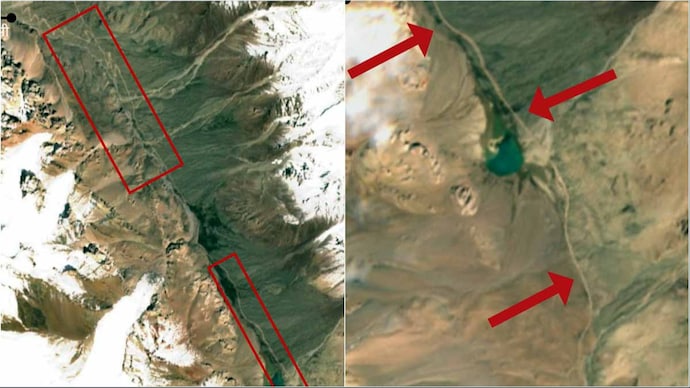
Back in 2021, the illegal authorities in the Pakistan-occupied Gilgit-Baltistan announced plans for constructing a new road connecting Muzaffarabad to Mustagh Pass, which sits on the Pakistan border with the Shaksgam Valley. It was reported that this road would be connected with Yarkand in Xinjiang, meaning that the road would likely pass through the Shaksgam Valley to link with China’s national highway G219.
While the road may have been constructed for the transportation of minerals like Uranium mined in Pakistan-occupied Gilgit-Baltistan, China and Pakistan can use the road for military manoeuvres in the face of a full-fledged conflict with India.
#Exclusive
— Nature Desai (@NatureDesai) April 21, 2024
Thread:
In a significant development, 🇨🇳 road has breached the border at Aghil Pass (4805 m) and entered the lower Shaksgam valley of Kashmir, 🇮🇳 with the road-head now less than 30 miles from 🇮🇳 Siachen
This permanently answers the question of Shaksgam for 🇮🇳
1/4 pic.twitter.com/TyjMcUqz2S
Notably, the road in question enters the Aghil Pass. This pass has historically been Kashmir’s frontier with Tibet. During the India-China border negotiations in 1960, the Indian side led by J. S. Mehta, Director, China Division in the Ministry of External Affairs, told the Chinese side, “The official maps of the Government of India, including the one attached to the 1907 edition of the Imperial Gazetteer of India and the political maps published by the Survey of India showed this area in Indian territory.”
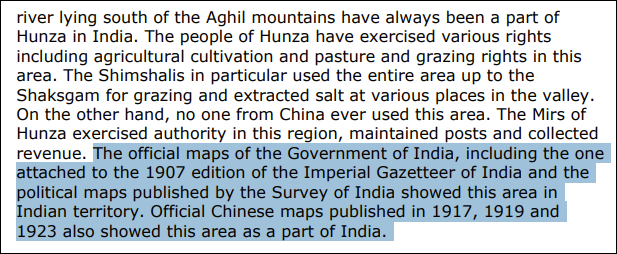
“The official maps of the Government of India, including the one attached to the 1907 edition of the Imperial Gazetteer of India and the political maps published by the Survey of India showed this area in Indian territory. Official Chinese maps published in 1917, 1919 and 1923 also showed this area as a part of India,” the Indian side pointed out back in 1960.
Shaksgam Valley: Pakistan ceded to China the territory that never belonged to it
The Shaksgam Valley is a remote, high-altitude area in the Karakoram mountain range, extending approximately 5,180 kilometres. The Valley lies in the north of the Siachen glacier and holds immense strategic significance given its proximity to key passes and its role in PoK with China’s Xinjiang. While the 1963 Sino-Pakistan Agreement is deemed the root of the Shaksgam Valley’s disputed status, the issues go back to 1947.
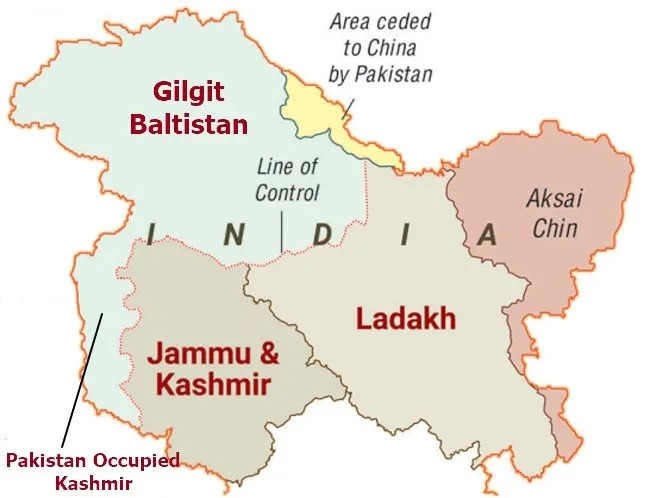
Before the partition of India on Islamic lines in 1947, the Shaksgam Valley was a part of the princely state of Jammu and Kashmir ruled by Raja Hari Singh. This region fell under local chieftain Mir of Hunza’s suzerainty. Hunza acknowledged the Hindu Maharaja’s authority. Historical evidence indicates that the Shaksgam Valley, along with the adjacent Raskam Valley, was included in Jammu and Kashmir’s boundaries. Even the British surveys in the late 19th and early 20th century recognised it as such. Although China made occasional claims relying on vague historical links with the Qing dynasty, these were not formalised.
After India’s partition and the birth of Pakistan in 1947, Pakistan-backed tribal invaders attacked Jammu and Kashmir, triggering the first India-Pakistan War. Amidst the war, Maharaja Hari Singh signed the Instrument of Accession on 26th October 1947, formally integrating the entire Jammu and Kashmir, including the Shaksgam Valley, into the Indian Dominion.
Pakistan, however, occupied a major portion of northern Kashmir during the conflict, including the areas that gave access to the Shaksgam Valley. Since this occupation was illegal, the entire region, including the Shaksgam Valley, remains Indian territory under international law.
There is a prevalent misconception that China-Pakistan relations became strong only after Pakistan and China joined hands for the illegal CPEC. However, Pakistan has long been cajoling China, with the ‘India containment’ goal being the unifying factor. Contrary to the prevalent narrative, China-Pakistan relations encompass six decades of military cooperation, economic and diplomatic alignments, the 1963 agreement on Shaksgam Valley, the onset of nuclear cooperation in the 1970s, Gwadar’s transfer in 2013, and the official launch of the CPEC.
In the aftermath of the Sino-Indian War in 1962, Pakistan seized the opportunity to bolster ties with China. On 2nd March 1963, China and Pakistan signed the Sino-Pakistan Frontier Agreement. Under this agreement, Pakistan ceded control of the Shaksgam Valley to China in exchange for border adjustments in other areas. This agreement, however, was conditional, stating that the ceded territory would be subject to final resolution in any future India-Pakistan settlement on the Kashmir issue.
Aside from being illegal, this agreement was deeply flawed, rather dishonest. How could China take control of the Shaksgam Valley, integrate it into its Xinjiang province, while also claiming that the territory will be subject to final resolution on Kashmir? Hypothetically, if India and Pakistan agree on Kashmir, and the Shaksgam Valley is decided to be returned to India, will China, after investing heavily in infrastructure there, just hand over the strategically significant Valley to India?
India has consistently rejected the 1963 Sino-Pakistan Agreement on the grounds that Pakistan illegally occupied the parts of Jammu and Kashmir now called PoK, and thus had no legal authority to negotiate or cede the territory that belongs to India. Since the Shaksgam Valley was a part of Jammu and Kashmir at the time of accession, Pakistan’s control over PoK is an illegal occupation. Islamabad had no locus standi to enter into bilateral agreements regarding Indian territory with China. It must not be forgotten that Mir of Hunza recognised the authority of Maharaja Hari Singh, and the Maharaja legally and wilfully ceded the entire Jammu and Kashmir to India.
In 1949, the PoK government signed the Karachi agreement with the then Government of Pakistan, wherein all the land rights of Gilgit-Baltistan were passed on to Pakistan. The agreement reportedly was signed by Mushtaq Ahmed Gurmani (Minister of Kashmir Affairs), Sardar Mohammad Ibrahim Khan (President of so called ‘Azad Kashmir’) and Chaudhary Ghulam Abbas.
In this agreement, the so-called ‘Azad Kashmir’ handed over the entire administration of Gilgit-Baltistan to Pakistan (which gave away part of the region to China). It is from this region that Pakistan handed over 5000 Square kilometres (the Shaksgam valley) to China. In fact, Sardar Ibrahim later revealed that his signatures were forged by Muhammad Din Taseer. Soon after the signing of the Karachi Agreement, Ibrahim was removed from office.
Be it the occupation of PoK or the ceding of the Shaksgam Valley, Pakistan has historically been an illegal occupier, with no legal standing to enter into any agreement with any country regarding the entire Jammu and Kashmir region. Thus, China’s control over the Shaksgam Valley and its infrastructure construction there is illegal.