

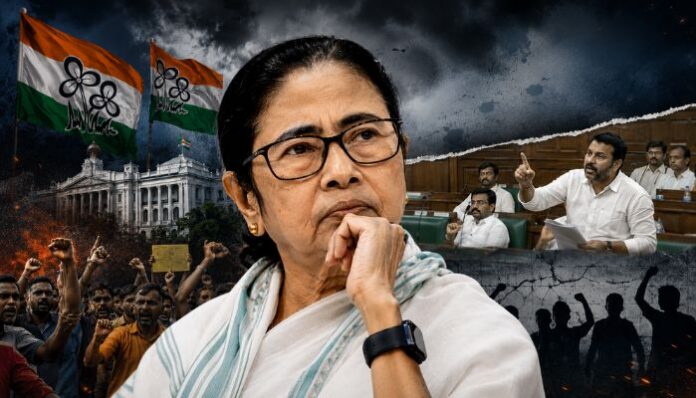
The Trinamool Congress (TMC), which ruled West Bengal for 15 years under the leadership of Mamata Banerjee, is currently facing the biggest political crisis in its history. Since its formation in 1998, the party has survived numerous political battles, defections and electoral challenges. However, the situation unfolding today appears very different. Following its defeat in the 2026 West Bengal Assembly elections, the party has been hit by rebellion at multiple levels, from Parliament to the Assembly and even within its organisational structure.
What began as dissatisfaction after the election results has now developed into a full-fledged internal revolt. Rebel MPs are openly challenging the authority of the party leadership, Rajya Sabha members are resigning one after another, dissident Lok Sabha MPs are trying to create a separate parliamentary faction, and a large group of MLAs has already installed its own Leader of the Opposition in the Assembly. At the same time, at the grassroots level, people who once feared local TMC syndicates are increasingly speaking out against them.
Cracks deepen as senior Rajya Sabha MPs quit
One of the most visible signs of the crisis has been the resignation of senior TMC leaders from the Rajya Sabha.
The latest blow came on Thursday, 11th June, when Rajya Sabha MP Prakash Chik Barik resigned from both the Upper House and the party. Barik, who had previously served as a minister in Mamata Banerjee’s government, submitted his resignation to Vice-President C.P. Radhakrishnan and announced that he would no longer remain associated with the party.
TMC's Prakash Baraik resigns as Rajya Sabha MP, third such exit within a week
— IndiaToday (@IndiaToday) June 11, 2026
TMC suffered another setback on Thursday as Rajya Sabha MP Prakash Chik Baraik resigned from the Upper House. His exit comes after the resignations of Sukhendu Sekhar Roy and Sushmita Dev, taking the… pic.twitter.com/CF4SkOfNnv
Barik’s resignation became particularly significant because he did not merely leave Parliament; he also publicly distanced himself from the TMC leadership and signalled support for the new BJP government in West Bengal.
“People have given a clear mandate. People have favoured the BJP over the Trinamool. Our party’s result was not even good in northern Bengal. I have resigned in view of the people’s mandate. I have not spoken to Mamata Banerjee as of now. But I have resigned from both the Rajya Sabha and the party organisation. I will work as per CM Suvendu Adhikari’s instructions in the future. I will work for development,” Barik said after resigning.
His departure came just days after two other prominent TMC Rajya Sabha MPs, Sukhendu Sekhar Roy and Sushmita Dev, also resigned from the Upper House and left the party.
#BREAKING | In a big setback for Mamata Banerjee, longtime aide Sukhendu Sekhar Ray has quit the Trinamool and resigned as Rajya Sabha MP amid a spiralling crisis in the party.
— NDTV (@ndtv) June 8, 2026
NDTV's @SreyashiDey joins @vedikas with more details pic.twitter.com/8EHI9Ur2ut
With these three resignations, the TMC’s strength in the Rajya Sabha is set to decline from 13 members to 10. Political observers believe the number could fall further, as speculation continues about more MPs preparing to leave.
The resignations have not only reduced the party’s strength in Parliament but have also created the perception that confidence in the leadership is weakening among senior leaders.
Lok Sabha rebels move to create the “Real TMC”
While resignations have weakened the party in the Rajya Sabha, the crisis in the Lok Sabha has become even more dramatic.
A group of rebel MPs has openly challenged Mamata Banerjee’s leadership and claimed that they represent the “real TMC” in Parliament.
The rebellion is being led by senior MP Kakoli Ghosh Dastidar, who resigned from party posts earlier and emerged as the face of the dissident camp. According to rebel leaders, as many as 19 Lok Sabha MPs have already joined their effort.
The BJP on Friday (June 12, 2026) claimed that a document carrying the signatures of 20 Trinamool Congress Lok Sabha MPs establishes that the "real TMC" is led by Kakoli Ghosh Dastidar, and not by Mamata Banerjee and her nephew Abhishek Banerjee.https://t.co/wWyxR0eNK8
— The Hindu (@the_hindu) June 12, 2026
The dissident faction has announced plans to approach Lok Sabha Speaker Om Birla and seek recognition as the genuine TMC parliamentary group.
The rebel group of parliamentarians in the Trinamool Congress is believed to have secured the support of 19 MPs — the two-thirds of the party's parliamentary strength required to form a separate faction.
— The Times Of India (@timesofindia) June 10, 2026
More details 🔗https://t.co/mGmTIlPodk
Breaking news, top stories,… pic.twitter.com/nzhrcqClpX
Rebel MP Jagadish Chandra Barma Basunia confirmed the move publicly.
“We have submitted the letter. On Monday, we will go to the Speaker and stake our claim to form the real TMC parliamentary group. We will ask the Speaker to give recognition to our claim,” he said.
According to the rebel camp, signatures of 19 MPs have already been collected in support of the initiative. The list includes the names: Kakoli Ghosh Dastidar
- Kakoli Ghosh Dastidar
- Satabdi Roy
- Rachna Banerjee
- Saayoni Ghosh
- Yusuf Pathan
- Mala Roy
- June Malia
- Deepak Adhikari
- Bapi Haldar
- Dr Sharmila Sarkar
- Prasun Bandyopadhyay
- Jagadish Barma Basunia
- Asit Kumar Mal
- Arup Chakraborty
- Khalilur Rahaman
- Abu Taher Khan
- Mitali Bag
- Kalipada Soren
- Partha Bhowmick
The Mamata Banerjee camp has strongly rejected the move. Senior MP Mahua Moitra argued that the rebels have misunderstood the anti-defection law.
“Traitor TMC lawmakers don’t know the law. Constitution 91st Amendment 2003 removed the provision for a split/separate bloc. The number of MPs is irrelevant – 2/3 of the original political party has to merge with another party. All 19 traitors need to resign & contest on BJP ticket,” she wrote on social media.
Traitor TMC lawmakers don’t know law. Constitution 91st Amendment 2003 removed provision for split/ separate bloc. Number of MPs is irrelevant- 2/3 of original political party has to MERGE with another party. All 19 traitors need to resign & contest on BJP ticket.
— Mahua Moitra (@MahuaMoitra) June 12, 2026
Despite these legal questions, the rebellion has exposed the depth of dissatisfaction within the parliamentary wing. For the first time since the party’s formation, a large group of sitting MPs is openly questioning the authority of the leadership.
Assembly revolt leaves party leadership isolated
If the rebellion in Parliament has embarrassed the party, the developments in the West Bengal Assembly have arguably caused even greater damage.
The controversy began after Mamata Banerjee lost the Bhabanipur seat in the Assembly elections. With the party moving into opposition, the post of Leader of the Opposition became crucial.
The party leadership selected veteran leader Sobhandeb Chattopadhyay for the position. However, a large section of TMC MLAs refused to accept the decision.
Soon, a group of 60 MLAs rallied behind expelled MLA Ritabrata Banerjee and submitted a letter to Speaker Rathindra Bose demanding that he be recognised as Leader of the Opposition instead.
The letter carried the signatures of 59 MLAs, demonstrating that the rebel camp had the support of a substantial majority of the party’s legislators.
The dissidents argued that they represented the true voice of the legislative party and that the leadership’s decision had been imposed without proper consultation.
The dispute became even more serious when allegations emerged that signatures supporting Sobhandeb Chattopadhyay had been used without the consent of some MLAs.
Ritabrata Banerjee and Sandipan Saha lodged complaints regarding theirregularities. The Assembly Secretariat subsequently registered a police case and the CID launched an investigation. Some legislators reportedly told investigators that they had not signed the document submitted in support of Chattopadhyay. With nearly 60 of the party’s 80 MLAs supporting the rebel faction, the balance of power inside the Assembly shifted dramatically.
The rebels eventually succeeded in installing Ritabrata Banerjee as Leader of the Opposition, a major setback for the official party leadership.
TMC rebel MLA Ritabrata Banerjee now Bengal Leader of Opposition@PadmajaJoshi shares details pic.twitter.com/HKU9kCCHWz
— NDTV (@ndtv) June 3, 2026
The crisis became so severe that the TMC leadership dissolved all organisational committees in West Bengal and announced a comprehensive review of the party structure.
In a statement, the party said all committees and frontal organisations stood dissolved with immediate effect and that the organisational framework would be rebuilt after a detailed assessment.
After careful consideration, it has been decided that all committees of the All India Trinamool Congress in West Bengal, as well as all its frontal organisations, shall stand dissolved with immediate effect.
— All India Trinamool Congress (@AITCofficial) June 3, 2026
The party will undertake a comprehensive exercise of introspection,…
Kalyan Banerjee’s public ultimatum to Mamata Banerjee
As if the resignations and rebellions were not enough, the party was shaken by an extraordinary public attack from one of its most senior MPs.
On Thursday, 11th June, veteran TMC leader and lawyer Kalyan Banerjee launched a scathing criticism of party general secretary Abhishek Banerjee. The dispute began over legal representation in a case involving Abhishek Banerjee. Kalyan Banerjee claimed that another lawyer had been appointed without consulting him, despite his involvement in the matter.
“I don’t like this arrogant attitude. One must respect the seniors. How can he humiliate me? He should understand that the party is facing problems because of him. But he goes and disrespects everyone. This is not tolerable,” Kalyan Banerjee said. He then directly appealed to Mamata Banerjee and effectively asked her to choose between him and her nephew.
Kolkata, West Bengal: TMC MP Kalyan Banerjee says, "I am with the Mamata Banerjee. But Mamata Di has to decide whether Mamata Di will keep Abhishek or keep myself…Mamata Di has to decide first. Mamata Di has to first decide that she cannot move the party without Abhishek… pic.twitter.com/HIq0zDoy06
— IANS (@ians_india) June 11, 2026
“I will urge Didi: if you will remain dependent on Abhishek Banerjee, then stick with him—leave me. But if you part ways with Abhishek Banerjee, then I am with you,” he said.
The remarks were unprecedented because they reflected frustration not merely with party strategy but with the internal power structure itself.
Grassroots resistance against the TMC syndicate system
While political battles continue within the party, a different kind of rebellion is taking place on the ground.
Across several parts of West Bengal, people are increasingly challenging the syndicate system that flourished under TMC rule.
In Sonarpur, South 24 Parganas, an autorickshaw union office that once operated under the TMC-affiliated INTTUC has switched allegiance to the BJP-backed Bharatiya Mazdoor Sangh.
Local drivers say they are relieved that they no longer have to pay monthly collections demanded by TMC-linked leaders. The change has become symbolic of a larger shift occurring across the state.
Abhishek Banerjee was attacked on 30th May by a mob in Sonarpur, which pelted him with eggs, shoes and stones – in what was seen as a reflection of the large-scale anger against the TMC in general, and Abhishek in particular.
#WATCH | Sonarpur, West Bengal: TMC MP Abhishek Banerjee was beaten up by locals during his visit to Sonarpur to meet the post-poll victims' families pic.twitter.com/zkXxLJydqe
— ANI (@ANI) May 30, 2026
Residents who once remained silent out of fear are now openly discussing extortion, land grabbing and intimidation.
In Kamrabad, residents say construction work on encroached government land stopped after the election results. “We don’t know how the government land was occupied, but no one protested out of fear. Since May 4, construction has stopped,” resident Bapi Haldar said.
In Ghashiyara, Rupali Mondol returned home after spending nearly a year away following an dispute with local TMC leaders.
She claims her vegetable shop was destroyed after she failed to pay money demanded by local political figures.
“So they ransacked my shop. I lodged a complaint with the police and the National Commission for Women, but nothing happened,” she said. Now, with several influential local leaders reportedly absconding or facing investigations, many residents feel emboldened to speak out.
Similar developments are being witnessed in Kolkata’s Beleghata area, where illegal construction networks linked to local political strongmen have come under scrutiny. Several buildings face demolition proceedings, and multiple influential figures have been arrested.
Residents who previously avoided filing complaints now say they are approaching authorities with allegations regarding land grabbing and illegal construction.
The same trend can be seen in Jamalpur in Purba Bardhaman district, where villagers have begun speaking openly about illegal sand mining operations and misuse of government resources.
“Every day, 150 to 200 trucks carried out sand. No one protested out of fear,” said resident Gopal Adak. “Now, that fear is gone,” added another villager, Nimai Majhi.
A bigger question: Will TMC cease to exist?
All these developments paint a troubling picture for the survival of Trinamool Congress.
The party is battling resignations in Parliament, rebellion in the Assembly, internal disagreements among senior leaders and growing public resentment at the grassroots level. What makes the situation particularly serious is that these challenges are emerging simultaneously.
The resignations of Rajya Sabha MPs have weakened the party nationally. The attempt by dissident Lok Sabha MPs to create a separate faction has exposed deep divisions in the parliamentary wing. The successful rebellion by MLAs has undermined the authority of the leadership in the Assembly. And on the ground, the weakening of local syndicate networks has encouraged ordinary citizens to raise complaints that many were previously afraid to voice.
For a party that once appeared politically invincible in West Bengal, the current crisis represents perhaps the greatest challenge in its 28-year history. Whether Mamata Banerjee can reunite the organisation and restore discipline remains uncertain. What is clear, however, is that the Trinamool Congress is no longer facing isolated acts of dissent. It is confronting a widespread challenge to its authority from within the party and from the public alike.


