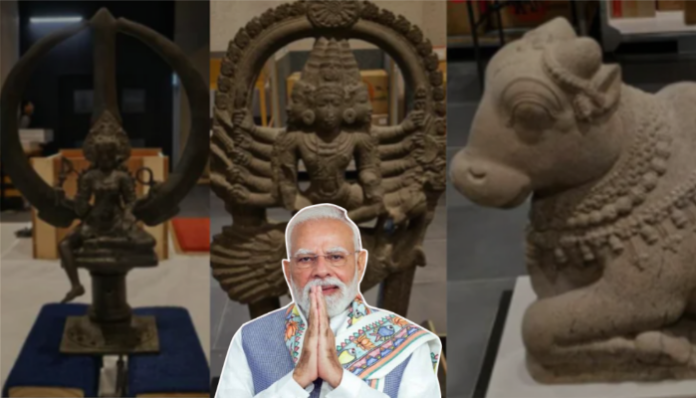
Australia is scheduled to transfer antiquities of great cultural importance to India, including a ceremonial bronze trident with Goddess Bhadrakali, a granite idol of Nandi and a basalt carving of the six-headed Lord Kartikeya. The artefacts were initially removed from ancient temples in Tamil Nadu. The Ministry of External Affairs shared that these are from the 11th and 12th centuries.
The development happened in the wake of Prime Minister Narendra Modi’s latest trip to the country for attending India-Australia Annual Summit. “In a profound testament to the civilisational resonance anchoring modern diplomacy, Australia is set to repatriate three culturally significant ancient antiquities to India,” Minister of Culture wrote on social media, remarking that the decision “further emphasised the strong cultural alignment between the two nations.”
In a profound testament to the civilisational resonance anchoring modern diplomacy, Australia is set to repatriate three culturally significant ancient antiquities to India.
— Ministry of Culture (@MinOfCultureGoI) July 9, 2026
These artefacts include a ceremonial bronze trident of Goddess Bhadrakali, a majestic granite idol of… pic.twitter.com/knmUGuo8Nn
The three magnificent antiques of ancient Hindu temples
Metal trident with Goddess Bhadrakali: In Shaiva-Shakti traditions, a ceremonial trishula with a figure of Goddess Bhadrakali (fierce from of Shakti) atop it represents protection, divine strength and the annihilation of evil. The deity’s idol is created in accordance with the South Indian temple ritual metalwork tradition.
Stone idol of Nandi: The revered bull and mount (vahana) of Lord Shiva is intricately carved in the Tamil Shaiva temple tradition, showcasing compact dimensions and elaborate ornamentation. It is customarily positioned facing the sanctum (garbhagriha) as an embodiment of devotion, strength and dharma. It is illustrated in a reclining position, adorned with decorative bells and garlands.
The two pieces originated from the Sri Kasiviswanathaswamy Temple in Kollumangudi of Thiruvarur district which was built under the late Chola to Vijayanagar/Nayak dynasties in the 13th and 16th centuries CE.
Stone idol of six-headed Kartikeya (Shanmukha): The six-headed statue shows Kartikeya also known as Murugan or Shanmukha, which stands for bravery, intelligence and divine protection. He is seen with twelve arms, armed with weapons like the vel (spear) and frequently accompanied by a peacock.
The artwork is carved using the Chola-period sculpture style which is renowned for its elaborate decoration and elegant proportions. It belonged to the Naganathsamy Temple in the Thanjavur district’s Manambadi village. The sacred structure was constructed during Rajendra Chola I in the early 11th century CE.
Australia to repatriate Indian artefacts- metal Trident with image of Goddess Bhadrakali, stone idol of Nandi and stone idol of six-headed Kartikeya pic.twitter.com/NfXc03v85a
— ANI (@ANI) July 9, 2026
PM Modi thanked Prime Minister Anthony Albanese for the gesture, which is going to take place under the Mutual Legal Assistance Treaty (MLAT). The three objects are presently kept in the National Gallery of Australia.
The dubious provenance history which exposed the truth
According to inquiries conducted by the Tamil Nadu Idol Wing CID (Crime Investigation Department), they had been taken from the state’s temples and trafficked abroad. The relics are coming back home after their provenance was confirmed following probes at the request of the agency.
S Vijaya Kumar, cultural enthusiast and co-founder of India Pride mentioned that former high court Justice Susan Crennan AC’s independent assessment of the National Gallery of Australia revealed serious flaws in their provenance over a decade ago, reported The Hindu. The examination came to the conclusion that the ownership histories of two idols did not prove that they were legally exported from India.
The Bhadrakali trident idol was purchased from Temple Gallery in New York and was reported to be the possession of Dr. PS Rao in Chennai. It was brought into the gallery in 1993, but it was not identified that the export was legal. Afterwards, the aforementioned temple was established as its source. The six-headed Kartikeya’s ownership was also linked to Dr PS Rao and Temple Gallery.
The Nandi monument was asserted to be acquired from Carlton Rochell Asian Art. It was alleged to be assembled by Mexican diplomat Mario Calderon in Goa and then inherited by Pedro Silva Villasenor in Mexico. According to the Crennan Review, there was insufficient substantiation of this chain and further research demonstrated that the sculpture hailed from a Tamil Nadu temple.
Notably, the Modi government has already effectively retrieved 650 stolen historical items from various countries since 2014.
India to return remains of First Nations ancestor
India has earlier committed to voluntarily and unconditionally hand over remains of an Australian First Nations ancestor (a member of Indigenous Aboriginal or Torres Strait Islander communities) that are currently housed at the Government Museum of Chennai and were received in exchange of the skull of a 30-year-old male Telugu in around 1935.
PM Albanese welcomed the move and reciprocated declaring, “In the spirit of friendship, Australia will voluntarily return several items of cultural significance to India, previously held in the collections of the National Gallery of Australia and the Art Gallery of New South Wales.”
“Australia and India share a deep history, and we are building strong people-to-people links between our two countries. The repatriation of a First Nations ancestor to their Traditional Custodians promotes healing, justice, and reconciliation. I commend PM Modi for the decision,” he expressed.
Six years into the India-Australia Comprehensive Strategic Partnership, PM Modi and PM Albanese described the act as a symbol of the strengthening mutual respect and cultural ties.
PM Modi in Australia
PM Modi landed in Australia on the evening of 8th July (Wednesday), marking the second leg of his three-nation diplomatic tour including Indonesia and New Zealand. He and PM Albanese even spoke at a packed community event titled “Melbourne Meets Modi” at Marvel Stadium.
However, the visit yielded vital outcomes that went beyond appearances. PM Modi held one-on-one discussions and delegation-level talks with his Australian counterpart and secured major investments. The two addressed the high-profile Australia-India CEO Forum. PM Modi narrated India’s growth story there and urged businesses to invest in its expanding economy and extend cooperation across different sectors involving critical minerals, rare earths, lithium, artificial intelligence, resilient supply chains and others.
18 landmark agreements pertaining to nuclear energy, defence, marine security, vital minerals, technology, cyber security, artificial intelligence, education and investment were inked between the two strategic allies. Canberra and New Delhi even signed a historic arrangement regarding Australian uranium exports to India for peaceful civilian purposes.
It signified the end of nearly 20 years of resistance from the western country stemming from Indian government’s unwillingness to ratify the Nuclear Non-Proliferation Treaty (NPT). PM Modi also engaged with multiple Australian leaders, including members of the opposition.