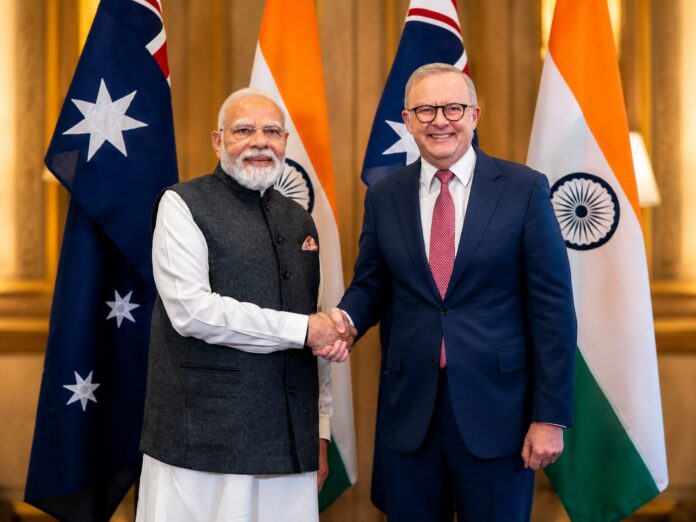
In a major diplomatic breakthrough, Prime Minister Narendra Modi has secured an agreement for Australia to export uranium to India for civilian nuclear use, ending nearly two decades of Australian resistance rooted in New Delhi’s refusal to sign the Nuclear Non-Proliferation Treaty (NPT).
The agreement was signed after bilateral talks between PM Modi and Australian Prime Minister Anthony Albanese in Melbourne. Announcing the deal, PM Modi said, “We have signed an important agreement today on nuclear energy. This will pave the way for uranium supplies from Australia to India and give our clean energy objectives fresh momentum.”
The two countries said the arrangement would facilitate long-term uranium exports for “exclusively peaceful purposes” under safeguards monitored by the International Atomic Energy Agency (IAEA).
The agreement marks a remarkable shift in Australia’s policy, which for nearly 20 years had consistently refused to sell uranium to India solely because it was not a signatory to the NPT.
Australia’s first ‘No’ came in 2006
Australia’s opposition to uranium exports to India began in March 2006, immediately after the landmark India-US Civil Nuclear Agreement announced by then Prime Minister Manmohan Singh and US President George W. Bush.
Although Washington agreed to cooperate with India’s civilian nuclear programme after New Delhi accepted international inspections of its civilian reactors, Australia refused to follow the US lead.
Then Australian Foreign Minister Alexander Downer made it clear that Canberra would not alter its long-standing policy of selling uranium only to countries that had signed the Nuclear Non-Proliferation Treaty.
“If we were to export uranium to India, that would constitute a significant shift in our policy,” Downer had said, arguing that doing so would also raise questions about exports to countries such as Pakistan and Israel.
He further asserted that Australia preferred to support the NPT and hoped India would eventually become a signatory before any uranium trade could take place.
Ironically, while refusing to sell uranium to India, Australia continued negotiations to export the mineral to China, citing Beijing’s status as an NPT signatory.
2008: Labour government formally shuts the door
Australia’s position hardened further after the Labour Party came to power in late 2007.
In January 2008, then Foreign Minister Stephen Smith informed India’s special envoy Shyam Saran that Australia would not authorise uranium exports to India unless it signed the Nuclear Non-Proliferation Treaty.
The decision effectively reversed the previous John Howard government’s 2007 in-principle willingness to consider uranium exports to India, subject to stringent conditions, including IAEA safeguards, consensus within the Nuclear Suppliers Group (NSG), completion of the India-US nuclear agreement and additional safeguards.
Smith reiterated that refusing uranium exports to non-NPT countries had always been the Australian Labour Party’s policy.
2010: ‘No prospect for a change’
Australia maintained the same position even after the India-US nuclear deal had become operational.
In April 2010, Canberra once again ruled out selling uranium to India, insisting there was “no prospect for a change” in its policy because India remained outside the NPT. Then Trade Minister Simon Crean reiterated that Australia could not supply uranium to countries that were not signatories to the treaty.
For years, successive Indian governments argued that uranium imports were essential for expanding clean energy generation and that India’s nuclear record was responsible despite its non-NPT status. Canberra, however, remained unmoved.
Modi-era breakthrough
The agreement signed in 2026 marks the most significant reversal in Australia’s uranium policy towards India.
Despite India continuing to remain outside the NPT, Australia has now agreed to supply uranium under IAEA safeguards exclusively for peaceful civilian use, reflecting the strategic trust that has developed between the two countries.
Australia possesses around 28 per cent of the world’s known uranium reserves, making it one of the largest holders of the critical resource.
For India, the deal is expected to support its target of achieving 100 GW of nuclear power capacity by 2047, an important pillar of the country’s clean energy transition.
Australian Prime Minister Anthony Albanese said the arrangement would help increase India’s share of non-fossil-fuel electricity generation.
Beyond uranium
The uranium agreement formed part of a broader package of strategic initiatives announced during Modi’s visit.
The two leaders agreed to deepen defence cooperation, strengthen supply chains for critical minerals and establish a temporary Indian space tracking terminal on Australia’s Cocos (Keeling) Islands to support Indian space missions.
India is now Australia’s fifth-largest trading partner, with bilateral trade in goods and services reaching AUD 54.4 billion (USD 37.7 billion) during the 2024-25 financial year.
For India, the significance of the uranium agreement extends beyond energy security. It marks the culmination of a diplomatic journey that began with repeated Australian refusals in 2006, was reaffirmed in 2008 and 2010, and has finally ended in 2026 with Canberra agreeing to export uranium to India despite New Delhi continuing to remain outside the Nuclear Non-Proliferation Treaty.
Why Australia changed course after two decades
Australia’s decision to supply uranium to India is not merely an energy agreement;it reflects a profound transformation in Indo-Australian ties and the changing geopolitical landscape of the Indo-Pacific.
A key factor has been PM Narendra Modi’s sustained diplomatic outreach, which has elevated India-Australia relations from a transactional partnership to a Comprehensive Strategic Partnership. Over the past decade, bilateral engagement has expanded significantly across defence, maritime security, critical minerals, technology, trade and intelligence sharing, fostering unprecedented strategic trust between Canberra and New Delhi.
The agreement also reflects the convergence of strategic interests between the two democracies. Both India and Australia increasingly view a stable, rules-based Indo-Pacific as vital to their national interests and have emerged as key partners in platforms such as the Quad.
The broader geopolitical environment has also altered Australia’s strategic calculations. China’s growing military assertiveness and economic coercion in the Indo-Pacific have prompted Canberra to diversify its strategic and economic partnerships. At the same time, uncertainty over the long-term reliability and consistency of the United States under Trump as a security guarantor has encouraged middle powers such as Australia to build stronger partnerships with like-minded countries, with India emerging as one of the most important.
These changing realities have diminished the relevance of Australia’s earlier objections based solely on India’s non-signatory status to the Nuclear Non-Proliferation Treaty. While India continues to remain outside the NPT, it has built a strong international reputation as a responsible nuclear power with an impeccable non-proliferation record and civilian nuclear facilities under IAEA safeguards.
For Australia, the uranium agreement also serves an economic purpose. Home to nearly 28 per cent of the world’s uranium reserves, the country is seeking to diversify export markets beyond its heavy dependence on China. India, meanwhile, aims to achieve 100 GW of nuclear power capacity by 2047 as part of its clean energy transition.
The uranium pact, therefore, represents more than the resolution of a long-standing policy dispute. It signals Australia’s recognition of India’s growing strategic weight and reflects how geopolitical realities have reshaped a policy that remained unchanged from 2006, through 2008 and 2010, before finally giving way in 2026.