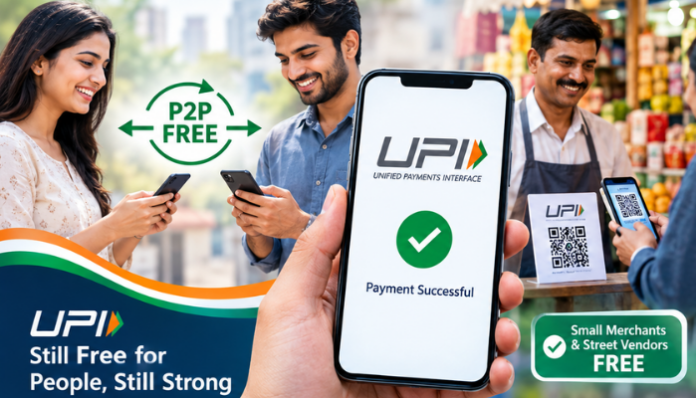
Amid speculation, the Ministry of Finance announced on 15th September that there will be no charges on person-to-person Unified Payments Interface (UPI) transactions. The National Payments Corporation of India confirmed that only nominal 0.4% charges will be levied on payments to merchants (P2M) transactions above ₹2,000. The revised UPI Merchant Discount Rate (MDR) will come into effect from 15th October 2026.
0.4% MDR on P2M UPI transactions
“The new UPI framework introduced has no impact on any person-to-person transactions. UPI will continue to remain completely free for all person-to-person transactions, irrespective of the amount transferred. Payments to merchants up to ₹2,000, along with transactions covered under the zero-MDR framework for small merchants, will also remain free. Consequently, approximately 96% of all P2M transactions will remain unaffected. MDR will apply only to specified merchant transactions above ₹2,000,” the Finance Ministry stated.
No tax or charges on person-to-person UPI transactions: Centre assures
It categorically rejected reports and claims that the Central government or NPCI were planning to impose a tax or charges on UPI transactions.
“It is clarified that MDR is neither a tax nor a charge collected by the Government or NPCI. It is distributed among payment ecosystem participants, including banks and payment application providers, to support the operation and continued expansion of the UPI ecosystem. Introduced under the Payment and Settlement Systems Act, 2007, following detailed deliberations by the UPI Steering Committee, the framework seeks to ensure the long-term sustainability of UPI while protecting individuals and small merchants from additional charges,” the Ministry said.
P2P UPI transactions to remain free irrespective of amount, Customers will not pay MDR
The Modi government also listed what will remain free and what will attract MDR. The government confirmed that all person-to-person (P2P) UPI transactions “will remain completely free, irrespective of the amount transferred.”
No transaction fee, platform fee or other charge may be imposed on individuals for sending or receiving money through UPI. “Therefore, UPI transactions accounting for 70% of the total transaction value will remain completely outside the MDR framework,” the Finance Ministry stated.
In addition, merchant payments up to ₹2,000 will remain free of MDR, and customers will not be required to pay any charge when making such payments through UPI.
Regarding payments received by small merchants like street vendors, the government said that those receiving up to ₹1 lakh per month through UPI QR codes under the Person-to-Person-Merchant (P2PM) category will “continue to enjoy zero MDR on all transactions.”
This provision is to keep street vendors, neighbourhood shops and other small businesses exempt from additional payment costs.
Addressing what will attract MDR, the Central government stated that a nominal MDR of 0.4% will apply only to Payments-to-Merchants (P2M) transactions above ₹2,000. The MDR will be shared among payment ecosystem participants, including banks, payment service providers and UPI application providers. For transactions of ₹75,000 and above, the MDR will be capped at ₹300 per transaction.
In addition, transactions above ₹2,000 in essential and thin-margin sectors, including railways, telecommunications, insurance, fuel and agricultural inputs, will attract a flat MDR of ₹5 per transaction.
The Finance Ministry argued that this flat charge will provide cost certainty for critical public services and businesses operating on narrow margins.
A nominal MDR of 0.2% will be levied on payments relating to mutual funds, securities, stockbrokers and dealers. “The lower rate is intended to support continued retail participation in formal financial markets,” the Ministry said.
Only 4% of P2M transactions will be affected
The Central government highlighted that despite the announced nominal MDR levies, most merchant transactions will remain unaffected.
The MDR will apply only to 4% of total merchant transactions, meaning that 96% of P2M transactions are either below the ₹2,000 threshold or covered by the zero-MDR framework for small merchants.
NPCI explains why MDR is being introduced
Following the announcement that P2M transactions will attract 0.4% MDR, the NPCI has issued an FAQ sheet addressing the key concerns.
Regarding why an MDR is being levied now, the NPCI said that since the MDR is distributed only amongst the UPI ecosystem, it will boost further investment into infrastructure resiliency, innovation, cybersecurity and customer service
“UPI processes billions of transactions every month. The MDR is distributed only amongst the UPI ecosystem to further invest into infrastructure resiliency, innovation, cybersecurity (protecting the UPI Infrastructure with banks and non-banks) and customer service. UPI is a home-grown payment system, and its charges (MDR) are much lower than other payment instruments such as Credit Cards, Debit Cards, Wallets etc. The charges are kept very reasonable and will be applicable only for transactions above ₹ 2,000 to ensure UPI remains the most affordable mode of accepting payments,” the NPCI said.
Regarding comparison between UPI MDR and traditional Debit and Credit card MDRs, the NPCI said that UPI MDR is comparatively very less than the fees levied on traditional debit-credit card-based transactions, which attract around 1.5% to 2.5% fees per transaction.
“UPI MDR is structured to be much lower than all traditional card-based transaction fees. Standard credit card MDRs typically range from 1.5% to 2.5% per transaction, while debit card MDRs are capped up to 0.90%. By setting the baseline UPI MDR at 0.4% on transaction above ₹ 2,000 and capping it at ₹300 for high-value purchases, UPI remains the most affordable digital payment acceptance tool for commercial enterprises. This cost difference helps merchants lower their payment processing expenses while accepting digital transactions,” the NPCI stated.
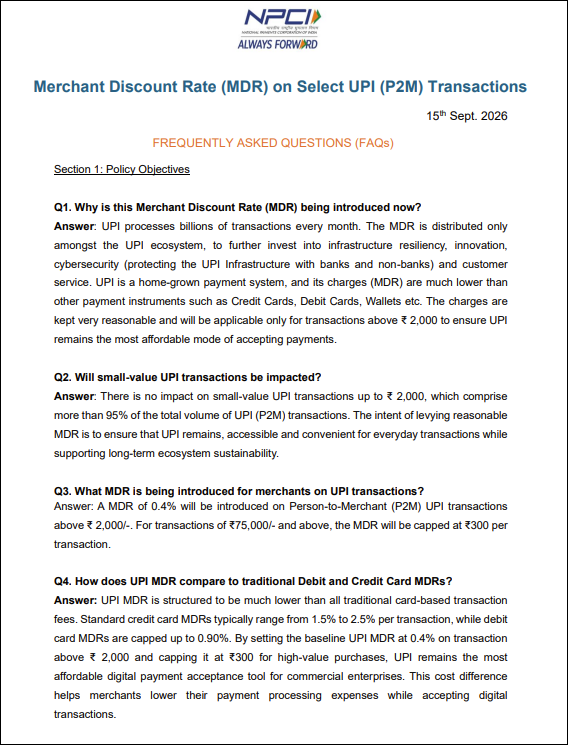
Explaining why reliance on government subsidy alone is not sufficient, the NPCI said that government subsidy was designed as short-term bridge funding rather than a permanent measure to compensate the cost incurred by the payment industry. It said that a sole and permanent reliance on government incentive/subsidy will create funding uncertainty and limit long-term technology investments by fintech and banks.
Regarding Merchant Discount Rate (MDR) on Select UPI (P2M) Transactions
— NPCI (@NPCI_NPCI) September 15, 2026
Please refer to the FAQs here: https://t.co/DTOZFVHAVB pic.twitter.com/4HMU0YZ2AC
“Annual government incentive/subsidy, while helpful in accelerating early digital adoption, were designed as short-term bridge funding rather than a permanent measure to compensate the cost incurred by the payment industry. Industry estimates indicate that maintaining UPI payment operations, server bandwidth, fraud prevention systems, and bank technical support costs around ~₹20,000 crore annually. Relying solely on fiscal budget allocations creates funding uncertainty and limits long-term technology investments by banks and fintech. Transitioning to a commercial, threshold-based model provides reliable capital for continuous technological innovation,” it said.
UPI apps will not charge any platform fee
Pertinently, the NPCI has confirmed that various UPI applications will not charge any platform fee or transaction fee.
“UPI App providers shall NOT charge Platform Fee or any other charge for any payment made through UPI. UPI applications are explicitly restricted from levying platform fees on UPI transactions,” it said.
Furthermore, scanning QR codes at local markets, street vendors, or small retail shops will also remain completely free for consumers.
There will also not be any monthly quotas, volume limits, or tiered caps on free UPI transactions for individual consumers.
“Users can make as many valid person-to-person(P2P) or person-to-merchant (P2M) transactions as necessary throughout the month without hitting a fee threshold. While individual banks and NPCI enforce standard daily security caps on aggregate transaction amounts (typically ₹1 lakh to ₹5 lakh depending on the transaction category), these are risk-management parameters, not commercial charge tiers. In any case, consumers face zero transaction fees regardless of how frequently they use UPI,” the NPCI said.
Government notifies zero charges on small transactions and RuPay cards
Earlier on 15th September, the Ministry of Finance, in a notification issued, stated that banks and system providers cannot impose charges, directly or indirectly, on UPI transactions within this limit or on payments made through RuPay debit cards. The new notification specifically protects UPI payments up to ₹2,000. It also covers RuPay debit card payments. For higher-value UPI transactions, the government has not introduced any fee for consumers.
Why did the Centre revise UPI MDR?
Over the years, UPI has grown rapidly, with more than 24,000 crore transactions worth ₹314 lakh crore recorded in 2025-26. However, payment companies and banks have raised concerns about the rising cost of running the system.
The Department of Financial Services told the Standing Committee on Finance that the payments industry was spending about ₹20,700 crore every year on person-to-merchant transactions. A committee report in March also said that the absence of MDR was making the UPI system financially difficult to sustain.
The government currently supports low-value UPI payments through its incentive scheme for promotion of RuPay debit cards and low-value BHIM-UPI transactions (P2M). The incentive is capped at 0.15% of the transaction value and applies to payments of up to ₹2,000 made to small merchants. Large merchants are not covered.
For 2026-27, the Budget has estimated ₹2,000 crore for this subsidy. The government paid ₹2,196.21 crore in 2025-26, compared with ₹1,922.77 crore in 2024-25.