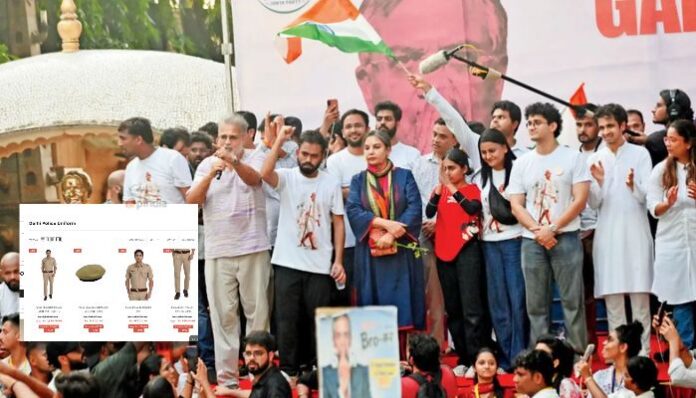
The Cockroach Janta Party (CJP) has called for a massive protest at Delhi’s Jantar Mantar on 10th October if the Chief Election Commissioner Gyanesh Kumar does not resign amid manufactured outrage over the Special Intensive Revision (SIR) of electoral rolls. Ahead of the protest, several CJP supporters online are directly or in veiled fashion urging those planning to join the protest to buy police uniforms online and impersonate police officials.
In this vein, a prominent anti-BJP troll, Ramit Verma, the man behind the @thepeeinghuman X handle, used the double bind trick of saying ‘do not do this’ while implicitly wanting people to do it. “Official PeeingHuman” wrote on X, ” REQUESTING all protesters to NOT buy this and show up at the protest wearing it, please DO NOT. Thanks. Also please report this link so that no one can use it.”
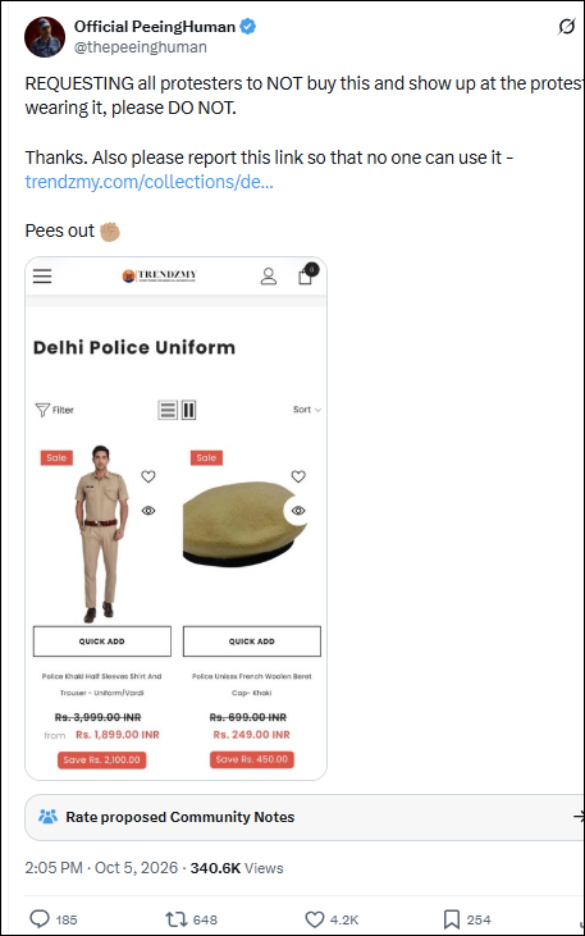
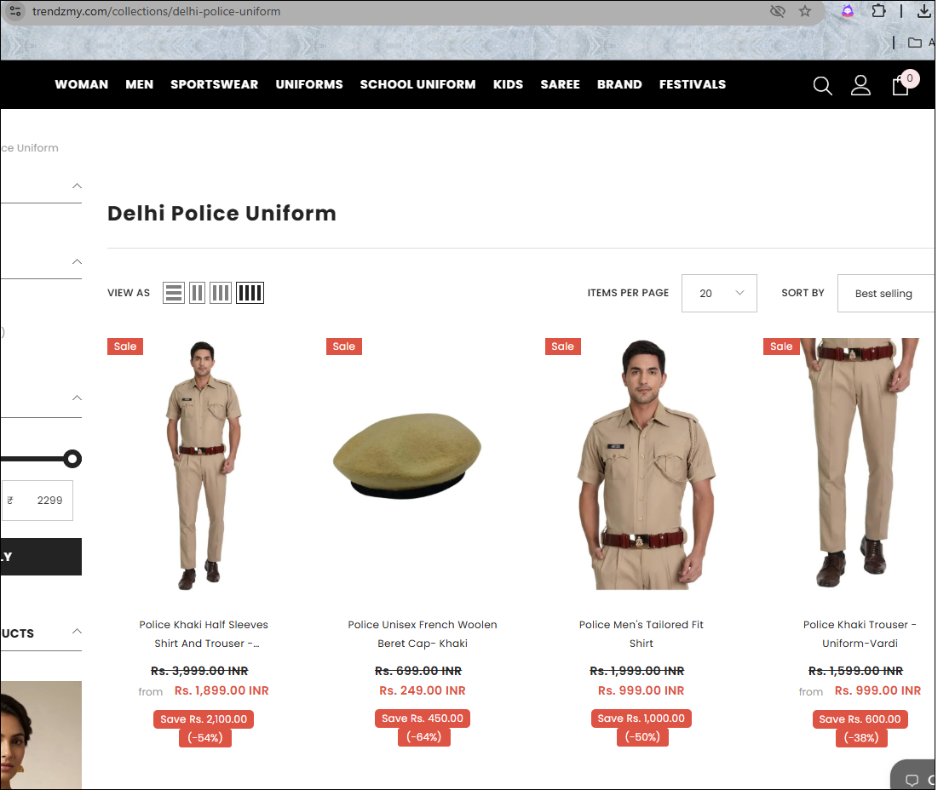
The admin of the pro-AAP channel also shared a link to an online platform called “Trendzmy” selling police uniforms and related accessories.
Notably, Ramit Verma has earlier received backlash for falsely claiming in 2020 that goons belonging to the BJP and RSS were harassing girls at Gargi College, University of Delhi. At that time, the then DCP Atul Thakur told journalist Swati Goel Sharma that investigations did not reveal any political affiliation of those involved in Gargi college harassment case.
In February 2025, Verma was invited by controversial US-based ‘researcher’ and Associate Professor at the University of Michigan Joyojeet Pal to an event bringing anti-India forces under one roof.
During the CJP’s Chalo Sansad protests in July this year, ‘Peeing Human’ Ramit Verma claimed to have been beaten by the police. He said that after one blow, when he asked a police officer to hit him again, instead of backing off, the officer fulfilled Verma’s request.
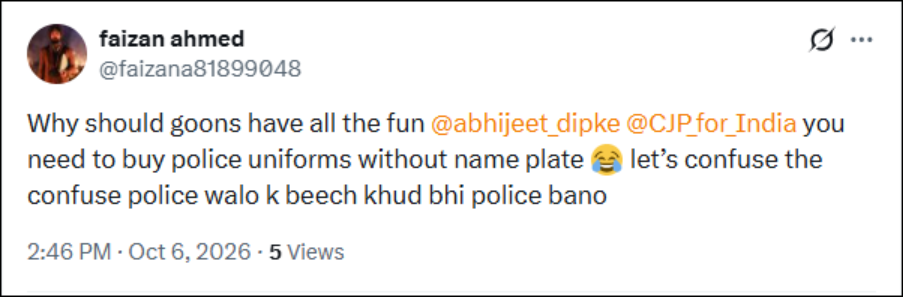
Moving ahead, an X post published on 6th October 2026 by Faizan Ahmed asked CJP and its founder, Abhijeet Dipke, to buy police uniforms without name plates, and ‘become police among the police’.
“Why should goons have all the fun @abhijeet_dipke @CJP_for_India you need to buy police uniforms without name plate. let’s confuse the confuse police walo k beech khud bhi police bano,” the X user wrote.
Another CJP supporter wrote, ” All protestors should wear police uniforms without name tags and confuse the fuck out of Delhi Police. Pakde gaye toh bolna baju main Singham 6 ki shooting chal rahi hai.”
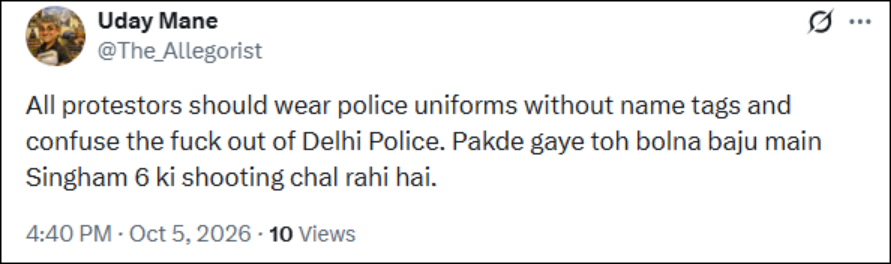
Notably, before these calls for buying and wearing police uniforms to impersonate Delhi Police officials deployed at Jantar Mantar came, several CJP supporters and influencers have been found masquerading as ‘independent journalists’. They have been exploiting press cards to create ruckus, level serious allegations against police officials, and evade detention.
Impersonating police officers by wearing uniforms in an unauthorised manner is not only about evading detention. Those CJP ‘cockroaches’ wearing police uniforms might resort to violence and hooliganism to blame it on the Delhi Police and incite protestors. It was seen during the CJP’s July protest how CJP supporters first pelted stones at police and resorted to violence, but when the police retaliated, the latter were painted as aggressors brutalizing ‘innocent students’.
It appears that after fake journalists and fake ‘police molesting women’ CCTV footage, a section of protestors might join the 10th of October protest while wearing police uniforms bought online.
It is, thus, pertinent to understand what the Indian laws say about impersonating a police officer.
What the law says about police uniforms
The Indian law restricts the use of police uniforms to authorised personnel.
Section 204 of the Bharatiya Nyaya Sanhita, a023, states that impersonating a public servant deliberately is a cognisable and non-bailable offence.
“Whoever pretends to hold any particular office as a public servant, knowing that he does not hold such office or falsely personates any other person holding such office, and in such assumed character does or attempts to do any act under colour of such office, shall be punished with imprisonment of either description for a term which shall not be less than six months but may extend to three years and with fine,” the law states.
Meanwhile, BNS Section 205 covers wearing garb or carrying a token used by a section of public servants with fraudulent intent. A person who does not belong to the class and wears resembling garb or carries a resembling token intending that it may be believed that he belongs to the class, faces imprisonment and a monetary fine. Thus, impersonating, in the present case, a police official is a cognisable and bailable offence.
“Whoever, not belonging to a certain class of public servants, wears any garb or carries any token resembling any garb or token used by that class of public servants, with the intention that it may be believed, or with the knowledge that it is likely to be believed, that he belongs to that class of public servants, shall be punished with imprisonment of either description for a term which may extend to three months, or with fine which may extend to five thousand rupees, or with both,” Section 205 states.
In addition, the Police Act, 1861, and service rules, including the Indian Police Service (Uniform) Rules, restrict the use of official uniform, badges, and insignia to serving personnel entitled to them. The authorised wearers include police officers and personnel on duty or as permitted by their force’s regulations.
There, however, are limited exceptions for ceremonial events, veterans, or training with explicit permission. In context. of actors and acting projects like films, television dramas, etc., prior formal permission and approval is required to be obtained from local enforcement authorities.
Thus, ordinary civilians using costumes with intent to deceive, or posing as officers to direct crowds, evade checks, or exercise authority, are all punishable offences. Besides, impersonating police officials may also attract additional offences, including cheating, assault, obstruction, etc.
E-commerce platforms selling police and military uniforms
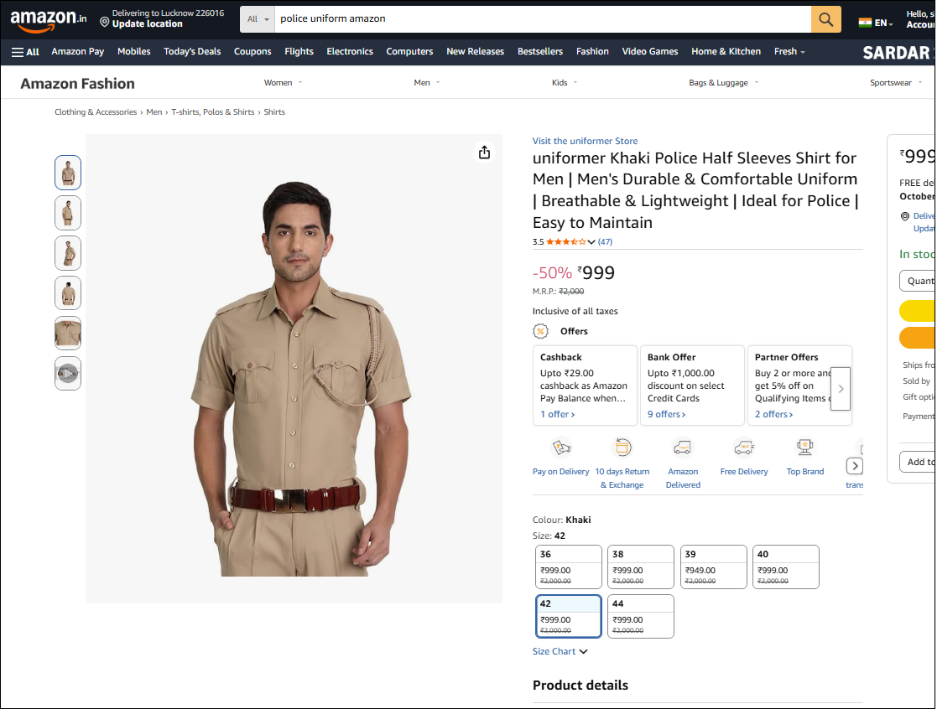
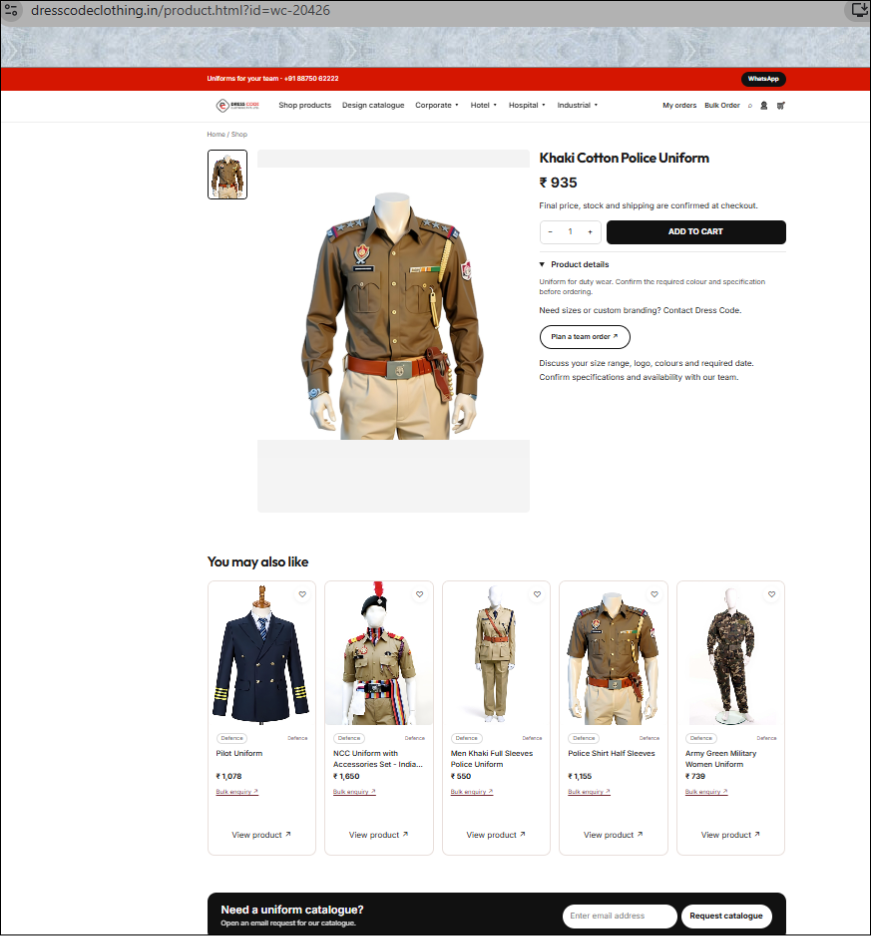
It is alarming that e-commerce platforms like Trendzmy, Amazon, Uniformer, and DressCode Clothing are selling Indian police uniforms.
Notably, while there is not a criminal blanket ban on selling police uniforms in the same way as wearing them to impersonate an officer is, it is restricted and regulated by local orders.
To prevent misuse, executive magistrates can issue temporary preventive orders under Section 163 of the Bharatiya Nagarik Suraksha Sanhita, directing people to abstain from certain acts in the interest of public safety and harmony. Such orders have been used in places including Chandigarh to ban the open sale of army and police uniforms, logos, insignias and related items unless the buyer produces official identification, with sellers required to keep records.
DressCode Clothing has also put up military, NCC and other defence uniforms for sale.
There have been cases earlier, wherein it turned out that fraudsters used police uniforms they purchased from e-commerce platforms to deceive people by posing as police officers.
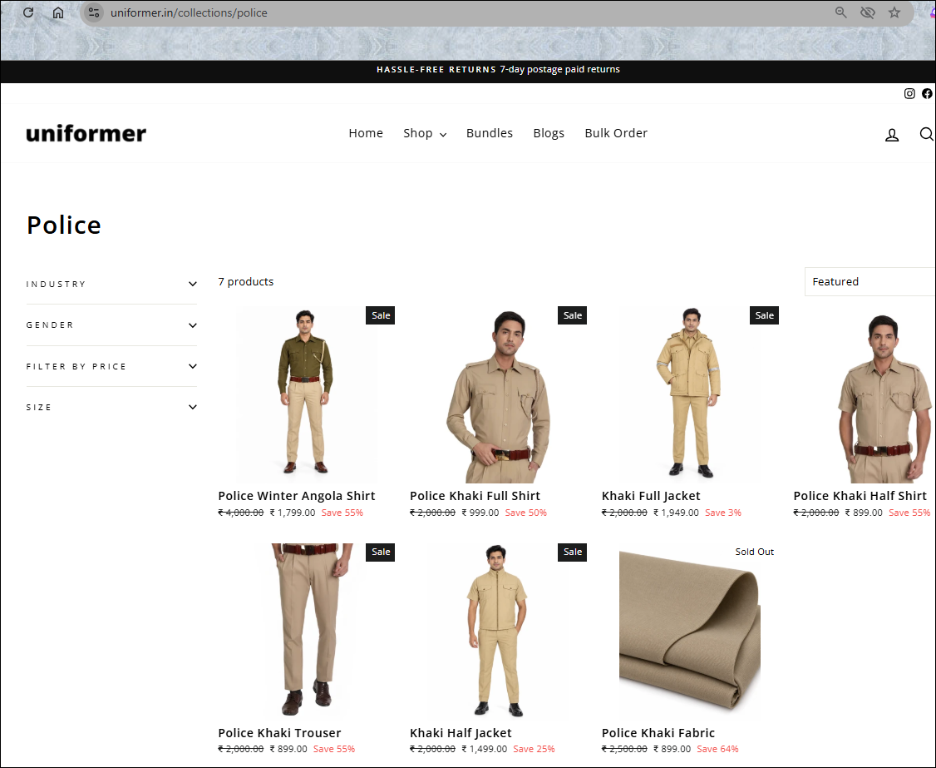
From beret caps, winter uniforms, belts, shoes, socks to other accessories related to the police uniforms are being openly sold online, which may be bought and misused by frauds, criminals, as indicated in the present case, by several people planning to impersonate the police. It is thus crucial that the police treat the online sales of police uniforms as a serious national security issue and take strict measures accordingly.