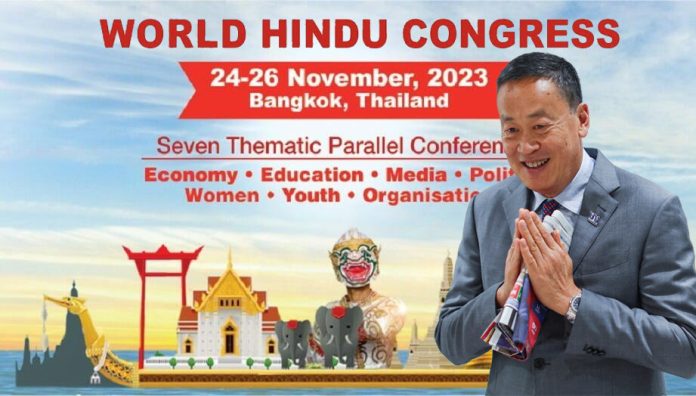
Thailand’s Prime Minister Srettha Thavisin highlighted Hindu values that promote peace and said that the world struggling with turmoil should take inspiration from Hindu values of non-violence, truth, tolerance and harmony, only then peace would be established in the world.
With the aim of establishing the identity of Hindus in the world as a progressive and talented society, the Third World Hindu Congress was inaugurated here today.
The Prime Minister of the host country, Thavisin, was to participate in the inaugural session but due to some reasons, he could not come. The message of the Thai Prime Minister was read out in the meeting. He said that it is an honour for Thailand to host the World Hindu Congress organized on the principles and values of Hinduism.
The Vedas visualize the key principles of synthesis and balance for a peaceful coexistence. The concept of shanti is established on these principles.
With the proclamation of ‘Victory of Dharma’, eminent saint Mata Amritanandamayi, Swami Purnatmanand of Bharat Sevashram Sangh, Sarsanghchalak Mohanrao Bhagwat of Rashtriya Swayamsevak Sangh, Sarkaryavah Dattatreya Hosabale, General Secretary of Vishwa Hindu Parishad Milind Parande and founder-facilitator of the programme Swami Vigyananand lit the lamp.
The World Hindu Congress gathered more than 2200 delegates invited from 61 countries of the world who made remarkable achievements in the fields of education, economy, academics, research and development, media and politics.
These include MPs and ministers from about 25 countries. There are about 10 lakh people of the Indian community living in Thailand whose contribution to the trade and economic development of the country is noteworthy.
Meanwhile, External Affairs Minister EAM Jaishankar recently said that India’s defence and security relationship with Thailand has grown after 2014. He noted that the Thailand government has also shown the same sentiment.
While addressing the Indian diaspora in Thailand, Jaishankar noted that India had a look-east policy while Thailand had a look-west policy. He highlighted the changes that took place in terms of India-Thailand ties after Prime Minister Narendra Modi came to power in 2014.
While interacting with the Indian community, Jaishankar said, “We engage with the countries of the ASEAN. So, for us, this is not just a relationship. It is not even a relationship that began, as I said, in 1947, in the modern form. It is, of course, a relationship that goes back in history, but it is a relationship that is associated with reform and change in India. So, this period that we are talking about, especially the last 25 years, this is a time when this relationship has grown very much.”
(This news report is published from a syndicated feed. Except for the headline, the content has not been written or edited by OpIndia staff)