India and Singapore agreed to cooperate in the development of the semiconductor ecosystem, the Ministry of Trade and Industry of Singapore said in a release on Thursday.
Both countries signed a Memorandum of Understanding (MoU) for cooperation in the sector. The MOU was exchanged in the presence of India’s Prime Minister Narendra Modi and Prime Minister Lawrence Wong during Prime Minister Modi’s Official Visit to Singapore.
The MoU aims to support India’s growing semiconductor industry while facilitating Singapore’s ecosystem of semiconductor companies and related supply chains to participate in the fast-growing Indian market, the statement added.
Under the MOU, Singapore and India will leverage complementary strengths in their semiconductor ecosystems and tap into opportunities to build resilience in their semiconductor supply chains. This will include government policy exchanges on ecosystem development, supply chain resilience, and workforce development.
The Ministry of Trade and Industry (MTI) and India’s Ministry of Electronics and Information Technology (MeitY) will establish a Policy Dialogue to facilitate discussions, oversee the implementation of the areas of collaboration, and exchange best practices.
A parallel business-to-business Cooperation Forum will be established and led by Enterprise Singapore and the India Semiconductor Mission (ISM) to encourage and catalyze more private-sector partnerships between both countries.
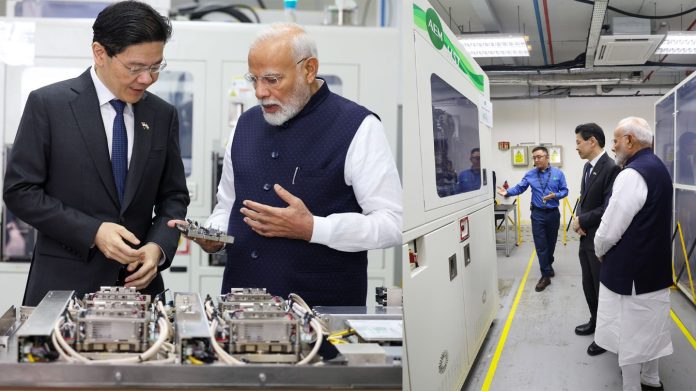
PM Modi, who is on a two-day visit to Singapore, visited the semiconductor facility of AEM Holdings Ltd. Singapore’s PM Lawrence Wong accompanied PM Modi during his visit to the semiconductor facility.
The visit comprised a sharing led by the Singapore Semiconductor Industry Association (SSIA) on the development of Singapore’s semiconductor industry opportunities for mutual collaboration between Singapore and India partners, and a tour of AEM’s facilities.
Prime Minister Modi also engaged with ecosystem players and institutions such as APP Systems, Century Water, Ecsal Technologies, NexGen Wafer Systems, PEP Innovation, and Temasek Polytechnic.
Deputy Prime Minister and Minister for Trade and Industry Gan Kim Yong said, “This MOU signals India’s and Singapore’s commitment to work together in the field of semiconductors to address the demand from industries around the world. This will also strengthen semiconductor supply chain resilience and create new markets and opportunities for businesses in our countries.”
(This news report is published from a syndicated feed. Except for the headline, the content has not been written or edited by OpIndia staff)