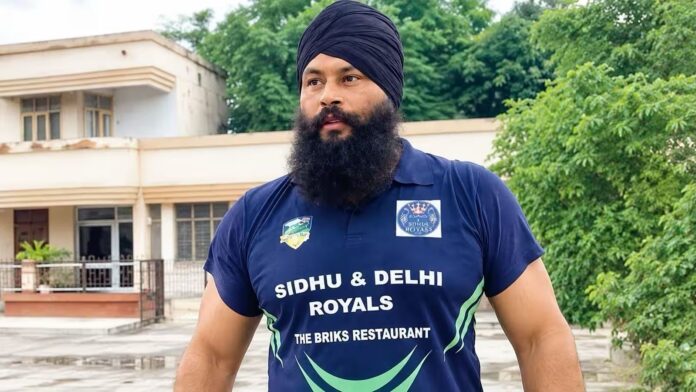
Parvinder Singh Jhota was fighting what he saw as Punjab’s drug menace. He confronted medical-store owners, challenged the alleged illegal sale of addictive medicines and built a following by publicly exposing what he believed was a criminal network destroying the state’s youth. On October 13, 2026, his campaign came to a tragic end when he was shot dead in Mansa during a confrontation with a medical-store owner.
His murder has triggered outrage, protests and accusations against the Aam Aadmi Party (AAP) government. But beyond the immediate questions surrounding his killing lies a wider political story: Jhota had reportedly grown disillusioned with the Bhagwant Mann government’s handling of drugs and had moved closer to Amritpal Singh’s Waris Punjab De, an organisation led by a man who openly advocates Khalistan.
The photograph of Jhota standing in front of Bhindranwale adds another dimension to this story. Bhindranwale, whose legacy continues to inspire sections of the Khalistani movement, also rose to prominence amid a campaign against tobacco in 1981. He subsequently became a central figure in the Khalistani terrorism that engulfed Punjab.
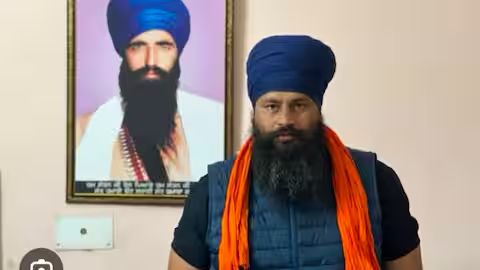
The parallel is worth examining, not because Jhota’s photograph or reported association proves that he was a Khalistani, but because Punjab’s history demonstrates how campaigns built around legitimate social and religious concerns can become intertwined with a much larger political project.
Jarnail Singh Bhindranwale: The anti-tobacco campaign of 1981
In May 1981, Amritsar became the centre of a bitter confrontation over tobacco. Sikh organisations demanded restrictions on tobacco sales and sought recognition of the city’s religious character. The agitation escalated when opposing groups staged a procession in support of smoking, inflaming tensions between Sikh and Hindu organisations.
Bhindranwale, then emerging as an influential religious preacher, mobilised supporters around the anti-tobacco campaign. The agitation brought him greater public visibility at a time when Sikh identity, religious authority and political representation were becoming increasingly contentious issues.
The anti-tobacco campaign was not, in itself, a separatist movement. Opposition to tobacco has a basis in Sikh religious norms, and people could support restrictions on smoking without endorsing Khalistan. Yet the events of 1981 helped bring religious mobilisation and the politics of Sikh identity into sharper confrontation.
Historical accounts identify the tobacco controversy as an important episode in the escalation of tensions that would subsequently shape Punjab’s politics. The issue became entangled with competing political agendas, militant assertions and the broader question of Sikh political identity.
Bhindranwale’s subsequent trajectory went far beyond campaigning against tobacco. He emerged as a central figure in Khalistani terrorism, a movement seeking a separate Sikh homeland. His growing confrontation with the Indian state culminated in Operation Blue Star in June 1984, during which he was killed.
Amritpal Singh: From anti-drug preacher to Khalistani politics
Four decades later, Punjab witnessed another figure whose rise to prominence was closely associated with a campaign against intoxicants.
Amritpal Singh returned to Punjab from Dubai in August 2022 and began mobilising young people around religious revival and the drug problem. His message resonated with sections of the youth in a state where addiction, unemployment and the social consequences of substance abuse have become persistent concerns.
His father, Tarsem Singh, spoke about the impact of the campaign in an interview with The Times of India. According to him, young people responded to Amritpal’s appeal, with some abandoning drugs and returning to religious observance.
The anti-drug campaign helped Amritpal establish a public profile. But his political messaging soon extended well beyond addiction and rehabilitation.
Amritpal openly invoked Bhindranwale’s legacy, adopted a similar appearance and began advocating Khalistan. His turban-tying ceremony as the head of Waris Punjab De was held in September 2022 in Rode, Bhindranwale’s native village. Some of his supporters began referring to him as “Bhindranwale 2.0”.
In February 2023, Amritpal and a large group of supporters stormed the Ajnala police station over the arrest of an associate. Six police personnel were injured during the confrontation, according to contemporary reports. The incident brought national attention to his confrontational methods and political influence.
After a 37-day manhunt, Amritpal was arrested on April 23, 2023, and detained under the National Security Act. In the 2024 Lok Sabha election, he contested from Khadoor Sahib while in detention and won by a margin of nearly two lakh votes.
His electoral victory demonstrated that his appeal extended well beyond a small circle of followers. It also underscored the political reach he had acquired through religious mobilisation and his messaging on Punjab’s social and political grievances.
Amritpal’s trajectory therefore presents an important distinction: his anti-drug campaign was one aspect of his public profile, while his advocacy of Khalistan represented a separate political objective. The existence of the former does not erase the latter.
Jhota’s reported proximity to Waris Punjab De
This brings us back to Jhota.
His campaign against the alleged illegal sale of addictive medicines addressed a serious problem. Reports following his death indicated that he had become increasingly disillusioned with the AAP government’s handling of the drug menace and had grown closer to Waris Punjab De.
That association is relevant because of the organisation’s leadership and political outlook. But the available reporting does not conclusively establish that Jhota was a formal member of Waris Punjab De, had adopted Amritpal’s separatist ideology or intended to pursue a Khalistani political agenda.
The photograph showing Jhota in front of Bhindranwale cannot establish any of those things either. It is a reason to examine the context of his reported associations, not proof of his personal beliefs.
Nevertheless, the broader political question remains. When a campaigner fighting a genuine social problem moves closer to an organisation led by an unabashed separatist advocate, it is legitimate to ask whether the social cause is becoming intertwined with a wider political mobilisation and separatist ambitions.
This is particularly relevant in Punjab, where the memory of terrorism and Khalistani separatism remains politically consequential and where public anger over governance failures can create opportunities for alternative political actors.
The danger is not that every anti-drug activist is secretly a separatist. Such a claim would be both unfair and unsupported. The danger is that a legitimate public grievance can be used to build political influence that eventually serves objectives extending beyond the original cause and promotes a radical ideology that calls for the secession of Punjab, thereby offering ammo to Pakistan-based terrorists and intelligence agencies to foment trouble in India.
Jhota’s murder becomes a political flashpoint
The reaction to Jhota’s killing has demonstrated how quickly the tragedy has become a political confrontation.
Balwinder Kaur, mother of Amritpal Singh, accused the Punjab government of killing Jhota and demanded Bhagwant Mann’s resignation, underscoring the close association of Jhota with Singh’s group.
“Parvinder Singh Jhota, who used to raise his voice against drugs, was killed by the Govt. Why are you killing those who are trying to stop the drug menace?” she said, alleging that people had been detained and prevented from travelling to Mansa for a protest.
#WATCH | Tarn Taran, Punjab | Balwinder Kaur, mother of Waris Punjab De chief Amritpal Singh, says, "Parvinder Singh Jhota, who used to raise his voice against drugs, was killed by the Govt. Why are you killing those who are trying to stop the drug menace? People have been detained and taken to Police station. This is shameful. I would like to tell the Govt., if you fear God then mend your ways…We have been stopped from heading to Mansa for a ‘dharna’. The Govt is acting shamelessly…Bhagwant Mann should resign and leave."
— ANI (@ANI) October 14, 2026
The political significance of the episode lies in how Jhota’s death is now being invoked to challenge the AAP government and mobilise public anger. Such mobilisation is not inherently illegitimate. Demanding justice for a murdered activist is entirely reasonable. But the wider political objectives of those participating in that mobilisation must remain open to scrutiny.
The photograph of Jhota with Bhindranwale has added to the controversy because the latter remains an icon for sections of the Khalistani movement.
The more substantial question is whether the drug crisis is becoming a platform through which organisations with separatist objectives garner sympathy among the public and strengthen their influence.
The lesson Punjab cannot afford to ignore
Punjab’s drug crisis is real. Families have lost children to addiction, criminal networks have profited from the illegal supply of intoxicating substances, and successive governments have faced questions over their ability to dismantle these networks.
The AAP government must be judged on its record: whether illegal supply chains are being broken, traffickers are being prosecuted, rehabilitation services are accessible, and people who expose criminal activity are adequately protected.
But the legitimacy of the anti-drug cause must not become a shield against examining the political objectives of those who claim to champion it.
Bhindranwale’s rise amid the anti-tobacco agitation of 1981 and Amritpal Singh’s emergence through an anti-drug campaign offer two historical reference points for understanding the relationship between social grievances and political mobilisation. Their subsequent trajectories demonstrate why the stated objective of a campaign cannot be the only factor in assessing the movement surrounding it.
Jhota’s story is not yet evidence of a similar trajectory. But his proximity to Waris Punjab De and the picture of him with Bhindranwale’s portrait reveals a clear pattern of how an anti-drug campaign is used to fuel Khalistani politics.
Yet his death presents Punjab with two urgent challenges. The first is to establish the truth about his murder and hold those responsible accountable. The second is to ensure that the state’s drug crisis is addressed through effective governance rather than being reduced to a political contest.
The fight against drugs must remain focused on saving lives, dismantling criminal networks and restoring families. Governments must answer for their failures, while political organisations must answer questions about their ideology and objectives.
A genuine social cause deserves public support. It does not confer immunity from scrutiny on every person or organisation that invokes it. And it also presents the government with the challenge of scrutinising the anti-drug crusade as a platform to further the Khalistani movement.
That is the lesson Punjab’s history offers, and one the state cannot afford to ignore.