

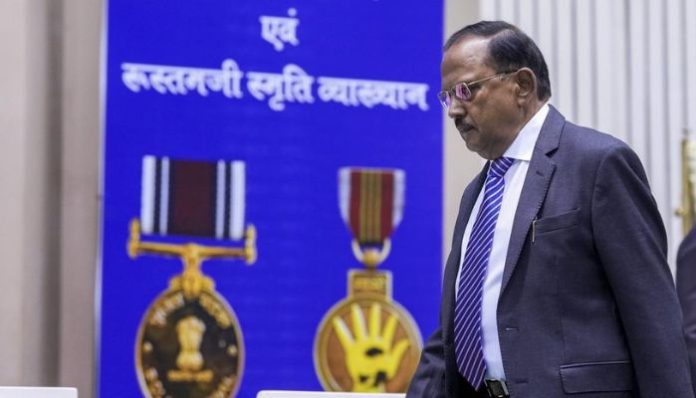
The dramatic escalation between India and Pakistan following the April 2025 Pahalgam terror attack culminated in Operation Sindoor. This precision military response has since become a case study in modern information warfare. National Security Advisor Ajit Doval‘s recent challenge at IIT Madras cuts to the heart of this battle: “Show me one photo of Indian damage, even a glass being broken”. This statement isn’t mere rhetoric; it exposes a calculated Pakistani disinformation campaign built on fabricated victories and recycled imagery.
The core of Doval’s challenge
Doval revealed that Operation Sindoor hit precisely nine targets deep inside Pakistan. This included terror hubs in Bahawalpur (JeM) and Muridke (LeT). The entire operation took just 23 minutes. Satellite images later confirmed the damage. India achieved its objectives with zero collateral damage.
The mission showcased India’s indigenous capability. It relied completely on homegrown technology. This covered navigation, targeting, and execution. It marked a strategic shift for India. The move was from border skirmishes to deep-territory counterterrorism.
Doval also said that foreign media’s reports were contradicted by evidence. He specifically mentioned outlets like The New York Times. These outlets had amplified Pakistan’s claim of “retaliation“. However, they could not produce any visual proof of damage in India. Instead, their own satellite images accidentally confirmed India’s story. The images validated India’s precision strike claims.
#WATCH | Chennai, Tamil Nadu | Speaking on Operation Sindoor, at IIT Madras, NSA Ajit Doval slams the foreign media for their reportage on the operation.
— ANI (@ANI) July 11, 2025
"Foreign press said that Pakistan did that and this…You tell me one photograph, one image, which shows any damage to any… pic.twitter.com/v13Pr8RuRf
Pakistan’s debunked claims: A pattern of fabrication
Pakistan’s military media (ISPR) and online supporters ran a coordinated campaign. They claimed two major victories. First, they alleged shooting down Indian fighter jets, including Rafales. They also said they captured pilots. Second, they claimed destroying Indian bases like Srinagar Airbase and an Army Brigade HQ.
But the reality was different. The story about downing jets, especially Rafales, was a hoax. A key viral image supposedly showing a downed Rafale was fake. It was actually from a September 2024 MiG-29 training crash in Rajasthan. The CEO of Rafale’s maker, Dassault Aviation, Eric Trappier, was clear. He stated: “What Pakistan is claiming about downing three Rafales is simply not true”.
The “evidence” presented online was also fake. Pro-Pakistan accounts shared misleading content. They used a video of the huge 2020 Beirut explosion and falsely claimed it showed retaliatory strikes on India. They passed off footage from the Battlefield 3 video game as real drone strikes. They even recycled an old clip of sectarian clashes inside Pakistan, pretending it showed the attack on Srinagar Airbase. None of it was real.
The Anatomy of a disinformation campaign
Pakistan’s ISPR-linked accounts rapidly pushed false narratives about Operation Sindoor. Some posts gained 3 million views in mere hours. Mainstream Pakistani media amplified these claims without verification. This tactic mirrors Pakistan’s response after the 2019 Balakot strikes. Back then, it denied losing an F-16, despite U.S. confirmation.
During Operation Sindoor, specific false claims emerged. One showed “Rafale wreckage,” but it was actually from a 2024 Indian MiG-29 crash. Another used a “Srinagar Airbase strike” video, which was really old footage from clashes in Pakistan. Pakistan also claimed “massive retaliation,” destroying 15 Indian locations. Yet, satellite images showed no damage. There was zero evidence supporting this claim.
Why this matters: The new frontlines of war
Doval’s challenge goes beyond military pride. It shows a key problem, information asymmetry. India shares openly, while Pakistan hides online. This digital deception hurts Pakistan’s global credibility. Meanwhile, India’s tech sovereignty made a difference. We have built our own systems. This meant real-time intelligence and precision strikes. India relied less on foreign tech. This matters globally.
Conclusion
Operation Sindoor underscores a paradigm shift, victory is no longer just territorial but narrative. Doval’s challenge—backed by satellite evidence and technological prowess—exposes Pakistan’s propaganda as a house of cards. For the international community, this is a wake-up call: in an era of deepfakes and synthetic media, verifying claims isn’t just journalistic duty—it’s a safeguard against escalation. As Doval asserted, “We missed none, and hit nowhere else”. In that precision lies India’s strategic edge—and Pakistan’s chronic credibility deficit.


