

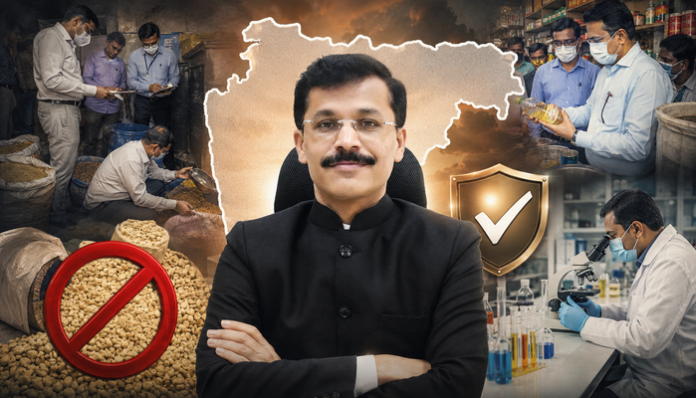
Maharashtra’s Food and Drug Administration has been carrying out a massive crackdown against food safety violations across the state. The man behind the unprecedented scale of FDA action is the IAS officer and FDA Commissioner, Tukaram Mundhe, who assumed office over a month ago.
In a major push for public health, IAS Officer Tukaram Mundhe, who assumed the office of Food Commissioner on 25th May, launched a sweeping enforcement across Maharashtra the same day. Under Mundhe’s command, the FDA has been conducting raids and inspections in hotels, restaurants and eateries, seizing food items and related materials and cancellation of licenses. “We will continue our action will continue on establishments not following the Food Safety and Standards Authority of India (FSSAI) norms. Citizens also should be aware of the norms and keep a close watch on hygiene standards,” Mundhe said in a statement.
The FDA action has targeted hotels, restaurants and eateries, milk supply chains, tobacco products and even blood banks. Here is a look at the actions taken by the FDA under Mundhe in the past couple of months to ensure food safety and public health.
Major Milk adulteration network busted
Right on his first day in the office, Mundhe directed strict enforcement of food safety rules throughout the milk supply chain. Emphasising that milk is not just a food product, but an essential source of nutrition for children, mothers, patients and senior citizens.
The FDA, along with the police, busted a major milk adulteration network operating in Bhoom taluka in the Dharashiv district, where synthetic milk was being prepared on a large scale. Officials examined the sales registers seized during the probe and found that around 2,30,470 kilograms of low-quality milk powder had been used over the past six months. Investigators estimate that this was enough to prepare nearly 23,04,070 litres of synthetic milk worth about ₹9.21 crore.
According to investigators, detergent powder, palm oil and low-grade chemical powder were mixed into the synthetic milk to make it look genuine and maintain fat content. Doctors have warned that regular consumption of such milk can seriously damage the liver, kidneys and digestive system, especially in children, pregnant women and elderly people.
The investigation revealed that around 10 litres of synthetic milk were mixed with every 100 litres of pure milk. Based on this ratio, officials suspect that more than 2.3 crore litres of adulterated milk may have been supplied from milk collection centres in the Bhoom region to different parts of Maharashtra. The action has already reduced the supply of milk and paneer in some areas.
Action against adulterated Prasad in Shirdi
In June 2026, the FDA carried out a major operation in Shirdi at the direction of Mundhe. During the operation, the department seized and destroyed around 700 kilograms of adulterated and low-quality peda near the revered Sai Baba temple complex. The FDA initially conducted tests on samples of the prasad pedas, which revealed that the dessert did not meet the required quality standards.
Subsequently, the department officials conducted raids and inspections at various Prasad selling centres and supply units within Shirdi, seizing the adulterated prasad and destroying it. The authorities initiated legal action against the persons concerned.
Crackdown on food establishments across the state
The Food and Drug Administration (FDA) under Mundhe launched a statewide crackdown on 7th and 8th July, inspecting 16 hotels, restaurants, and dhabas. Following the inspections, the department issued improvement notices to 10 establishments and suspended the licenses of others.
The crackdown included the immediate suspension of the license of Mumbai’s famous ice cream parlour, M/s. K. Rustom & Co (Rodabe K. Irani), located at Brabourne Stadium House in Churchgate under Section 32(3) of the Food Safety and Standards Act, 2006. The suspension followed the inspection, which uncovered severe hygiene and food safety violations, including low milk fat compliance.
Subsequently, in Nagpur, the FDA suspended the license of M/s. Shri Heera Sweets Pvt. Ltd., after inspectors discovered a dead rat lying right next to the ongoing food production. A hotel named Hotel Patilwada in Dhule also faced license suspension for operating without a valid food business license, violating state regulations.
Days later, the FDA suspended the licenses of three of Mumbai’s well-known restaurants, namely Noor Mohammadi, Shalimar and Rahmania restaurants, after inspections revealed serious hygiene and food safety violations. The FDA officials said that the three restaurants were given the opportunity to comply with regulations, but they failed to do so.
At Shalimar, the investigators found wet and slippery kitchen floors, the absence of raw material procurement records, failure to maintain drinking water quality reports, no records for edible oil quality, improper segregation of vegetarian and non-vegetarian food, and open windows without insect-proof mesh. The restaurant did not improve after being served a notice after the initial inspection in April.
At Noor Mohammad, the officials found thick layers of black grease on kitchen floors near the kebab section, open windows, uncovered peeling paint and grease deposits on kitchen walls and ceilings, unhygienic raw material storage, missing supplier records, old and unclean utensils, no drinking water testing records, and inadequate drainage required for pest control.
At Rahmania restaurants, the investigators found inadequate storage arrangements for food items, chemicals, and packaging material, doors without insect-proofing, rusting and poor-quality kitchen equipment, peeling paint and plaster on walls and ceilings, and the absence of mandatory food testing and drinking water quality records.
Mundhe’s drive against Gutkha
In addition to food products and dairy products, Mundhe has also initiated a campaign against Gutkha (a chewable tobacco product). As part of the campaign, the FDA conducted raids at around 904 locations across Maharashtra and seized tobacco products. In Amravati, the FDA seized banned pan masala and scented tobacco worth ₹55 lakh, including a truck used for transportation.
Blood Bank inspection and stringent action
In a statewide action against blood banks not complying with the rules, the FDA took stringent action against 23 blood centres and 15 blood storage centres between April and June. It suspended the licences of 21 blood centres and cancelled two, while 13 blood storage centres were suspended and two licences were cancelled.
Of the 21 suspended blood centres, 10 are in Pune district, including the Metro Blood Bank and centres at Dehu Road, Mangalwar Peth, Shirur and Rasta Peth. Blood storage centres at Vishrantwadi, Lohegaon, Uruli Kanchan, Daund, Junnar and Shivajinagar also faced suspension. As part of the crackdown, the license of the Metro Blood Bank at Aundh District Hospital (ADH) was suspended by the FDA.
Commenting on the FDA’s action against erring blood banks, FDA commissioner Tukaram Mundhe said the department would continue strict surveillance of blood centres and storage facilities. “Blood is not an ordinary drug but a life-saving necessity. Providing citizens with safe and quality blood and blood components that meet prescribed standards is the highest responsibility of the FDA. Blood centres and blood storage centres must strictly comply with the Drugs and Cosmetics Act, 1940, and the rules framed under it. The FDA is committed to protecting public health through continuous surveillance and action against centres violating the rules,” Mundhe said.
While people are pleasantly surprised at the FDA’s unprecedented vigilance and action against food adulteration in the state ever since Mundhe took charge, it might also set a positive example for other states to prioritise food safety and public health.


