

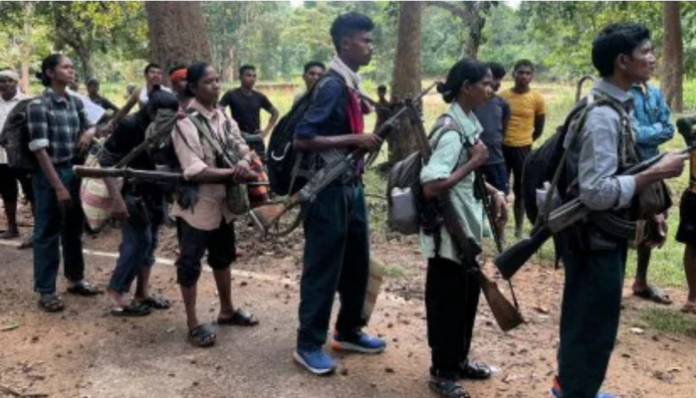
Marking a major milestone in the ongoing anti-Naxal operation of the security forces, around 80% of the Naxals active in the Abujhmad region of Chhattisgarh have laid down weapons, as confirmed by Superintendent of Police Narayanpur Robinsons Guria on Wednesday (5th November). SP Guria said that the security forces now have about 2/3rd of the Abujhmad region under control. “Currently, in the Abujhmad area, 80% of the Naxals have surrendered across levels. Many partners and all members have surrendered. We feel that we have control over 2/3rd of Abujhmad now,” SP Guria told ANI.
He added that there are still some areas where the remaining Naxal cadres are active and which are under the constant surveillance of the security forces. “There are a few areas where they are still active, and we are continuing the operations with a clear target, and we will eliminate them,” SP Guria said. However, the senior police official said that the security forces will soon gain control over the last remaining Naxal areas. He explained that, considering the challenging terrain of the remaining Naxal-affected areas and the scarcity of resources in the region, the Naxal cadres would not be able to survive for long.
#WATCH | Narayanpur, Chhattisgarh | On the surrender and rehabilitation of Naxals in the district, SP Narayanpur, Robinson Guriya says, "Currently in the Abujhmarh area, 80% of the Naxals have surrendered, across levels. Many partners and all members have surrendered. We feel… pic.twitter.com/BAlrOyw5sI
— ANI (@ANI) November 4, 2025
“The first of the most impactful areas of Naxalism was in the South Bastar region. In the 2000s, they came to the Abujhmarh area, which has a very difficult terrain and geography. The population of the area is also very small. Sustaining in an area where there are very few resources and a very difficult terrain is difficult. Now the police are entering the area and carrying out operations. The Abujmarh area is not very fertile for them, either, and seeing the police operations, they won’t be able to sustain themselves here for long. On the contrary, they hold and maintain their militia base in the South Bastar region… We are trying to win over the villages… Very few, only a handful of senior leaders are left in militancy… We have the cadre, counted number of Naxalites and their days are also counted…” he stated.
Last two years have been decisive for the security forces :IG Sundarraj
Speaking about the success of the anti-Naxal operation, IG Bastar P Sundarraj extolled the efforts of the security forces. He added how, after the country suffered decades of left-wing extremism, the last couple of years were fruitful for anti-Naxal operations, particularly in the Bastar region. IG Sundarraj stated that, as a result of the anti-Naxal operations of the security forces, several senior Naxal leaders have been eliminated, and a large number of Naxal cadres have surrendered to join the mainstream.
#WATCH | Jagdalpur, Chhattisgarh | On surrender of 21 cadres in Kanker recently, IG Bastar P Sundarraj says, "As a result of the comprehensive action plan, we have recovered over 450 naxal bodies in the last couple of seasons…More than 200 naxals have decided to shun violence… pic.twitter.com/wNv6qkHjUq
— ANI (@ANI) November 4, 2025
‘Red Terror’ or the Left-Wing Extremism (LWE) has witnessed a sharp decline since 2014 under the Modi government. A reply to OpIndia’s RTI on Naxalism from the Left-Wing Extremism (LWE) Division of the Ministry of Home Affairs (MHA), Government of India, revealed that Chhattisgarh recorded the highest LWE surrenders (6,153) and the highest LWE killings (1,129) among the ten tracked states from May 2014 to 30th September 2025. The highest number of surrenders (1,440) was recorded in 2016, and 2025 (till 30th September) registered the most LWE killings (311). The figures indicate the efficacy of the Naxalism eradication efforts of the security forces and the central government.
The Modi government adopted zero-tolerance policy towards Naxalism
The Modi government has set March 2026 as the target to completely eradicate Left-Wing Extremism from the country as part of its zero-tolerance policy towards Naxalism. The government launched Operation Kagar in January 2024, a multi-pronged strategy combining aggressive military operations, enhanced coordination between Central and State forces, and development efforts to address the root causes of Naxalism. Under this operation, around 1 lakh para-military troops, including the Central Reserve Police Force (CRPF), its elite CoBRA units, District Reserve Guards DRG), and state police, have been deployed in the left-wing terrorism affected areas. These security personnel are equipped with modern technology like drones for information gathering, AI for intelligence gathering, and satellite imagery, among others. The security forces have been undertaking operations in the Naxal-infected Dandakaranya region spanning multiple states.
Apart from neutralising Naxal leaders and urging Maoist cadres to surrender, the government is also carrying out development work in Naxal-affected regions to connect them to the mainstream. The government has constructed 11,503 kilometres of highways in Naxal-affected areas. The minister added that 20,000 kilometres of rural roads were built. In the first phase, 2,343 mobile towers were installed, and in the second phase, 2,545 towers were set up. The work of installing 4,000 mobile towers is still ongoing. Shah mentioned that the entire Naxal-affected region will be equipped with mobile connectivity by December 1st.
