

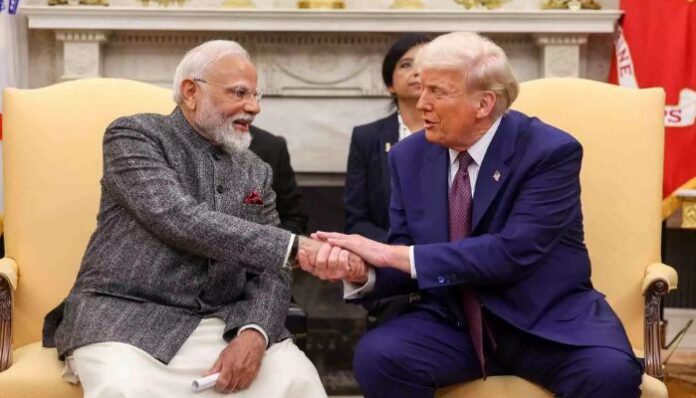
The United States and India on Saturday, 7th February, unveiled a new joint framework for an Interim Trade Agreement, calling it a major step toward a full Bilateral Trade Agreement (BTA). Both US President Donald Trump and Prime Minister Narendra Modi described the move as a big breakthrough that could open the door to deeper economic cooperation between the two countries.
Great news for India and USA!
— Narendra Modi (@narendramodi) February 7, 2026
We have agreed on a framework for an Interim Trade Agreement between our two great nations. I thank President Trump for his personal commitment to robust ties between our countries.
This framework reflects the growing depth, trust and dynamism of… https://t.co/zs1ZLzamhd
This comes just days after the two leaders announced that they had reached a trade understanding that would “unlock immense opportunities for mutually beneficial cooperation.” The interim framework is expected to act as the base for a much larger and more detailed trade deal in the coming months.
Trump announces tariff cut
On Monday, US President Trump said he plans to reduce tariffs on Indian goods to 18%, down from 25%. Earlier, Indian exports were facing even steeper duties, with a 50% tariff imposed last year after India continued buying Russian oil. Trump said the new decision followed Prime Minister Modi’s agreement to stop purchasing Russian oil.
In another Executive Order issued on the same day, Trump slashed the 25% ‘penalty’ tariff imposed on Indian goods for the purchase of Russian oil.
Prime Minister Modi responded positively, saying he looks forward to working closely with the US. He said that when two large economies and the world’s biggest democracies work together, it benefits both nations. Modi also praised Trump’s leadership, saying it is important for global peace and stability, and added that India fully supports efforts toward peace.
What the Interim deal includes
The White House released a joint India-US statement, outlining a 12-point framework. According to the statement, this interim deal will serve as a historic milestone and lay the foundation for a bigger trade agreement expected to be signed by mid-March.
Under the framework, India will remove or reduce tariffs on all US industrial goods and a wide range of agricultural products. These include items like dried distillers’ grains (DDGs), red sorghum used for animal feed, tree nuts, fruits, soybean oil, wine and spirits.
In return, the US will lower its tariff rate to 18% on Indian exports. It will also remove tariffs completely on some products such as generic medicines, gems and diamonds, and aircraft parts, once the agreement is finalised.
The two sides have also agreed to work on clearer rules of origin, better regulatory cooperation, anf smoother market access as talks continue on the full bilateral trade agreement.
Big gains for Indian exporters
Union Commerce and Industry Minister Piyush Goyal, who played a key role in the negotiations, called the agreement a landmark deal. He said it would give Indian businesses access to a $30 trillion US market. According to him, sectors such as textiles, leather, footwear, chemicals, machinery, and handicrafts are likely to benefit the most.
Under the decisive leadership of PM @NarendraModi ji, India has reached a framework for an Interim Agreement with the US. This will open a $30 trillion market for Indian exporters, especially MSMEs, farmers and fishermen. The increase in exports will create lakhs of new job… pic.twitter.com/xYSjxML6kt
— Piyush Goyal (@PiyushGoyal) February 7, 2026
Goyal added that MSMEs, farmers, fishermen, women entrepreneurs, and young business owners would gain from the deal. He also said the expected rise in exports could create lakhs of new jobs across the country.
At the same time, the government has protected sensitive agricultural sectors. There will be no concessions on key products such as maize, wheat, rice, soya, poultry, dairy products, ethanol, tobacco, and certain vegetables. Officials say this step is meant to protect rural livelihoods and prevent sudden import shocks for farmers.
The interests of our farmers remain paramount in all trade negotiations. The Modi Government remains fully committed to protecting our Annadatas and securing rural livelihoods.
— Piyush Goyal (@PiyushGoyal) February 7, 2026
No concessions have been extended to sensitive agricultural sector produce in grains, fruits,… pic.twitter.com/6QiohiyKL5
India won’t allow US-produced potatoes, peas, beans, other leguminous vegetables (peeled or unpeeled), frozen mixtures of vegetables, dried vegetables like onions, Agaricus mushrooms, and fruits like oranges, mandarins,citrus hybrids and berries, to safeguard the interests of Indian farmers.
India’s commitments
India has also made several commitments under the framework. Apart from reducing tariffs on US goods, it has agreed to address non-tariff barriers, especially in areas like medical devices, ICT products, and agriculture. The government will review standards and testing rules within six months.
New Delhi has also expressed an intent to buy $500 billion worth of US energy, aircraft, precious metals, technology products, and coking coal over five years. Trade in GPUs and data-centre equipment is also expected to increase.
The agreement comes after a difficult phase in trade ties. In August last year, the US imposed heavy tariffs on India over its purchase of Russian oil, hitting Indian exporters hard. With this new framework in place, both countries are expected to “promptly implement” the agreement and move toward signing the final deal by mid-March.
