

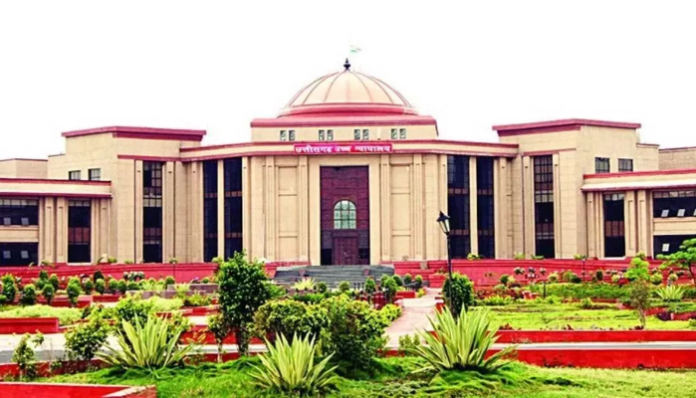
On 2nd February (Monday), the Chhattisgarh High Court has issued a significant verdict regarding the distribution of property among Muslims and emphasised that no member of the community is permitted to bequeath more than one-third of their assets to any person via a will without obtaining the consent of their legal heirs. A single-judge bench of Justice Bibhu Datta Guru declared that protecting the rights of heirs is a core tenet of the Islamic law.
He overturned the rulings of the lower courts in a matter from the Korba district, outlining that they had neglected to safeguard a widow’s legitimate statutory rights. The court remarked that under the provisions of Sections 117 and 118 of Mohammedan law, a Muslim individual is allowed to bequeath merely one-third of their property through a will. It further mentioned that allocating a larger share or creating a will in favour of a legal heir requires the clear and independent consent of the other heirs after the death of the testator.
“Once the respondent relied upon a will bequeathing the entire property, the onus squarely lay upon him to establish compliance with Sections 117 and 118 of Mahomedan Law,” the judge mentioned.
Background of the matter
This case pertains to 64-year-old Jaibun Nisha who resides in Korba and is the widow of Abdul Sattar Lodhiya who passed away on 19th May 2004 after which a conflict emerged concerning his house and land. Nisha’s name was documented in the revenue records alongside their nephew, Mohammad Sikandar who submitted a will dated 27th April 2004 alleging that he was the deceased’s “adopted son” and the entire property was left to him.
However, she complained that the will was forged and produced without her approval. Nevertheless, the lower courts rejected the argument in 2015 and 2016, prompting her to approach the high court.
The high court’s decision
The judge remarked that the lower courts had “committed a serious error” by imposing the burden of proof on Nisha while it was the duty of Sikandar to establish that she had given her voluntary consent after the death of her husband.
“A bequest to an heir is not valid except to the extent to which the persons who are the heirs of the testator at the time of his death, expressly or impliedly consent to the bequest after his death. It is evident from the abovesaid section of Mohammedan Law that while it permits the making of a will to a limited extent in favour of stranger or strangers, it does not allow undue preference being given to a particular heir or heirs and be quest to such heir or heirs without the consent of other heirs. It is also evident from the abovesaid provision of law that bequest to an heir or heirs without the consent of other heirs will be altogether invalid,” he noted.
The court also pointed out that mere silence or a delay in filing a lawsuit cannot be interpreted as consent. It pronounced that Sikandar could not claim more than one-third of the property even if the will were valid.
“Importantly, none of the witnesses examined on behalf of the respondent categorically proved that the appellant gave express consent after the death of the testator for bequeathing more than one-third of the estate. The statements of the witnesses only indicate handing over of the document, which cannot be equated with legal consent as contemplated under Mahomedan Law,” the judge highlighted.
