

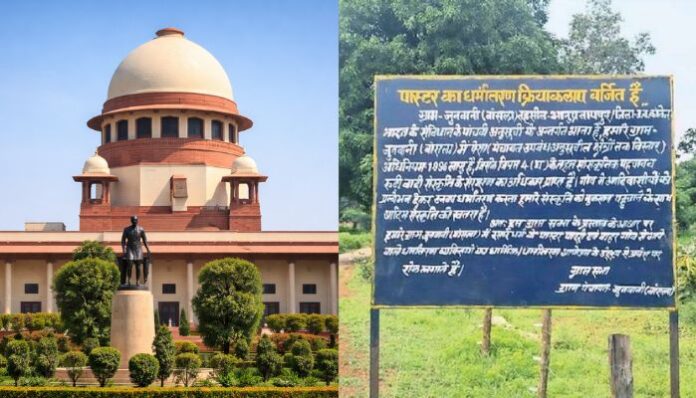
On 16th February, the Supreme Court of India dismissed a plea challenging restrictions imposed in certain tribal villages in Chhattisgarh on the entry of Christian missionaries and pastors. The case arose from resolutions passed by Gram Sabhas and hoardings put up in Scheduled Areas cautioning against religious conversion activities.
The judgment was pronounced by a bench of Justice Vikram Nath and Justice Sandeep Mehta. The Court declined to interfere with the Chhattisgarh High Court’s order, which had made detailed observations about conversions carried out through inducement and manipulation, and their impact on social harmony and tribal cultural identity.
What happened in the Supreme Court
Senior Advocate Colin Gonsalves appeared for the petitioner, Digbal Tandi. He argued that the High Court had made sweeping and adverse remarks on Christian missionary activities without any supporting material on record. He claimed that the issue before the High Court was limited and that its commentary on conversions went beyond the scope of the petition.
Gonsalves claimed that there is a case pending before the Supreme Court dealing with over 700 “attacks” on pastors during prayer meetings. He also pointed to instances where tribals converted to Christianity were allegedly denied burial rights in their villages. He referred to another matter listed before the Court and claimed that bodies of converted tribals buried in villages were being exhumed. He further argued that there had not been a single conviction under the State’s conversion law in the past ten years.
He argued, “You can’t stop me from doing my Sunday prayer meeting. And the High Court says it’s not unconstitutional,” and asserted that the High Court’s remarks would have wider consequences.
Solicitor General Tushar Mehta appeared for the State of Chhattisgarh. He countered that several assertions being raised before the Supreme Court were not part of the original pleadings before the High Court. He emphasised that the matter before the High Court was confined to the removal of hoardings and that the petitioners had been directed to approach the concerned Gram Sabhas.
SG Tushar Mehta: the petition before the high court was limited. Now there are several new facts, documents and dimensions.
— Bar and Bench (@barandbench) February 16, 2026
Sr. Adv. Colin Gonsalves (for petitioner): in Chhattisgarh there is a custom. First case was 700 attacks on Pastors during prayer meetings. That is…
The Supreme Court agreed with the State’s position and observed that the writ petition before the High Court was limited in scope. The bench noted, “Mr Gonsalves, please see the writ petition before the High Court and the relief claimed. You have been asked to go to the Gram Sabha.” The Supreme Court dismissed the petition, effectively upholding the High Court’s reasoning and observations.
Court: please see the writ petition before the high court and the relief claimed. You have been asked to go the gram Sabha.
— Bar and Bench (@barandbench) February 16, 2026
Gonsalves: the high court has given a long statement about how Christians are doing this and that without any material. You can’t stop me from doing my…
Background of the case
The matter traces back to resolutions passed by Gram Sabhas in eight tribal villages in Kanker district, including Kudal, Parvi, Junwani, Ghota, Ghotiya, Habechur, Musurputta and Sulagi. Villagers placed hoardings stating that the entry of pastors and priests was prohibited under the Panchayat Extension to Scheduled Areas Act.
A writ petition was filed before the Chhattisgarh High Court by Digbal Tandi, in which he claimed that the resolutions and hoardings effectively banned Christian pastors and converted tribals from entering the villages. He claimed that this violated Articles 14, 19(1)(d) and 25 of the Constitution. The petitioner also claimed that Christian tribals were being denied burial rights, subjected to social boycott and forced displacement, and that communal tensions were being fuelled.
A bench of Chief Justice Ramesh Sinha and Justice Bibhu Datta Guru refused to prohibit the tribals from erecting the hoardings. The High Court held that installing banners cautioning against illegal or forcible conversions could not per se be termed unconstitutional.
In a strongly worded judgment, the High Court observed that religious conversion has long been a sensitive issue in India’s socio-political landscape. While the Constitution guarantees the freedom to profess, practice and propagate religion, the Court cautioned that misuse of this liberty through coercion, inducement or deception is a matter of grave concern.
The High Court noted that missionary activity in India dates back to the colonial period, initially focusing on social upliftment, literacy and healthcare. However, it observed that over time, some missionary groups began using such platforms as avenues for proselytisation among economically and socially deprived sections, especially Scheduled Tribes and Scheduled Castes.
According to the High Court, when conversion ceases to be a matter of personal faith and becomes a result of inducement or exploitation of vulnerability, it amounts to cultural coercion. The Court remarked that such practices have led to polarisation within tribal communities, social boycotts and, at times, violent clashes.
Importantly, the High Court clarified that Article 25 is not an absolute right and is subject to public order, morality and health. This means that conversions by inducement are not merely a religious concern but a social menace that threatens the cultural continuity of indigenous communities.
The High Court rejected the petitioner’s allegations of discrimination and stated that it found no material to show that the circular or the hoardings authorised discrimination against Christians. It held that the hoardings only prohibited the entry of certain pastors if they intended to organise conversion activities.
The High Court also pointed out that the petitioner had not exhausted alternate statutory remedies before approaching the Court and directed him to first seek redress before the concerned Gram Sabhas.
