

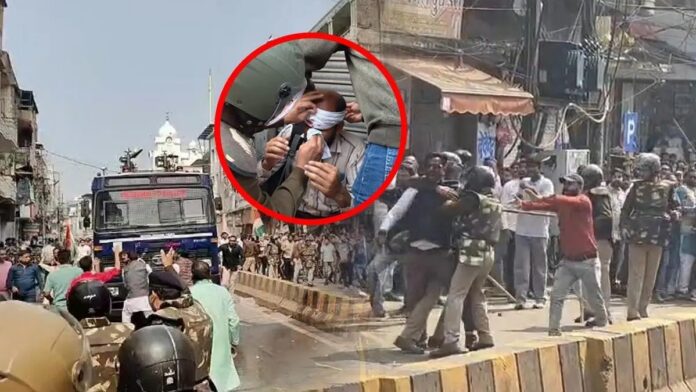
A day after the Congress’s controversial “shirtless protest” at the AI Summit in Delhi sparked nationwide outrage, the Indian Youth Congress escalated its agitation with coordinated demonstrations in the national capital and Chandigarh, while violent clashes broke out in Madhya Pradesh’s Indore between Congress and BJP youth wing workers.
The political storm intensified as posters depicting Mahatma Gandhi with the caption “Shirtless Congressi” appeared across parts of Delhi and near the Congress office, underlining how sharply the episode had polarised the political atmosphere. At the same time, the Bharatiya Janata Yuva Morcha (BJYM), the BJP’s youth wing, launched counter-protests in Uttar Pradesh and Delhi, accusing the Congress of disgracing the country on a global platform.
The unrest followed Friday’s dramatic incident at the AI Impact Summit, held at Bharat Mandapam in New Delhi, where shirtless Youth Congress workers barged into an exhibition hall and raised slogans against Prime Minister Narendra Modi and the US–India trade deal. The summit was attended by foreign dignitaries and top global tech executives, making the disruption particularly sensitive. The Congress claimed its protest was against a trade deal it alleges compromises farmers’ interests, but the spectacle drew sharp criticism from across the political spectrum.
On Saturday, police sent four of the accused to five-day custody, with investigators claiming the group was influenced by recent violent Gen Z protests in Nepal that had led to the fall of the KP Sharma Oli government.
Clashes in Chandigarh and Indore
Undeterred by the backlash, the Youth Congress resumed protests in Delhi and Chandigarh, once again raising the slogan “PM is compromised,” a charge earlier voiced by Rahul Gandhi in Parliament. In both cities, protesters briefly clashed with security personnel, forcing the police to use water cannons to disperse the crowd and restore order.
Meanwhile, nearly 1,000 kilometres away in Indore, tensions flared as Youth Congress workers came face to face with BJYM members who were holding a counter-protest. What began as sloganeering soon turned violent, with both sides pelting stones and engaging in scuffles. Additional police forces were rushed in to bring the situation under control.
The Youth Congress later alleged on X that BJP workers had attacked the Congress office in Indore under police protection and claimed that its district president, Vipin Wankhede, was injured in the violence.
BJYM steps up counter-protests
The BJP’s youth wing, for its part, intensified its campaign against the Congress’s “shirtless” stir. In Mumbai, BJYM workers showed black flags to Rahul Gandhi when he appeared before a court in connection with a 2014 defamation case. In Uttar Pradesh’s Firozabad, party workers burnt his effigy and raised slogans against the Leader of the Opposition.
Senior BJYM leader Satish Diwakar said the Youth Congress’s actions at the AI Summit had tarnished India’s image on the global stage. Similar protests were also held in Delhi near the Congress’s Akbar Road office.
Congress faces criticism beyond the BJP
The Congress did not just face attacks from the BJP and NDA leaders. Even opposition figures and allies distanced themselves from the protest. Samajwadi Party chief Akhilesh Yadav said any form of protest that humiliates India in front of foreign delegates and the international community should be avoided.
With demonstrations, counter-protests, and street clashes unfolding across multiple states, the fallout of the AI Summit disruption has now turned into a broader political confrontation, one that has put Congress on the defensive and reignited debate over the limits of protest, especially on global platforms meant to showcase India’s technological ambitions.
