

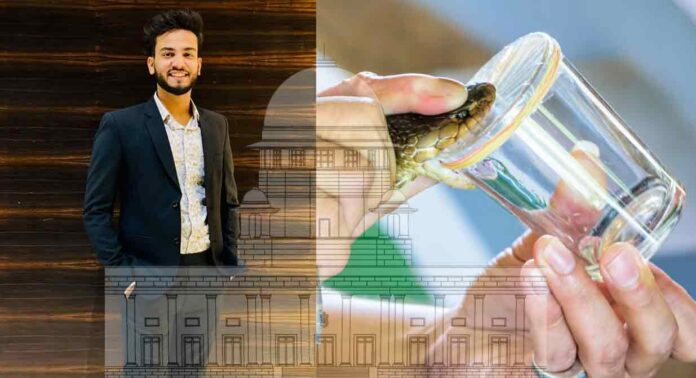
The Supreme Court of India has quashed criminal proceedings against YouTuber and influencer Elvish Yadav in a high-profile case involving allegations of snake venom use at rave parties.
In a ruling delivered on Thursday, 19 March 2026, a bench comprising Justices M M Sundresh and N Kotiswar Singh held that the case could not be sustained in law. The decision came on Yadav’s petition challenging proceedings under the Narcotic Drugs and Psychotropic Substances (NDPS) Act, 1985, and the Wildlife (Protection) Act, 1972.
The case originated from a 2023 incident in Noida, Uttar Pradesh, where police raided an event and recovered snake venom along with protected snakes from co-accused individuals. Authorities alleged that Yadav organised or facilitated “rave parties” where snake venom was used as a recreational drug by attendees of the parties including foreigners, and that snakes were misused in videos or events. Yadav was arrested in March 2024 but has consistently denied the allegations, claiming no substances were recovered from him and no direct involvement.
The Supreme Court focused on two key legal issues. First, regarding the NDPS Act, the bench ruled that snake venom does not qualify as a psychotropic substance under Section 2(23) of the Act, as it is not listed in the schedule of prohibited substances. The court observed: “Insofar as the issue pertaining to Section 2(23) of NDPS Act is concerned, admittedly what is recovered from the co-accused cannot come within the purview of psychotropic substances found in the schedule (of the Act).”
Even accepting the allegations of use at face value, the offence under the NDPS Act was deemed not made out.
Second, under the Wildlife (Protection) Act, the court held that cognisance of offences requires a complaint from an authorised officer, as mandated by Section 55. Since no such competent authority lodged the complaint, the proceedings were invalid. The bench stated: “We find that Section 55 of the Act requires a complaint by an authorised authority.”
The court quashed the FIR, chargesheet, and all subsequent proceedings, including the trial court’s cognisance order. However, it granted liberty to the competent authority to file a fresh, proper complaint under the Wildlife (Protection) Act if deemed appropriate, noting it had not examined the factual merits of the allegations.
The Allahabad High Court had previously declined to quash the case in May 2025, emphasising equality before the law regardless of fame. The Supreme Court’s intervention provides significant relief to Yadav, whose legal team argued the NDPS provisions were invoked to sensationalise the matter due to his public profile as a reality show participant and influencer.
