

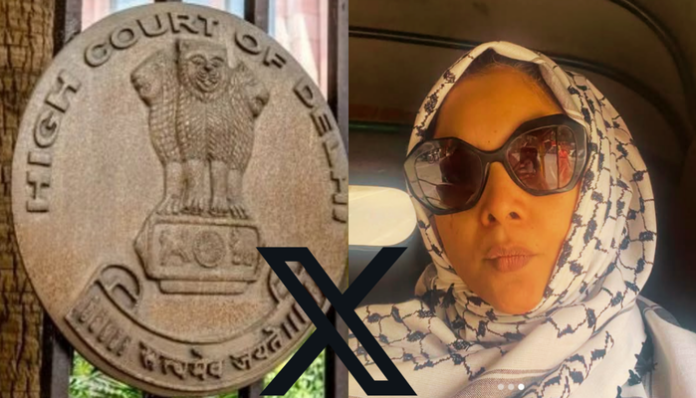
During the hearing of a petition relating to propagandist Rana Ayyub’s X posts demeaning Hindu deities, the central government told the Delhi High Court that X (formerly Twitter) is liable to lose its safe harbour protection in India as it failed to take down Ayyub’s offensive posts.
In a short note submitted before a Bench of Justice Purushaindra Kumar Kaurav, the central government said that the police issued notices to X in September 2025 and December 2025, urging it to remove Ayyub’s tweets. Subsequently, in January 2025, a trial court directed the registration of an FIR against Ayyub in connection with her posts.
The central government said that the notices and the trial court order, which constituted “actual knowledge” under the Information Technology (Intermediary Guidelines and Digital Media Ethics Code) Rules, 2021, conferred a statutory obligation on X to remove the posts. “It is apposite to note that such inaction amounts to non-compliance with the due diligence requirements provided for in the applicable Rules and facilitates continues commission of unlawful acts by its user i.e. Rana Ayyub (Respondent No. 04), and as a consequence thereof, the protection of safe harbor available to the intermediary available under Section 79(1) is liable to be withdrawn,” the centre said.
In the previous hearing of the petition, the High Court termed Ayyub’s posts as “highly derogatory, inflammatory and communal”, and issued notices to Rana Ayyub, Delhi Police and X seeking their responses. In its reply submitted before the court, X said that the petition did not lie against it and that it should be directed towards Ayyub, as she posted the offensive remarks. It further said that the petition is not maintainable against it because it neither falls within the definition of ‘State’ nor does it perform a public function under Article 12 of the Constitution to be subjected to the writ jurisdiction of the High Court under Article 226.
It added that the High Court, in the exercise of its writ jurisdiction, should not adjudicate on the legality of the posts, as such an adjudication was possible if the petitioner had filed a civil suit seeking the posts to be declared as unlawful. Furthermore, X urged the High Court to direct the central government and the Delhi Police to issue a blocking order against Ayyub’s posts under Section 69A of the IT Act and the 2009 Blocking Rules. Notably, Section 69A allows the Central government to block public access to online information in the interest of the sovereignty and integrity of India, national security or defence, public order, maintaining friendly relations with foreign states, or for preventing the incitement of offences.
Pertinently, the central government apprised the court that the Delhi Police had submitted a request to the Ministry of Electronics and Information Technology on 9th April, which is under consideration and will be processed under the IT Blocking Rules, 2009, by the Designated Officer.
“It is submitted that the Union of India, under the Information Technology (Procedure and Safeguards for Blocking for Access of Information by Public) Rules, 2009, has already initiated the proceedings in accordance with law. It is further submitted that the Designated Officer appointed under Rule 03, upon being satisfied that the circumstances warrant the invocation of emergency powers under Rule 09, shall take an appropriate decision which shall be placed before this Hon’ble Court,” the Centre informed the High Court.
After the hearing of the submissions, the High Court granted two weeks to Ayyub to file a reply. It directed the Delhi Police to give effect to the Court’s interim orders to transmit the necessary documents to X. The next hearing of the petition is scheduled on 19th May.
