

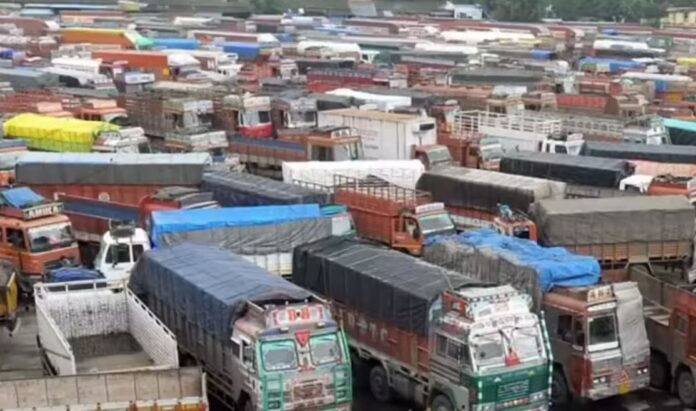
In a significant move to tackle the persistent air pollution crisis in the National Capital Region, the Union Cabinet, chaired by Prime Minister Narendra Modi, on 3rd June approved a comprehensive two-year scheme for the replacement of old trucks and buses in Delhi-NCR.
The scheme, which carries a total financial outlay of ₹9,585 crore, will be funded through the National Capital Region Planning Board (NCRPB) under the Ministry of Housing and Urban Affairs. It will be implemented in collaboration with the Ministries of Road Transport and Highways, and Petroleum and Natural Gas, along with the states of Delhi, Haryana, Rajasthan, and Uttar Pradesh.
Under the initiative, owners of trucks and buses registered in the Delhi-NCR region that comply with BS-IV or earlier emission norms will be incentivised to scrap or replace their old vehicles with cleaner BS-VI or stricter emission-compliant vehicles, or electric vehicles (EVs). The Central Government will contribute ₹5,041 crore, while the participating states are expected to provide tax concessions worth around ₹1,601 crore.
According to a 2018 report by Automotive Research Association of India (ARAI) and The Energy and Resources Institute (TERI), the transport sector accounts for a substantial share of pollution in Delhi-NCR, with trucks and buses, despite constituting only 3 per cent of the total vehicle fleet, contributing 36 per cent of PM 2.5 emissions from the transport sector. A single pre-BS heavy-duty vehicle is estimated to emit pollutants equivalent to 14 BS-VI vehicles, highlighting the urgent need for fleet modernisation. Even a BS-IV vehicle emits 2.7 times more than a BS-VI vehicle. Hence, the newer fleet is expected to reduce the vehicular pollution substantially.
The scheme is expected to benefit approximately 2.07 lakh vehicle owners, including 1.91 lakh truck owners and 16,329 bus owners across Delhi, Haryana, Rajasthan, and Uttar Pradesh.
For BS‑III or older vehicles, scrapping at Registered Vehicle Scrapping Facilities is mandatory, while BS-IV vehicles can be scrapped or sold outside the NCR. After scrapping/selling the old vehicles, the owners purchase and register a BS‑VI or stricter norms compliant or electric vehicle within NCR.
However, In Delhi, light goods vehicles purchased under the scheme must be electric, and buses must run on BS-VI CNG or be electric. Government vehicles are excluded from the scheme.
Central incentives include 5 per cent interest subvention on loans for five years, monthly fuel vouchers up to ₹4,800, and additional support for EV purchases. States will provide full waiver of registration fees, up to 100 per cent motor vehicle tax exemption for new vehicles and 50 per cent for used ones for 10 years, along with waiver of pending liabilities on old vehicles. Auto manufacturers will offer an 8 per cent discount on ex-showroom prices.
The entire process will be conducted through a fully digital integrated portal for transparency and ease of implementation. Benefits from the Central Government will continue for five years from the registration of the new vehicle, ensuring long-term impact.
An Empowered Committee headed by the Cabinet Secretary, with senior officials and Chief Secretaries of the concerned states as members, will monitor the scheme. District Collectors and Magistrates will oversee implementation at the ground level.
By accelerating the transition to cleaner transport technologies, the scheme is expected to significantly reduce vehicular emissions across the Delhi-NCR region. This initiative is being seen as a major step towards improving air quality in Delhi-NCR, especially during the winter months when pollution levels typically spike, and is expected to accelerate the shift to cleaner mobility in the region.
