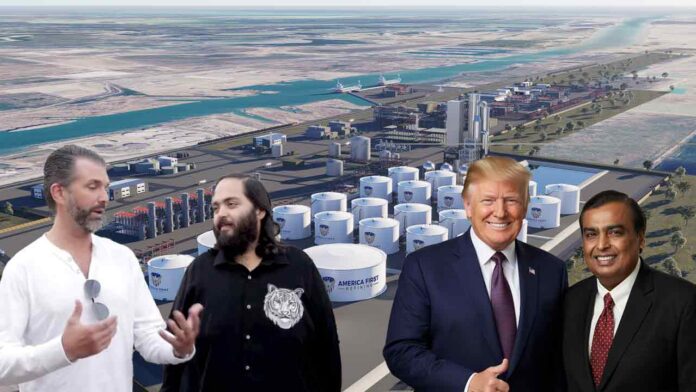
Western media has, for the record, looked at India’s energy security manoeuvres through a distorted lens of political lobbying and backroom transactions. An investigative report by US-based ProPublica, published on 9th June 2026, delved into the timeline of business dealings involving Indian businessman Mukesh Ambani’s Reliance Industries, a Texas-based America First Refining (AFR), and Donald Trump Jr.
The report suggests that there may be potential conflicts of interest in the Trump family’s dealings, and that the Ambani investment in AFR resulted from favourable policy developments for Reliance.
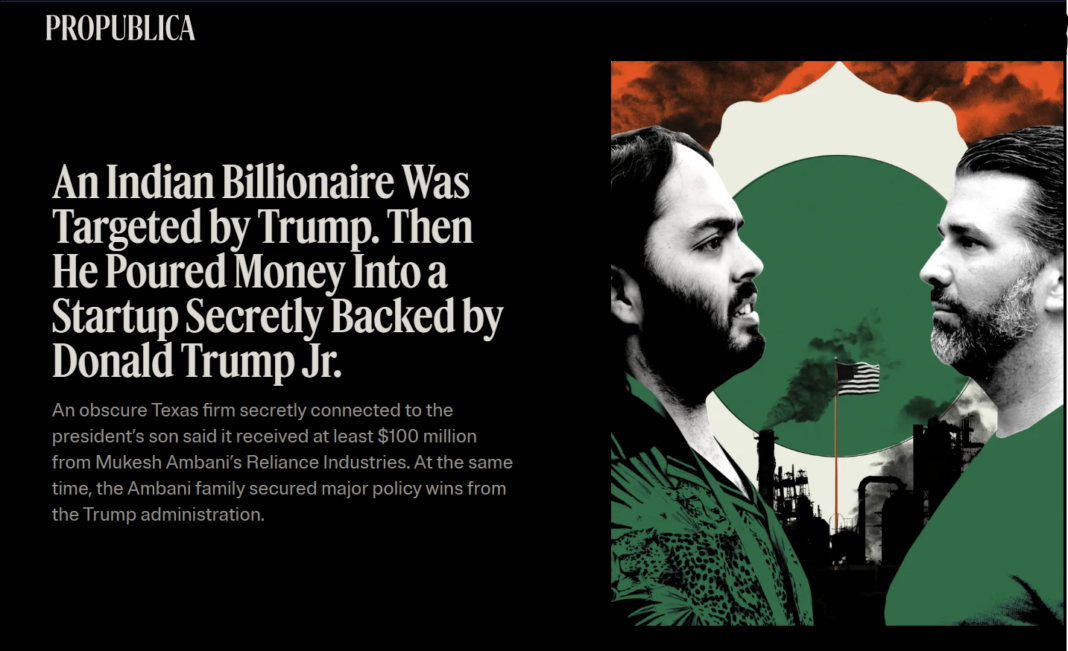
Donald Trump Jr’s secret stake in AFR, US tariff war impact on Reliance, Don-Anant Ambani meet, and political ‘favouritism’: The timeline and what the ProPublica report claims
It all began in August 2025. Donald Trump was upset with India for not giving fake credit for ending the India-Pakistan conflict in May. Trump was also frustrated with his failure to even secure a ceasefire between Russia and Ukraine, despite promises of ending the war within 24 hours of assuming office as US President. These factors, coupled with his desire to arm-twist countries into signing pro-US trade deals, led Donald Trump to find a special target in India.
The Trump administration first imposed ‘reciprocal’ tariffs and doubled tariffs on India to 50%. The additional 25% was a ‘penalty’ for buying Russian oil. Trump unleashed his officials to launch rhetorical attacks on India and Indian refiners and portray New Delhi as the financier of Russia’s war against Ukraine.
India was villainised by the Trump administration as a country fuelling Russian President Vladimir Putin’s “war machine” even as China remained the largest importer of Russian oil, and America itself continued to buy non-essentials from Russia.
On 19th August, the United States Treasury Secretary Scott Bessent accused the wealthiest families in India of profiting from the significant rise in Russian oil purchases during the Ukraine conflict. He even stated that it was “unacceptable” to Washington.
“If you go back and look now, I believe India had less than 1% of their oil. And now I believe it’s up to 42%. So, India is just profiteering. They are reselling. They made $16 billion in excess profits. Some of the richest families in India. So, this is a completely different thing. What I would call the Indian arbitrage, buying cheap Russian oil, reselling it as a product, has just sprung up during the war, which is unacceptable. We have planned to up the tariffs on India, these are secondary tariffs for buying the sanctioned Russian oil,” Bessent said in an interview.
Peter Navarro, the White House’s trade adviser, even wrote an article in the Financial Times, blaming “India’s oil lobby” for buying Russian oil. In a separate rant, Navarro went on to claim that Brahmins are benefiting at the cost of the Indian citizens.
Similar statements came from Marco Rubio, Howard Lutnick and other Trump administration officials. Earlier, Donald Trump himself had thrown a divorced-from-reality, “dead economy” jibe against India on his online echo chamber, Truth Social.
As the Modi government refused to open up India’s dairy sector for American exports, Trump’s officials intensified their anti-India rhetoric.
Being India’s biggest oil importer and refiner, Reliance Industries Limited (RIL) was directly impacted by Trump’s tariff war. RIL was navigating its way through the quagmire of tariffs, political attacks, and constant villainization. By November 2025, however, things began to change, as Donald Trump Jr., son of President Trump, visited Jamnagar in India’s Gujarat state. Trump Jr. met Mukesh Ambani’s son Anant Ambani, toured the animal shelter Vantara run by Reliance Foundation, and attended cultural events. The talks between Ambani and Trump scions yielded positive results.
As India-US trade deal talks advanced, things began to ease between the two countries, although a trust deficit persisted. By February 2026, the US lowered its effective tariff rates on most Indian goods to 18% and removed the 25% Russian-oil penalty, issued Reliance a general license to buy Venezuelan crude directly, and also announced a sanctions ‘waiver’ for Russian oil purchases. The Modi government, however, made it clear that New Delhi will continue buying Russian oil regardless of whether America allows India to do so or not.
As America launched a war against Iran in February this year, and an energy crisis followed the blockade of the Strait of Hormuz, the Trump administration ‘allowed’ India to buy Russian oil to ensure global supplies and control price spikes. Ironically, the US ‘punished’ India with a 25% tariff earlier, for buying Russian oil earlier for the same reasons.
Geopolitical developments, America’s policy shift, and Reliance’s manoeuvrability brought the Ambanis and the Trumps closer. In March 2026, Donald Trump announced that a new oil refinery in Brownsville, Texas, would be part of a “historic $300 billion deal”. He called it the largest energy deal in US history.
In his post on the social media platform Truth Social, Trump said India’s Reliance Industries was involved in the project. He credited his administration’s “America First energy agenda” for attracting the investment. The announcement described the refinery as a major economic project that would boost American energy production, create thousands of jobs, strengthen national security and power global exports.
Trump boasted of the investment commitment as an outcome of his government’s policies focused on domestic production and streamlined regulatory approvals.
As reported earlier, AFR announced in March this year that it is planning the refinery at the Port of Brownsville in Texas, which is close to the US-Mexico border. The facility is expected to produce around 1,68,000 barrels of crude oil per day. It is designed specifically to refine light shale oil produced in the United States.
While Trump’s ‘Ambani pouring in $300 billion into AFR’ framing surprised many, Reliance has made a “nine-figure investment”, which means the investment likely ranges between $100 million and $999 million. The $300 billion figure refers to a projected long-term economic impact calculated over many years, not investment by Reliance.
Essentially, Reliance will be a long-term buyer and commercial partner, rather than the primary investor funding the construction of the refinery.
Citing Trump Jr.’s personal lawyer, ProPublica’s report claimed that the process of the transformation of Element Fuels into America First Refining LLC began the very next week after Anant Ambani and Trump Jr. met in Gujarat. The ProPublica report further claims that Trump Jr secretly bought a stake in AFR and that the Trump family is allowing foreign investors to funnel money into the American President’s personal pockets in exchange for US government favours.
“America First Refining’s unexpected breakthrough came after it forged a previously unreported relationship with Trump Jr., who secretly acquired a stake in the startup, according to records and seven people familiar with the company. The new details reveal the role the president’s son has played in a theme of Trump’s second term: overseas investors with interests before the administration putting money into the Trump family’s business interests,” the report reads.
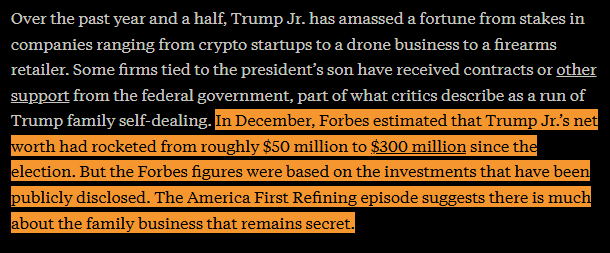
The report further highlights how Trump Jr’s net worth has skyrocketed from $50 million to $300 million since his father returned to White House in January 2025.
“Over the past year and a half, Trump Jr. has amassed a fortune from stakes in companies ranging from crypto startups to a drone business to a firearms retailer. Some firms tied to the president’s son have received contracts or other support from the federal government, part of what critics describe as a run of Trump family self-dealing,” the report reads.
ProPublica, however, stated that it has no confirmed information on the size of Trump Jr’s stake in America First Refining. He has, however, publicly appeared in meetings and events linked to AFR.
Citing a report by Bloomberg, which has a reputation for getting frequently fact-checked by the Indian government, ProPublica claimed, “The Ambanis’ investment coincided with the family’s securing major U.S. policy wins that their company, Reliance Industries, had been lobbying for.”
It further mentions that the Ambani-owned Reliance paid $10 million to the Trump Organisation in 2024 as a “development fee” for a project in Mumbai; however, no project has been announced.
The White House has denied any conflicts of interest, while Reliance has also pushed back against the quid-pro-quo narrative and maintained that it did not receive “any unique or preferential treatment” from the U.S. government. The company stated that the investment into America First Refining was evaluated and approved strictly on “commercial merits, strategic fit, and long-term value creation potential.”
“There is no connection between Reliance’s investment in AFR and any unique measures associated with general U.S. trade, tariff, sanctions or licensing outcomes. Reliance’s investment rationale was commercial. The U.S. policy decisions were broad governmental actions affecting multiple countries, industries and market participants,” the RIL stated.
Although ProPublica fairly attempted to present the side of all stakeholders in the matter, it framed the financial dealings of Reliance as bribery or a quid pro quo arrangement.
However, from India’s perspective, Reliance’s manoeuvres appear less political influence-peddling and more strategic hedging. The Indian company has mastered the art of structured opportunism in one of the world’s riskiest industries.
From Jamnagar for the world: Inside the refining mastery of Reliance
Reliance runs the world’s largest and most complex single-site refinery complex in Gujarat’s Jamnagar. The refinery has a 1.4 million barrels per day (MMBPD) capacity. It has a Nelson Complexity Index of 21.1, the global highest.
While simple “sweet” crude refineries struggle with volatility, RIL’s Jamnagar refinery was purpose-built from the late 1990s to process what are described as opportunity crudes. These include heavy, sour, acidic, high-sulphur feedstocks, mainly the Venezuelan, Iranian, Mexican Maya crude, and Middle Eastern sour.
Reliance’s Jamnagar refinery processes these crudes while several major global refiners avoid them due to processing complexities and environmental costs. It handles over 216 different crude grades. The deep-conversion configuration involving cokers, fluid catalytic crackers, alkylation, etc, and full petrochemical integration allows RIL to transform low-cost ‘bottom-of-the-barrel’ barrels into petrochemicals, premium Euro-VI fuels, and a wide range of high-value products.
It, however, is true that geopolitical disruptions have benefited Reliance. The RIL’s margins soared as discounted feedstock was abundant during geopolitical upheavals. However, Reliance has, through its engineering and scale, reached that level where it could significantly benefit from such volatile situations, while competitors look on in awe and envy.
While the detractors of the Ambanis in India framed RIL’s Trump-announced investment in the Texas project as some sort of ‘donation’ to the US, Reliance is diversifying its footprint and securing long-term supply chains, which is not only a lucrative strategy for the company but also benefits India.
Reliance has long positioned itself wherever it finds an opportunity to secure long-term refining gains. It must not be forgotten that the global refining business is not a conventional manufacturing sector; it is an industry defined by geopolitical disruptions, sanctions, wars, trade disputes, and commodity volatility, in addition to the technical complexities.
Refiners often make multi-billion-dollar bets on assets whose profitability can change overnight due to sanctions, wars, environmental regulations, and alterations in crude supply patterns. Understanding the uncertainties, Reliance plays smart and depends less on predicting the future or anticipating favourable geopolitical situations, and more on building diverse options across multiple geopolitical scenarios.
The Ambanis have adopted an approach of not exclusively aligning with one geopolitical bloc. RIL follows the strategy that can be best described as structured opportunism. The company systematically exploits market dislocations, though not without staying within legal and regulatory frameworks.
Interestingly, Reliance’s approach aligns with the Modi government’s foreign policy approach. India proudly exercises its strategic autonomy and maintains friendly transactional relationships across competing power centres. India is arguably the only country that has good relations with Russia, the US, China, Ukraine, Iran, Israel, Palestine, EU nations and other countries that are either engaged in conventional wars or economic rivalry.
Having a refinery capable of converting discounted feedstock into high-value fuels, Reliance has enjoyed a structural advantage that allowed it not only to make big money during the geopolitical disruptions in the last few years but also to ensure global energy supplies.
It was seen how Reliance, and by extension India, kept the oil flowing globally after the outbreak of the Russia-Ukraine War in 2022. While many Western purchasers exited Russian crude markets due to sanctions, India increased purchases of discounted Russian crude dramatically. Reliance emerged as one of the largest buyers. Leveraging its refining capabilities, the RIL processed the discounted barrels of Russian crude into profitability.
Many in Europe and the US hypocritically criticised India for bolstering oil trade with Russia and accused New Delhi of ‘profiteering’ from the Russia-Ukraine war. However, the Modi government maintained that it will not step back from its responsibility of ensuring an uninterrupted and affordable energy supply for 1.4 billion Indians.
With lowered import costs of Russian crude due to discounts and improved refining margins, India protected itself from the worst inflationary effects of the global energy shock.
On many occasions, Indian External Affairs Minister S Jaishankar strongly contended that Indian purchases of Russian oil helped moderate global energy prices by keeping supplies flowing into international markets. Had India not stepped up, the global energy crisis would’ve taken a catastrophic turn.
Recently, MEA Jaishankar said that if Indian refiners suddenly stopped buying and processing ‘controversial’ crudes, the global market would grapple with an immediate supply crunch, sending oil prices skyrocketing past $150 per barrel, and triggering global inflation.
From villainising to appreciating, the US changed tunes recently, with US Ambassador to India, Sergio Gor, hailing India’s anchor role in global oil price stability amid the Russian-Ukrainian conflict and the Iran war.
India was not simply acting as a consumer; it became a significant balancing force in a turbulent global oil system, with Reliance on the centre stage.
Reliance has also navigated its way to Venezuelan crude exports. While the legal and moral aspects of America’s act of kidnapping Venezuelan President Nicholas Maduro are debatable, Washington’s subsequent policy changes allowed greater Venezuelan crude exports. Indian refiners, especially Reliance, emerged as one of the top companies best positioned to utilise Venezuelan crude supplies.
Venezuelan crude is heavy, but the Ambanis have the Jamnagar RIL refinery. Russia, Venezuela, West Asia or elsewhere, Reliance weaponised its competitive advantage to earn profits, ensure global energy supplies, while also contributing to fulfilling domestic requirements in India.
Although Reliance has not given explicit confirmation on the scale of President Trump’s $300 billion investment, RIL’s interest in US refining ventures is a continuation of its business strategy of investing where the company sees strategic value, secures access to feedstock and markets, scales significantly, and exploits refining complexities.
The contemporary decade has been an era of wars and geopolitical uncertainties, and things are expected to stay either the same or get worse in the coming years. This is a world where Russian crude may become available in one year, Venezuelan crude in another, Gulf supplies get disrupted, and US shale production may open up a new door to refining opportunities. The RIL is among those few companies that can navigate all of these environments to survive, profit globally, and contribute to energy security domestically.
India imports the majority of its crude oil requirements, and thus, having access to diverse and affordable markets is essential. Indian refiners, particularly Reliance, have enabled India to source oil from multiple regions, refine it efficiently, and export finished products globally. From the Russia-Ukraine war to the prevailing instability in West Asia, the RIL has proven its mettle.
As India faced challenges to fulfil domestic LPG needs, Reliance announced plans to maximise production of LPG at its Jamnagar refinery and divert natural gas from its KG-D6 block in the Bay of Bengal to “priority sectors”.
It would be an exaggeration to claim that India alone kept global oil prices steady, but India’s refiners undeniably played a stabilising role, benefiting India and energy-importing countries.
Compared to neighbouring countries and G20 peers, India managed to keep domestic fuel prices steadier, credit to buffers, dynamic foreign policy, and Reliance’s scaling superpower, turning geopolitical minefields into opportunities.
In the last few months, Reliance faced US criticism, braved the impacts of US tariffs, phased down imports, secured waivers, and resumed selectively via non-sanctioned routes and yet remained highly profitable. After Russian oil, Reliance has secured Venezuelan crude supplies as well for India. Amidst global uncertainties and conflict-driven disruptions, the Indian government and refiners are doing whatever it takes to keep the oil flowing.