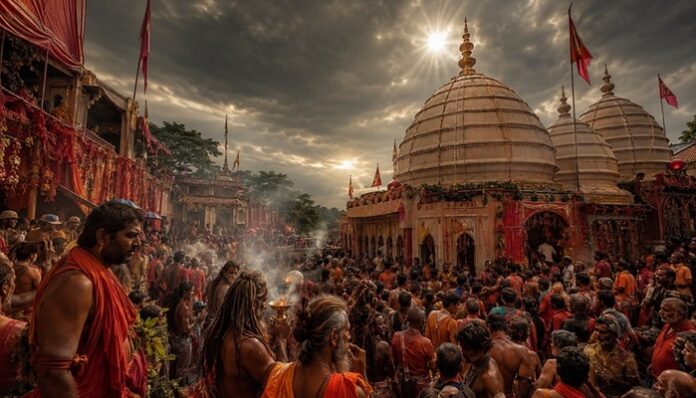
India’s religious traditions are not limited to worship or faith, but also embody a profound philosophy of nature, life, feminine power, and creation. Many of the festivals celebrated in the country underscore the relationship between humans and nature. One such festival is the Ambubachi Mela, held annually at the Maa Kamakhya Temple in Guwahati, Assam.
Ambubachi Mela stands because of the rituals and religious beliefs associated with it. It is said that the festival marks the menstruation phase of Goddess Kamakhya. This is her annual menstruation phase during which the doors of the Khamakhya Temple are closed for a few days.
The festival is said to be the largest religious gathering in Northeast India, attracting millions of devotees, saints, tantric practitioners, and tourists from India and abroad. During this time, the entire region becomes a centre of devotion, meditation, mystery, and spiritual energy.
What is Ambubachi Mela, what does it represent?
The Ambubachi Mela is an annual religious event associated with the worship of Shakti, the feminine energy. During the festival, Goddess Kamakhya is given a break and usual worship at the temple is suspended.
The tradition is considered a symbol of respect for the female body and the process of creation. While different cultures view the menstrual cycle differently, this tradition honours it as a source of creative power and life. The word Ambubachi is also associated with water, fertility, and creation.
This is the reason that this festival holds not only religious but also cultural and philosophical significance. This time is also considered extremely important for those involved in Tantra Sadhana. It is believed that this period holds special significance for spiritual practice and mantra siddhis, which is why a large number of practitioners arrive here.
Ambubachi Mela 2026: When will it start, and what will be the schedule?
This year, the Ambubachi Mela will begin on 22nd June at night. The doors of the temple’s sanctum sanctorum will be closed at approximately 9:08 pm on that day. The sanctum sanctorum will then remain completely closed for the next three days, 23rd June, 24th June, and 25th June. During this time, no devotees will be permitted to have a direct darshan of the goddess.
Usual religious activities are also restricted within the temple complex. The four-day event will conclude on the morning of 26th June with special rituals and purification ceremonies. After this, Darshan will be reopened for devotees. The annual visitor count during this period is in the millions.
In past years, the administration and temple committee made special arrangements for the large number of devotees arriving. This time too, extensive preparations are underway for security, sanitation, drinking water, medical care, and the movement of devotees.
Pravritti and Nivritti: The Two Spiritual Stages of the Mela
The entire Ambubachi Mela process is completed in two major phases: Pravritti and Nivritti. The Pravritti phase marks the beginning of the goddess’s menstrual period. During this time, the temple doors are closed, and the goddess is given rest. Pujas, aartis, and regular religious activities are not performed during these days.
This is followed by the Nivriti phase. This is considered the end of the Goddess’s resting period and the time when she is re-energised to appear. The temple is opened after special purification and Vedic rituals. This is the time when the largest number of devotees arrive for darshan, and a special religious atmosphere prevails within the temple complex.
The message of Mother Earth’s rest and feminine power
The significance of the Ambubachi Fair is not limited to religious beliefs. It conveys a profound natural and cultural message. According to popular belief, just as a woman rests during menstruation, the earth also rests during this period.
This time is also commonly associated with the arrival of the monsoons and the renewed fertility of the land. Because of this belief, even today, many families postpone farming, tilling, or other auspicious tasks during these times. This is not out of fear, but rather out of respect for nature and an understanding of the creative process.
This belief suggests that the earth is not just a resource but a life-giving force that needs periodic rest and respect.
Angodak, Angvastra and special traditions associated with the fair
An important hallmark of the Ambubachi Mela is the special offerings made here. According to tradition, special cloths are placed in the sanctum sanctorum before the temple is closed. After the doors open, devotees are offered Angodak and Angavastra. Angodak refers to holy water, while Angavastra refers to a small piece of red cloth.
Devotees take it with them, considering it a symbol of the goddess’s grace and power. During these days, the temple complex also sees a special gathering of saints and sages from across the country, as well as those associated with the Tantric tradition, further enhancing the spiritual nature of the fair.
Maa Kamakhya Temple: Where no idol is worshipped, but a symbol of Shakti
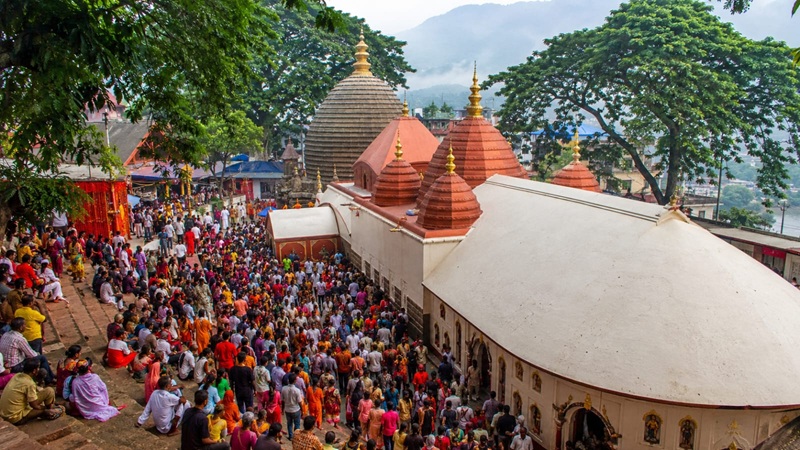
The soul of the Ambubachi Mela is the Maa Kamakhya Temple. Located on the Nilachal Hill in Guwahati, Assam, this temple is considered one of India’s most prominent Shaktipeeths. According to Hindu religious beliefs, Shaktipeeths were established in areas where various body parts of Goddess Sati fell when Lord Vishnu dismembered her corpse with Sudarshana Chakra. Kamakhya Temple was established on the place where the goddess’s vagina is believed to have fallen.
For this reason, this temple is considered a vital centre of power, creation, and goddess worship. The most unique feature of the temple is that it lacks a traditional idol of the goddess. A natural rock form, always moistened by a stream of water, is worshipped within the sanctum sanctorum. This unique feature distinguishes this temple from other Shaktipeeths.
Surrounding the main temple are numerous temples dedicated to various manifestations of the Goddess and Lord Shiva, transforming the entire Nilachal region into a vast spiritual complex. This is why the Ambubachi Mela is considered not just a religious festival but a vibrant celebration of faith, women’s power, nature, creation, and the Indian spiritual tradition.
(This article is a translation of the original article published on OpIndia Hindi.)