

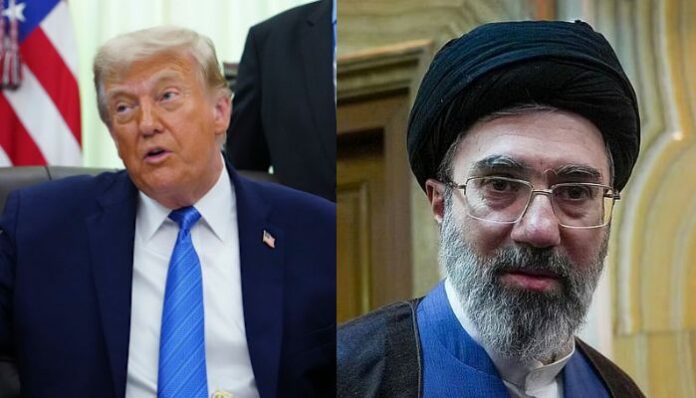
The United States and Iran have reached a major ceasefire agreement that could bring an end to months of military tensions and reopen one of the world’s most important oil routes, the Strait of Hormuz. US President Donald Trump announced the development on Sunday, 14th June, saying that a deal with Iran had been completed and that shipping through the Strait of Hormuz would resume without restrictions.
On Truth Social, US President Donald Trump posts, "The Deal with the Islamic Republic of Iran is now complete. Congratulations to all! I hereby fully authorize the toll free opening of the Strait of Hormuz, and, simultaneously herewith, authorize the immediate removal of the… pic.twitter.com/fPLg91aBTy
— ANI (@ANI) June 14, 2026
The announcement comes after months of conflict that intensified following military operations launched by the US and Israel against Iran in February this year. The Strait of Hormuz, a critical route for global energy supplies, had remained largely shut during the crisis, raising concerns about energy markets and regional stability.
As per reports, leaders of the two sides are expected to meet for a signing ceremony on Friday, June 19, in Switzerland, where Pakistan will also be there as a mediator.
Trump announces breakthrough deal
In a post on Truth Social, Trump declared that the agreement with Iran had been finalised and described it as a major diplomatic achievement.
“The Deal with Islamic Republic of Iran is now complete. Congratulations to all!” President Donald J. Trump 🇺🇸 pic.twitter.com/RdSwyEdEtO
— The White House (@WhiteHouse) June 14, 2026
“The Deal with the Islamic Republic of Iran is now complete,” Trump wrote.
He also announced the reopening of the Strait of Hormuz and the lifting of the US naval blockade. “Congratulations to all! I hereby fully authorise the toll-free opening of the Strait of Hormuz, and, simultaneously herewith, authorise the immediate removal of the United States Naval blockade. Ships of the World, start your engines. Let the oil flow!”
In another post, Trump claimed the agreement would bring stability to the wider Middle East and suggested that a broader peace arrangement could follow. “This Great Deal will bring Peace and Security to the whole Region,” he wrote.
Trump also highlighted what he described as his unique role in achieving the breakthrough.
“Many presidents have tried to make Peace with Iran, and all have failed before me. The Leaders of the Region have, for the first time, found a President who can help them achieve real Peace. With the opening of the Strait upon the signing of the Deal on Friday, for purposes of mine removal, oil will flow on both ends again for the Region, and the World!”
Iran later confirmed that an agreement had been reached. Iranian Deputy Foreign Minister Kazem Gharibabadi acknowledged the deal on Sunday, indicating that hostilities between Tehran and Washington would end under the arrangement.
Pakistan announces ceasefire agreement
Before Trump’s statement, Pakistan Prime Minister Shehbaz Sharif publicly revealed that a ceasefire agreement had been reached following intensive diplomatic efforts.
Posting on X, Sharif said the agreement would end military operations across multiple fronts.
“Following intensive talks, we are pleased to announce that the Peace Deal between the United States of America and the Islamic Republic of Iran has been REACHED. Both sides have declared the immediate and permanent termination of military operations on all fronts, including in Lebanon.”
Following intensive talks, we are pleased to announce that the Peace Deal between the United States of America and Islamic Republic of Iran has been REACHED. Both sides have declared the immediate and permanent termination of military operations on all fronts, including in…
— Shehbaz Sharif (@CMShehbaz) June 14, 2026
He said the official signing ceremony would take place in Switzerland on coming Friday, 19th June and thanked several countries that participated in mediation efforts.
“We would like to thank the United States of America and the Islamic Republic of Iran for their commitment to finding a diplomatic solution to the conflict. We would also like to extend our sincere appreciation to our brothers in this mediation effort, the great leadership of the State of Qatar, for their support in reaching this agreement.”
Deal comes after days of uncertainty
The announcement follows several days of speculation that a ceasefire was close. Trump had earlier indicated that a major announcement would be made on Sunday.
However, concerns emerged after Israel reportedly carried out air strikes in Beirut’s southern suburbs, raising fears that tensions could derail the negotiations. Iranian officials had repeatedly warned that attacks on Beirut represented a red line and could trigger retaliation against Israel.
Despite those concerns, diplomatic efforts continued behind the scenes, eventually leading to Sunday’s announcement.
What the agreement contains
Ahead of the formal signing ceremony, Iran‘s semi-official Mehr News Agency published what it described as a draft 14-point memorandum of understanding between Washington and Tehran. Neither government has officially confirmed the contents, but the reported provisions offer a glimpse into what the final agreement may include.
According to Mehr, the proposed memorandum includes a permanent ceasefire on all fronts, including Lebanon, and a US commitment not to interfere in Iran’s internal affairs.
The memorandum reportedly provides a 60-day window, extendable by mutual consent, for negotiating a final comprehensive agreement. As part of the initial confidence-building measures, the United States would lift its naval blockade immediately and restore maritime traffic involving Iran to pre-war levels within 30 days. Washington would also withdraw its forces from surrounding areas within 30 days of the final agreement.
For its part, Iran would ensure the resumption of merchant shipping between the Persian Gulf and the Sea of Oman, including through the Strait of Hormuz, restoring traffic to pre-war levels after completing mine-clearance and other technical operations.
One of the most significant provisions concerns sanctions relief and economic recovery. The draft states that the United States, together with regional partners, would formulate a comprehensive reconstruction and economic development programme for Iran worth at least $300 billion. Washington would also commit to ending all sanctions on Iran according to a mutually agreed schedule, including unilateral US sanctions as well as sanctions linked to resolutions of the UN Security Council and the Board of Governors of the International Atomic Energy Agency (IAEA).
The reported framework also includes immediate US Treasury waivers allowing Iranian crude oil, petrochemical exports and related services, including banking, insurance and transportation, to resume. Additionally, frozen Iranian funds and restricted assets would gradually be released as negotiations progress, with the United States issuing the necessary licences and permissions to facilitate access.
On the nuclear issue, Iran reportedly reiterates that it will never produce nuclear weapons. Questions surrounding enriched uranium stockpiles, Iran’s nuclear requirements and other nuclear-related matters would be addressed in the final agreement. Until then, both sides would maintain the status quo: Iran would not expand its nuclear programme, while the United States would refrain from imposing new sanctions or increasing its military presence in the region.
The memorandum further envisages the creation of a joint implementation mechanism to monitor compliance with the final accord. According to the reported draft, negotiations on the remaining provisions would only proceed after Iran receives assurances that key commitments, including the lifting of the naval blockade, restoration of shipping routes, oil-export waivers and the release of frozen assets, are being implemented.
Finally, the draft states that any eventual final agreement would be endorsed through a binding resolution of the United Nations Security Council, giving the deal international legal backing.
If implemented as outlined, the agreement would represent one of the most far-reaching diplomatic understandings between Washington and Tehran in decades, touching on military de-escalation, sanctions relief, nuclear restrictions, regional security and economic reconstruction. Iranian state-linked media have portrayed the framework as a major diplomatic victory for Tehran.
