

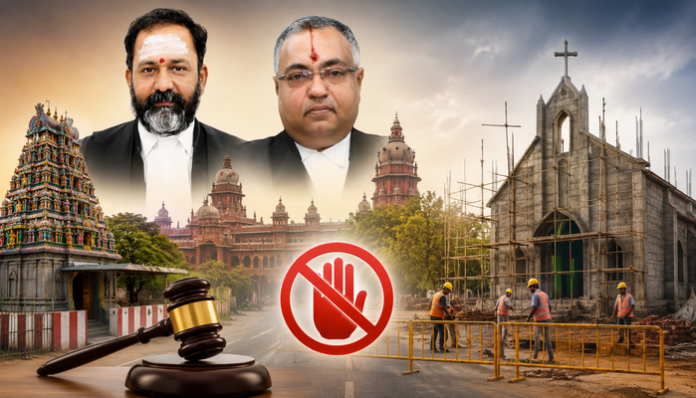
The Madras High Court recently restrained the construction of a church in the vicinity of Mariamman Temple on Kalapatti Main Road in Coimbatore, Tamil Nadu. A Division Bench of Justices G.R. Swaminathan and V. Lakshminarayanan passed the interim injunction in the writ petition filed by Balasubramaniyam, a resident of Kalapatti, against the orders passed by the District Collector and the Revenue Divisional Officer (RDO).
The High Court examined the records of the case and found that the land on which the proposed church was to be erected was classified as a public road in revenue records. In addition to that, the court noted that the proposed church was being constructed in an area where there was a handful of Christian population and the Hindu majority in the area had been vehemently opposing it. The court also held that the construction of a large church in proximity to an over 100-year-old Hindu temple hints at mala fide intentions.
“Coimbatore is a communally sensitive city. It witnessed bomb blasts and bloody religious riots. The proposed church would come up within a stone’s throw from the existing Mariyamman Temple. There are only a handful of Christian families. If a large church is proposed to be constructed in the vicinity of the Mariyamman Temple, mala fide intentions cannot be ruled out,” stated the judgment dated May 25, 2026, authored by Justice G.R. Swaminathan.
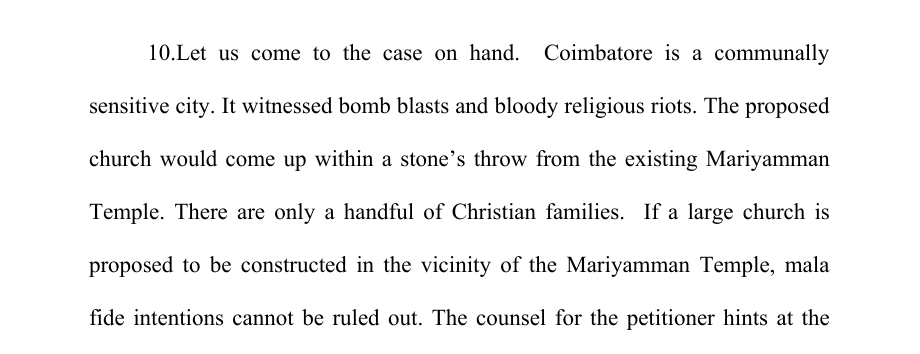
“Since India is a secular nation and a pluralistic society, religious amity has to be preserved, especially when an overwhelming majority of Hindus oppose the construction of a church in close proximity to the temple,” Justice Swaminathan noted, adding that the constitutional right to practise, profess and propagate any religion is subject to public order.
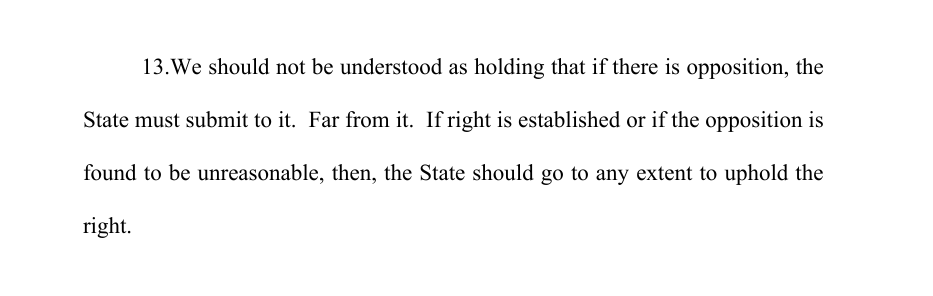
However, he clarified that the court is not directing the state to surrender to opposition from a section of society. He added that if a right is established and the opposition is found unreasonable, then the state must enforce and uphold the right. “We should not be understood as holding that if there is opposition, the State must submit to it. Far from it. If the right is established or if the opposition is found to be unreasonable, then the State should go to any extent to uphold the right,” Justice Swaminathan clarified.
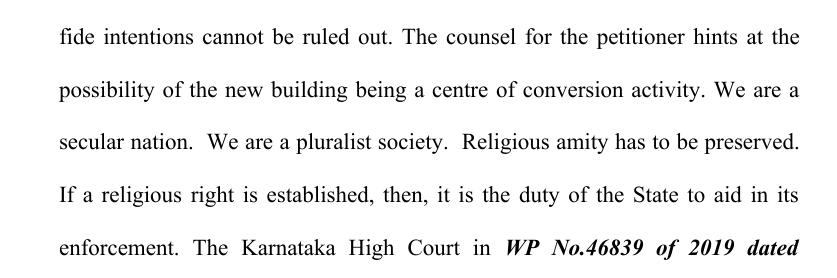
Justice Swaminathan also considered the petitioner’s submission that the proposed church building could be used as a centre for conversion activity. “The counsel for the petitioner hints at the possibility of the new building being a centre of conversion activity. We are a secular nation. We are a pluralist society. Religious amity has to be preserved. If a religious right is established, then it is the duty of the State to aid in its enforcement,” Justice Swaminathan said.
Petitioner said fundamentalist groups in the state emboldened under the Joseph Vijay government
The petitioner submitted before the High Court that since the government headed by Chief Minister C. Joseph Vijay took charge in the state, certain fundamentalist organisations have become emboldened. He pointed out certain instances to show how the socio-religious environment in the state has changed after the new government was formed.
He said that Speaker of the Legislative Assembly, JCD Prabhakar, who proclaims that he had distributed thousands of free copies of the Bible, quoted biblical verses in his inaugural address to the Legislative Assembly. The petitioner also added that when Shri Udhayanidhi Stalin, the leader of the opposition, called for annihilation of Sanatana Dharma in his address in the Assembly, it was not condemned or even objected to by the ruling party.
A Single-Judge Bench had stayed the construction of the church pending a suit
The village where the church is proposed to be constructed has a minuscule Christian population. The village has around 1000 families, out of which 950 are Hindus, 15 are Muslims, and a few of the remaining are Christians. In January 2010, the District Collector passed an order permitting the construction of the church near the temple. The Hindus of the village opposed the construction of the church and challenged the order of the District Collector before the District Munsif Court, Coimbatore, vide a civil suit in 2011. The suit is still pending.
Around 13 years later, some private individuals tried to resume the construction of the church and obtained orders to that effect. However, after a law and order situation arose, the District Collector asked them to stop the construction. Subsequently, in 2024, the Church of South India (CSI) filed a writ petition before the Madras High Court challenging the order of the District Collector. A Bench of Justice M. Dhandapani, in April 2026, refused to decide the case on the merits as the civil suit was pending. The court directed the petitioners to make a fresh application after the disposal of the civil suit.
The Madras High Court earlier upheld religious rights
Last year in December, the Madurai Bench of the Madras High Court upheld the rights of Hindus to light Karthigai Deepam at the Mandu Kovil (Dindigul) and the Deepathoon pillar at Thiruparankundram hill in Madurai. A Single-Judge Bench of Justice G R Swaminathan slammed the district administrations of Dindigul and Madurai for failing to make arrangements for the lighting of lamps by Hindu devotees.


