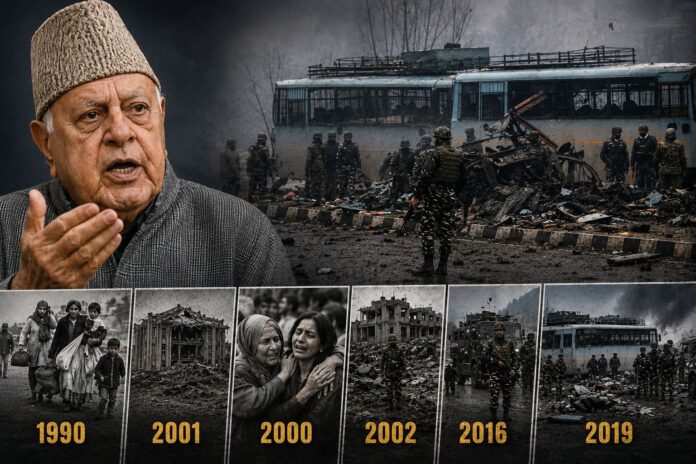
National Conference president Farooq Abdullah has triggered a fresh political controversy after questioning why terrorist attacks seem to occur whenever the demand for restoring Jammu and Kashmir’s statehood gathers momentum. The remarks came in the wake of the Kulgam terror attack, where terrorists killed two migrant labourers from Chhattisgarh.
Speaking to reporters in Baramulla, Abdullah said, “I regret it. We do not even know who killed them and how they were killed. There should be an investigation, a fair probe into who the killers are.” The former CM said, “I don’t know why such incidents happen when we seek statehood.”
What Abdullah was alluding to was that terror attacks are orchestrated whenever there are talks demanding restoration of Jammu and Kashmir’s statehood.
His remarks have invited sharp criticism because they appear to overlook an inconvenient historical fact: terrorism in Jammu and Kashmir neither began after the abrogation of Article 370 in August 2019 nor after the erstwhile state was reorganised into a Union Territory.
Controversial statement by Farooq Abdullah. Asks why do terror attacks happen only when we demand statehood?
— Aditya Raj Kaul (@AdityaRajKaul) August 1, 2026
Who will remind him about terror attacks in Kashmir since last 37 years?
Why play politics over terror?
And he says he doesn’t know the perpetrators… O’really? pic.twitter.com/4PYDV71J3F
If anything, the overall scale of violence has declined since 2019. Terrorism has not disappeared, but the Valley today bears little resemblance to the years when bomb blasts, targeted killings, separatist shutdowns and mass protests were routine.
Farooq Abdullah’s question therefore raises another: When did terrorism in Kashmir ever stop while Article 370 was in force?
Pakistan-backed insurgency took root before the 1990s
The insurgency that engulfed Kashmir did not emerge overnight in 1989. Its foundations were laid after the controversial Assembly elections of 1987, when Pakistan’s military establishment and intelligence agencies exploited political discontent to build an armed insurgency. Young men were recruited, trained across the border and infiltrated back into Jammu and Kashmir with weapons, money and ideological backing.
Groups such as the Jammu and Kashmir Liberation Front (JKLF), later joined by Hizbul Mujahideen, Lashkar-e-Taiba and Jaish-e-Mohammed, launched an armed campaign against India. But the violence soon went beyond attacks on security forces. It evolved into an ideological movement aimed at changing the Valley’s demographic and religious character.
Bomb blasts, kidnappings, assassinations and attacks on government institutions became increasingly frequent. Islamist slogans advocating Nizam-e-Mustafa echoed across towns and villages, while fear became part of everyday life.
Targeted killings paved the way for the exodus of Kashmiri Hindus
The principal victims of this campaign were the indigenous Kashmiri Hindus.
The slogan that came to define the period, “Raliv, Galiv ya Chaaliv” (Convert, Die or Leave), was directed not at New Delhi but at the Valley’s Hindu minority. Long before January 1990, prominent Kashmiri Hindus had begun receiving threats. Posters ordering them to leave appeared outside homes, anonymous letters warned families they would be killed if they stayed, and mosque loudspeakers blared threatening slogans throughout the night.
The intimidation was accompanied by carefully planned assassinations.
One of the first high-profile victims was Tika Lal Taploo, a prominent advocate, social worker and BJP leader. On 14 September 1989, he was shot dead outside his Srinagar residence by JKLF terrorists. His murder sent shockwaves through Kashmir and signalled that terrorists had moved beyond attacking representatives of the Indian state. They had begun systematically eliminating influential members of the Hindu community.
Barely weeks later, another prominent Kashmiri Pandit was assassinated.
On 4 November 1989, retired Sessions Judge Justice Neelkanth Ganjoo was shot dead in broad daylight near Hari Singh Street market in Srinagar after visiting a Jammu and Kashmir Bank branch. Three JKLF terrorists opened fire at close range before fleeing.
Justice Ganjoo had been marked for death because, as a Sessions Judge in 1968, he had sentenced JKLF founder Maqbool Bhat to death for the murder of CID Inspector Amar Chand. The conviction was upheld by higher courts, and Bhat was eventually executed in Tihar Jail on 11 February 1984.
Bhat himself was among the pioneers of the separatist movement. Associated with Sheikh Abdullah’s Plebiscite Front before moving to Pakistan, he co-founded the National Liberation Front, the armed precursor to the JKLF. He was linked to the murder of Amar Chand and the hijacking of Indian Airlines Flight Ganga in 1971. Following his execution, he became a martyr for separatist groups, making Justice Ganjoo a symbol of the Indian judicial system they sought to avenge.
His assassination was therefore not merely an act of revenge but a message that judges, lawyers and anyone associated with India’s constitutional institutions could be eliminated.
The killings continued.
Advocate Prem Nath Bhat was murdered in December 1989, while government officials, teachers, engineers, journalists and ordinary civilians increasingly became targets solely because they were Hindus or were perceived as supporters of India.
These were not isolated incidents but part of a systematic campaign to terrorise Kashmiri Hindus into leaving the Valley.
As 1989 drew to a close, threatening posters appeared outside Hindu homes, anonymous warnings multiplied and mosque loudspeakers amplified slogans demanding that Hindus either convert, leave or die. Women were specifically threatened, while families were warned that resistance would invite death.
The ethnic cleansing of Kashmiri Hindus under Article 370
By January 1990, fear had overwhelmed Kashmir.
The administration appeared paralysed as law and order collapsed. On the night of 19 January 1990, mosque loudspeakers across the Valley simultaneously broadcast slogans threatening Kashmiri Hindus with extermination if they refused to leave.
Within days, an estimated three to four lakh Kashmiri Hindus abandoned homes, businesses, orchards and temples built over generations. Carrying little more than clothes and essential documents, they fled what became one of independent India’s largest episodes of forced internal displacement.
The tragedy is often described as an exodus. For the victims, however, it was an organised campaign of ethnic cleansing carried out under the shadow of Pakistan-sponsored jihadist terrorism.
Most importantly, it happened when Jammu and Kashmir enjoyed complete statehood, Article 370 remained fully operational and elected governments were in office.
Neither Article 370 nor local political autonomy prevented terrorism or protected Kashmir’s indigenous Hindu population.
The exodus did not mark the end of terrorism. It marked the beginning of an even bloodier phase.
Throughout the 1990s, Kashmir became synonymous with bombings, kidnappings, massacres and attacks on security forces. Pakistan-backed groups continued to infiltrate across the Line of Control while outfits such as Hizbul Mujahideen, Lashkar-e-Taiba and Jaish-e-Mohammed replaced the JKLF as the principal faces of militancy.
Ordinary civilians repeatedly paid the price.
On 25 January 1998, terrorists entered Wandhama village and massacred 23 Kashmiri Hindus, including women and children, who had remained in the Valley despite the exodus. Barely months later, terrorists wiped out an entire Hindu family in Prankote, reportedly torturing several victims before killing them.
The violence extended beyond Hindus. On 20 March 2000, terrorists lined up 35 Sikh men in Chittisinghpora village and shot them dead on the eve of US President Bill Clinton’s visit to India, drawing international attention to Pakistan-sponsored terrorism in Kashmir.
Democratic institutions were also targeted.
On 1 October 2001, Jaish-e-Mohammed terrorists carried out a suicide attack on the Jammu and Kashmir Legislative Assembly in Srinagar, killing nearly 40 people, including Assembly staff, security personnel and civilians.
Just months later, on 14 May 2002, terrorists attacked a civilian bus before storming the Kaluchak Army family quarters, killing 31 people, including women and children. The massacre demonstrated that terrorists were willing to target even soldiers’ families to spread fear.
The Amarnath Yatra also came under repeated attack, with terrorists targeting Hindu pilgrims in an effort to discourage one of India’s most important religious pilgrimages.
Despite changes in governments, from the National Conference to the PDP and Congress-led coalitions, terrorism remained a constant feature of life in Jammu and Kashmir. Article 370 continued throughout these decades, yet it neither prevented Pakistan from sponsoring terrorism nor insulated civilians from violence.
Uri and Pulwama attacks occurred before Article 370 was abrogated
By the 2010s, sustained counter-insurgency operations had reduced the intensity of militancy, but Pakistan shifted towards high-impact attacks designed to inflict maximum casualties.
On 18 September 2016, Jaish-e-Mohammed terrorists attacked the Army brigade headquarters at Uri, killing 19 soldiers. India responded with surgical strikes across the Line of Control.
On 14 February 2019, a suicide bomber rammed an explosives-laden vehicle into a CRPF convoy near Pulwama, killing 40 personnel. India responded with the Balakot airstrike targeting Jaish-e-Mohammed infrastructure inside Pakistan.
Both Uri and Pulwama occurred before Article 370 was abrogated.
These attacks alone undermine the argument that Jammu and Kashmir remained peaceful under its previous constitutional arrangement.
Security situation after the abrogation of Article 370
When the Union government revoked Article 370 on 5 August 2019, critics predicted that militancy would spiral out of control. Those predictions have not materialised.
Pakistan-backed groups continue infiltration attempts and isolated attacks on civilians and security personnel. However, the broader security landscape has changed significantly. Organised stone-pelting campaigns have virtually disappeared, separatist mobilisation has weakened, schools and markets function with fewer disruptions, and tourism has reached record levels. Government data has also indicated a decline in terror incidents, local militant recruitment and organised violence compared to the years preceding the constitutional changes.
The security challenge remains, but the sustained insurgency that characterised the 1990s and 2000s has weakened considerably.
This history is particularly relevant when discussing the restoration of statehood.
Statehood cannot be dictated by terrorism
The Centre has repeatedly stated before Parliament and the Supreme Court that statehood will be restored at an appropriate time. However, no responsible government can allow terrorist violence to dictate the timing of such a constitutional decision.
Restoring statehood immediately after terrorist attacks would risk creating the perception that violence can influence constitutional outcomes, handing Pakistan-backed terror groups exactly the psychological victory they seek.
Constitutional decisions must instead be guided by national interest, administrative preparedness and the security environment—not by attempts to shape policy through bloodshed.
Farooq Abdullah is entitled to advocate the restoration of statehood. But suggesting that terrorist attacks somehow strengthen that demand ignores the lessons of the last four decades.
From the assassination of Tika Lal Taploo and Justice Neelkanth Ganjoo to the ethnic cleansing of Kashmiri Hindus; from the massacres at Wandhama, Prankote, Chittisinghpora and Kaluchak to the attacks on the J&K Assembly, Uri and Pulwama, terrorism remained a grim constant while Article 370 was fully operational.
The historical record overwhelmingly suggests that terrorism in Jammu and Kashmir has never been determined by its constitutional status. Its principal driver has consistently been Pakistan-sponsored cross-border jihadist violence.
That is why the answer to terrorism cannot be constitutional concessions made under the shadow of violence. A democratic government must decide the future of Jammu and Kashmir on its own terms, not according to the timetable set by terrorists.