

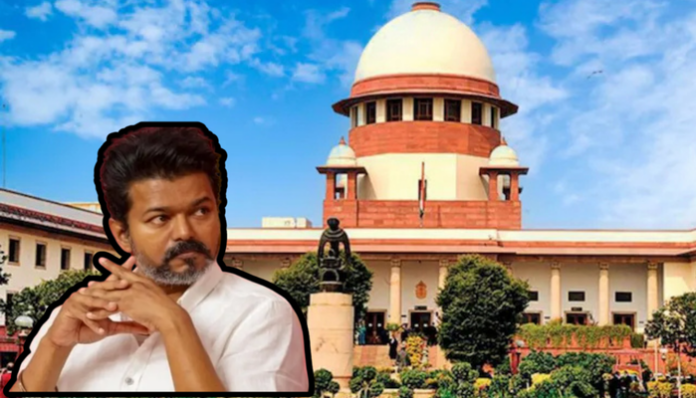
The newly formed Joseph Vijay government in Tamil Nadu has moved the Supreme Court, challenging the Madras High Court order that held that converts to Islam cannot claim reservations meant for Backwards Class (BC) Muslims. The state government filed a Special Leave Petition (SLP) before the Supreme Court on 6th July.
The matter relates to a Madras High Court order that declared a 2024 order of the Tamil Nadu government as unconstitutional and arbitrary. A Division Bench of Justices GR Swaminathan and PB Balaji passed a decision on June 25, 2026, criticising the government order allowing converts to Islam to claim BC status. The Honourable High Court reprimanded the Tamil Nadu government for passing the order with the intention of overriding the judicial precedents and, in effect, incentivising conversion to Islam.
What was the case before the Madras High Court?
The High Court passed the impugned decision in a case relating to a Hindu man who sought to be included within a Backward Muslim community after conversion to avail reservation benefits meant for the community. The man was born into a Hindu family in the Thoothukudi district in April 1993 and converted to Islam in September 2015. He was issued a certificate of conversion by Sunnath Jamath, Kayathar. Subsequently, he filed an application before the Tahsildar, Kayathar, seeking to be certified as ‘Muslim Lebbai’, a community of Muslims eligible for reservation benefits in the state. However, his application was rejected, prompting him to file a writ petition before the High Court.
He relied on the 2024 Tamil Nadu government order, which provided that if a person belonging to Backward Classes (BCs), Most Backward Classes (MBCs), Denotified Communities (DNCs), or Scheduled Castes (SCs) converts to Islam, he should be treated as BC Muslim and should be given reservation benefits meant for the community. In other words, the government order provided that converts who enjoyed reservation benefits before conversion to Islam can continue to avail reservation benefits after conversion.
The High Court saw through the Tamil Nadu government’s appeasement tactics
The Madras High Court saw through the fraud being committed by the Tamil Nadu government on the established order by passing the order. The court pointed out that the judicial position was clear that a reservation cannot be granted merely based on religion because the Constitution permits affirmative action only for socially and educationally backward classes and specified constitutional categories.
The Court cited precedents and explained that after converting to Islam, a convert’s place in the Muslim community will not necessarily correspond to his status before conversion. His position within the Muslim community will not be determined by the caste to which he belonged before converting to Islam. He ceases to be a member of his pre-conversion caste. The High Court further explained that the seven Muslim categories recognised for reservation in Tamil Nadu are historically identified communities and membership in those communities is ordinarily determined by birth, not conversion.
The Division Bench called out the Tamil Nadu government for rewarding conversion to Islam through its flawed order. The court pointed out the latent appeasement of the Tamil Nadu government, which went to the extent of overriding judicial precedents prohibiting reservation benefits for converts to Islam, in order to please the Muslim community. The court emphasised that the legislature cannot declare a binding judicial precedent void or ineffective by passing a law. It also pointed out how the government order went against the principles of Islam, which claims to be an egalitarian religion, free from caste hierarchies, by introducing hierarchies in it.
The High Court clearly explained and emphasised in its decision by quoting judicial precedents that established law prohibits reservation benefits for converts to Islam, and the Tamil Nadu government order was flawed and unconstitutional. However, the Tamil Nadu government went ahead to challenge the High Court’s decision before the Supreme Court, utilising the opportunity to appease the Muslim community in the state, even if that amounts to disregarding the established law.


