

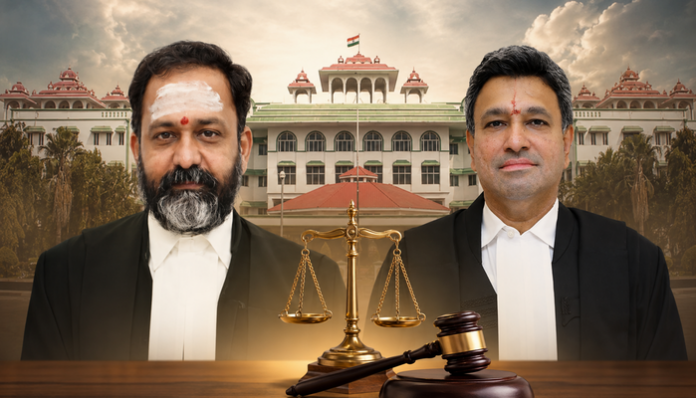
The Madurai Bench of the Madras High Court recently struck down a Tamil Nadu government order that allowed a Hindu man from Backwards Classes, Most Backwards Classes, Denotified Communities, or Scheduled Castes to avail reservation benefits even after converting to Islam. A Division Bench of Justices GR Swaminathan and PB Balaji rebuked the Tamil Nadu government for passing an unconstitutional and arbitrary order with the intention of overriding the law as laid down by a previous judicial decision.
The decision was passed by the High Court on Thursday (25th June) in a petition seeking a writ of Mandamus filed by a Muslim convert named Sameer Ahamed (formerly Paramasivam). The man was born into a Hindu family in the Thoothukudi district in April 1993 and had converted to Islam in September 2015. He was issued a certificate of conversion by Sunnath Jamath, Kayathar. Subsequently, he filed an application before the Tahsildar, Kayathar, seeking to be certified as ‘Muslim Lebbai’, a community of Muslims eligible for reservation benefits in the state. However, his application was rejected, prompting him to file a writ petition before the High Court.
The petitioner relied on a Tamil Nadu government order dated March 3, 2024, which allowed a convert to Islam from Backward Classes (BCs), Most Backward Classes (MBCs), Denotified Communities (DNCs), or Scheduled Castes (SCs) to be treated as BC (Muslim) for availing the benefit of reservation. As per the order, such a convert could avail the reservation benefits meant after obtaining a community certificate certifying that he belongs to either of the notified communities. In other words, the government order provided that converts who enjoyed reservation benefits before conversion to Islam can continue to avail reservation benefits after conversion.
So, the broader legal and constitutional question for consideration before the High Court was whether a person belonging to a Backward community can claim reservation benefits available to specific notified Backward Class Muslim communities in Tamil Nadu upon conversion to Islam. As pointed out by the High Court, the petitioner’s counsel admitted that the petition filed in 2022 became legally arguable only after the 2024 government order. The High Court, therefore, examined the constitutional validity of the government order.
After examining the record of the case and the judicial precedents in detail, the High Court concluded that the Tamil Nadu government order was unconstitutional. The court said that the judicial position was clear that a reservation cannot be granted merely based on religion because the Constitution permits affirmative action only for socially and educationally backward classes and specified constitutional categories.
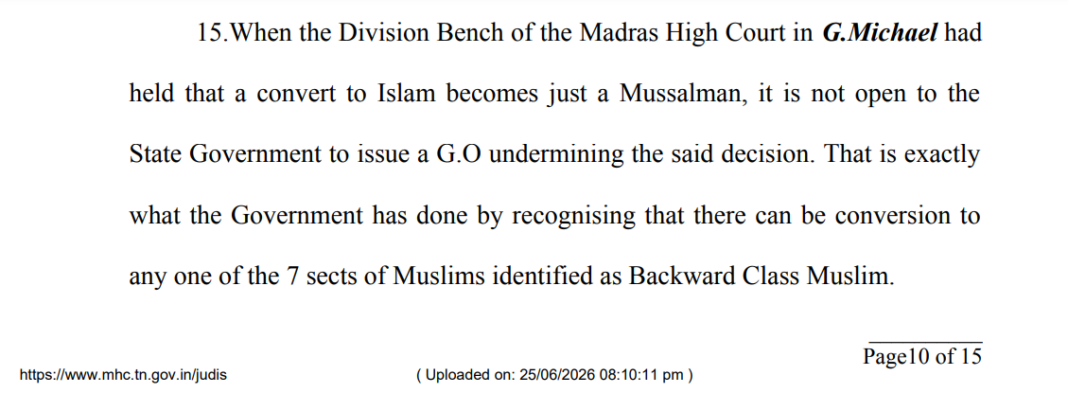
A Hindu converting to Islam becomes just a ‘Mussalman’: HC
Citing judicial precedents, the court said that if a person converts to Islam, he becomes a Muslim, and his place in Muslim society is not determined by the caste to which he belonged before his conversion. “…when a Hindu gets converted to Islam, he becomes just a Mussalman and his place in Muslim society is not determined by the caste to which he belonged before his conversion. It was further held that a member of one of the castes or sub-castes, when he is converted to Islam, ceases to be a member of any caste,” the High Court cited a precedent.
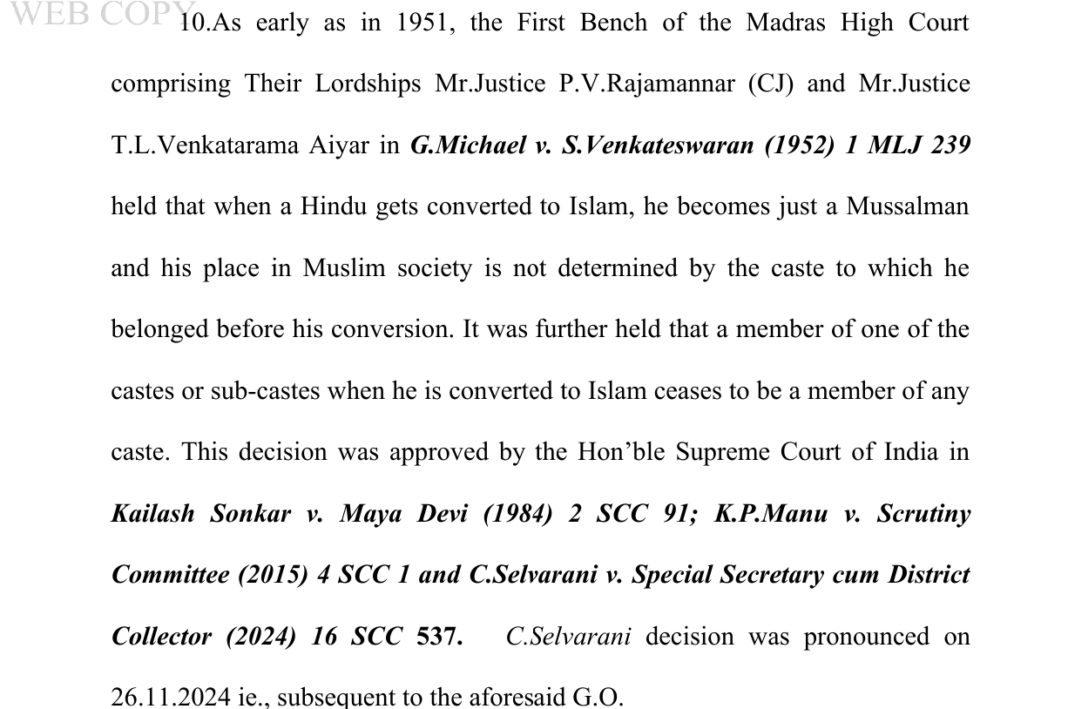
The High Court explained that the seven Muslim categories recognised for reservation are historically identified communities and membership in those communities is ordinarily determined by birth, not conversion. “As a corollary, we hold that a convert to Islam cannot claim the status of Backward Class Muslim. He is only a Muslim, and that’s all there is to it,” the High Court held.
The order was passed to give reservation benefits to converts to Islam: HC
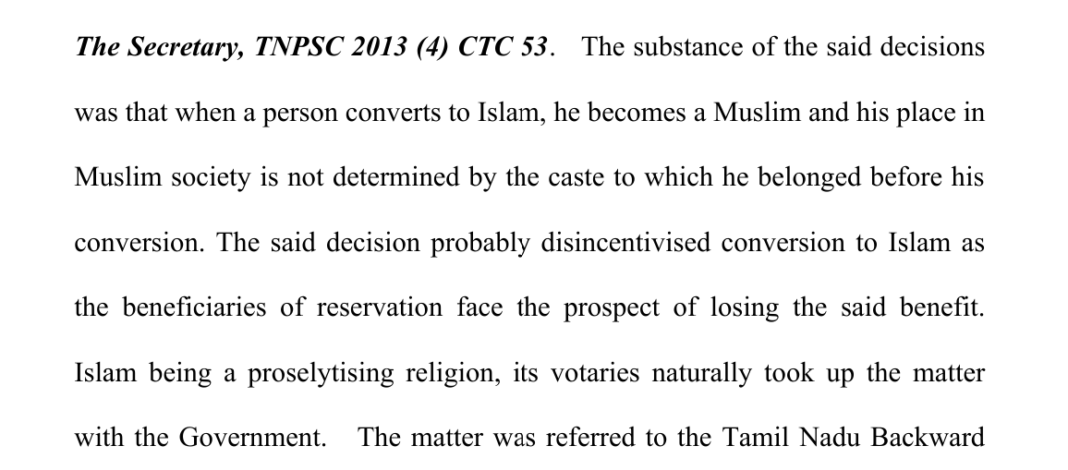
Regarding the Tamil Nadu government order, the Division Bench observed that the Tamil Nadu government came up with the order just to override the judicial precedents prohibiting reservation benefits for converts to Islam, as they disincentivised conversion to Islam. This would not have sat right with the Muslim community as Islam is a proselytising religion, and thus the government passed the order to extend reservation benefits for converts to Islam.
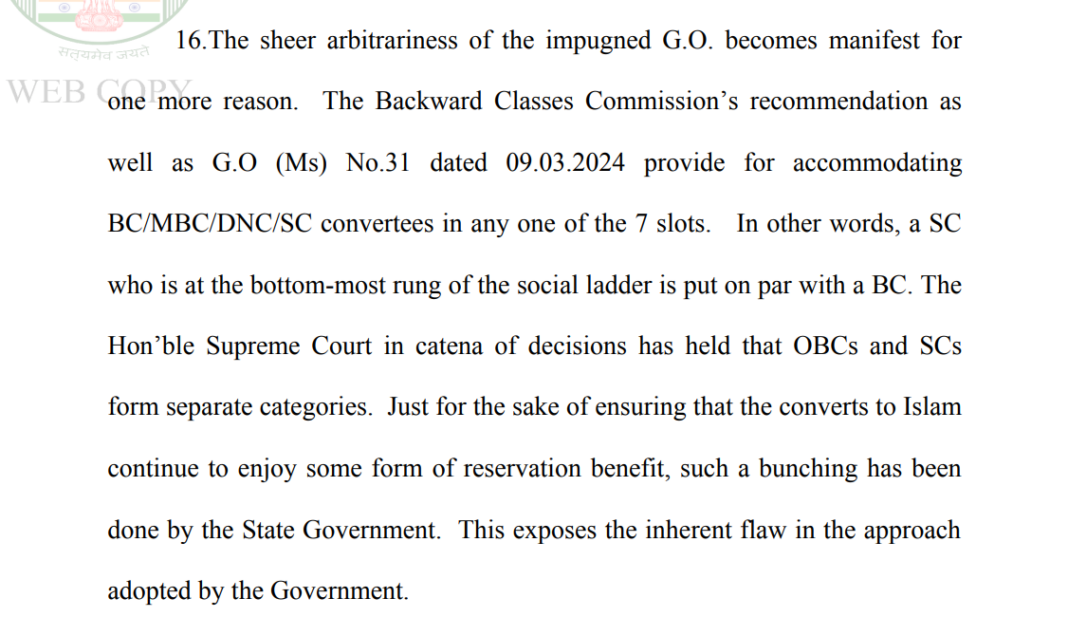
Criticising the government order, the court said that it grouped persons belonging to BCs, MBCs, DNCs, and SCs into a single Muslim Backward Community upon conversion, disregarding the fact that these categories are given distinct constitutional treatment for sociological and historical reasons.
“In other words, a SC who is at the bottom-most rung of the social ladder is put on par with a BC. The Hon’ble Supreme Court, in a catena of decisions, has held that OBCs and SCs form separate categories. Just for the sake of ensuring that the converts to Islam continue to enjoy some form of reservation benefit, such a bunching has been done by the State Government. This exposes the inherent flaw in the approach adopted by the Government,” the High Court sternly remarked. The court pointed out that the order was passed merely for the purpose of extending reservation benefits for converts to Islam.
The government order was meant to undo judicial precedent: HC
Striking at the validity of the government order, the High Court said that the legislature cannot declare a binding judicial precedent void or ineffective. “The legislature cannot declare any decision of a court of law to be void or of no effect. A court’s decision must always bind unless the conditions on which it is based or so fundamentally altered that the decision could not have been given in the altered circumstances,” the High Court stated.
The court further reasoned that the executive does not have the privilege to pass an order overriding a final judicial decision. “While the legislature has the power and competence to make a validating law, the executive has no such privilege. It can never go against the final judgment of a court,” it added.
Muslim preachers have been attracting converts by claiming that Islam is egalitarian: HC
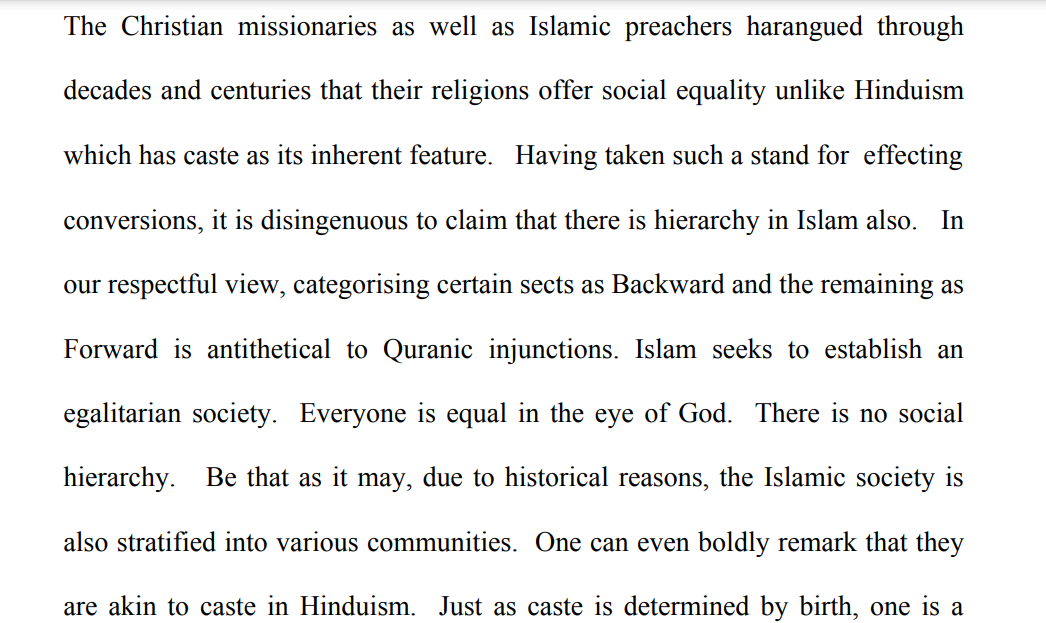
The Division Bench further noted that the government order was not only unconstitutional and arbitrary but also opposed to the ideology of Islam. The court noted that preachers of Islam have long effected conversions by claiming that their religion is free from hierarchies and is egalitarian, unlike Hinduism. Considering this, the government order goes against the values and principles of Islam.
“The Christian missionaries, as well as Islamic preachers, harangued through decades and centuries that their religions offer social equality unlike Hinduism, which has caste as its inherent feature. Having taken such a stand for effecting conversions, it is disingenuous to claim that there is hierarchy in Islam also. In our respectful view, categorising certain sects as Backward and the remaining as Forward is antithetical to Quranic injunctions. Islam seeks to establish an egalitarian society,” the court stated.
“We have no option but to conclude that, only to undo the judgments of this Court, has the Government come out with an innovation that is not only unconstitutional but also un-Islamic,” the High Court said, striking down the government order and upholding the order of the Tahsildar, Kayathar.


