

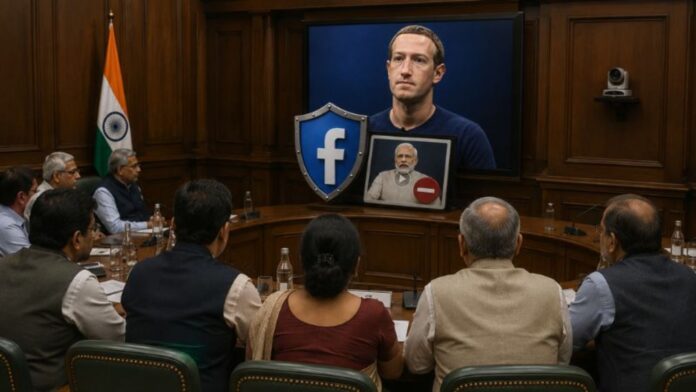
The parliamentary committee has asked Meta owner Mark Zuckerberg to apologise within three days over Prime Minister Narendra Modi’s video being removed from Facebook for a few hours. The committee has said that if Zuckerberg does not apologise within the given time, Facebook’s safe harbour protection could be revoked.
In fact, Meta, Google and other platforms are no longer limited to playing the role of mere intermediaries. They have gone beyond this by taking actions such as blocking and promoting content. This also increases their accountability.
The PM Modi Video Case
The Information and IT Committee has warned that if its direction is not followed within three days, the government could consider withdrawing Facebook’s safe harbour protection. This could expose Facebook officials to criminal prosecution, as FIRs could be registered against company officials if this protection is removed.
The controversy began over a video released by PM Modi late at night on July 23, 2026. PM Modi had posted it on Instagram, and it was later shared on Facebook. The video was made in a selfie-style format. It had disappeared from Facebook for five hours.
In this case, an Information and IT Committee was formed under the chairmanship of BJP MP Nishikant Dubey. The committee held a meeting with officials of Meta, X, Google and other digital platforms. Meta officials admitted that PM Modi’s video had disappeared from the platform for some time because of a technical error. The officials expressed regret over it, but the committee and the government considered this expression of regret insufficient.
The Information Technology and Communications Committee called the removal of the PM’s video an ‘attack on democracy’ and said that Meta should take action against the officials responsible for it. Apart from this, Zuckerberg himself should apologise, and that too within three days.
What is Safe Harbour?
Safe harbour protection is a legal protection under which internet platforms (Intermediaries) are not automatically held responsible for content posted or activities carried out by their users. In India, this protection is provided under Section 79 of the IT Act, 2000.
This does not mean that platforms are above the law. It means that if they are only platforms and follow the law, they cannot be held responsible for every action of every user. In other words, safe harbour legally protects websites and platforms from liability so that they are not held responsible for content shared by users.
In fact, this was introduced in the early years of the internet to encourage online navigation, so that platforms could avoid unnecessary legal troubles. Safe harbour protection is therefore quite important because of this. It means that sites cannot face criminal action simply because of material posted by users.
In the United States, safe harbour was included under Section 230 of the Communications Act of 1934. It was added with a new provision in 1996, while in India it was included under Section 79 of the Information Technology Act, 2000.
According to this, if companies follow the rules set by the Indian government and courts, they cannot be held responsible for illegal posts made by users, and no case can be filed against them. However, India has become strict about removing objectionable and deepfake content through the amendments to the new IT Rules, 2021, and 36 hours are given for this in certain cases.
What is the difference between a publisher and an intermediary?
A publisher is someone who selects, edits and publishes content. For example, a news channel or newspaper creates its own news, edits it and then shows or publishes it. In such a situation, it is responsible for that content. Therefore, if false news is published or shown, the publisher is responsible for it.
On the other hand, the role of an Intermediary is different. It only provides a platform, such as Instagram, Facebook, Google, X, YouTube, Telegram and other platforms used by users. In other words, intermediaries do not create content. They host content uploaded by users. This is why they receive safe harbour protection.
Now the question is, when companies give preference to specific content through algorithms, promote it and make money from it, do they still remain only intermediaries or do they become like publishers?
What are the rules in India?
In India, safe harbour can also be removed. If a platform does not take action even after being informed about illegal activity, its safe harbour protection can be removed. If it does not follow an order of the court or government, or promotes cybercrime, its safe harbour protection can be ended.
This can be decided on the orders of the government or a court. Apart from this, if a platform itself starts controlling content in the way publishers do and makes money from it, its safe harbour protection can be removed. In such a situation, the platform can lose its “legal shield”.
Under the IT Rules, 2021, large social media platforms have been given several responsibilities in India. Platforms are required to appoint a governance officer. If a complaint is filed, it has to be dealt with on time. They are required to cooperate with law enforcement agencies and remove content when required. They are also required to provide information related to major cybercrimes.
A platform cannot be held guilty simply because a crime started on Instagram, Facebook or another platform. For example, if a person meets someone on Instagram and later commits fraud offline, the primary responsibility will remain with the accused person. But if the platform does not take action even after receiving a complaint, or repeatedly allows fake accounts to operate, legal action can be taken against it. The same applies if it ignores a court order.
This is not the first time that the Indian government and a digital platform have had a dispute. There have been several disputes with X, WhatsApp, Google and Meta in the past as well. These disputes have involved orders to remove objectionable content, fake news and matters of national security. Questions have also been raised over content related to Shaheen Bagh and the farmers’ protest. There have been several disputes over compliance with the IT rules issued by the government.
In the case of alleged AI-generated and morphed videos of Prime Minister Modi being circulated on social media, Hyderabad Cyber Crime Police registered an FIR in July 2026 against Meta India head Arun Srinivas and several social media users. The police are now investigating what Meta did to stop such deepfake and misleading content. They are also examining why a content moderation system was not in place on the platform.
A similar thing happened in the case involving Union Minister Nitin Gadkari. AI-generated deepfake videos were made involving his family and claims about them benefiting from E-20 petrol. He has approached the Bombay High Court over this. The Bombay High Court allowed Gadkari to file a case against Meta, X, Google and all other platforms. The court also ordered these platforms to remove all such links.
In several cases, companies have approached courts, while the government has said that every platform operating in India must follow Indian laws.
Safe Harbour Has Become A Global Controversy
The controversy over safe harbour has grown across the world. Under US law, Section 230 gives internet companies safe harbour protection. But over the past few years, Meta, Google and X have faced allegations of allowing fake news to spread, not stopping content that could influence elections and not taking sufficient action against hate speech. Because of this, both Republicans and Democrats have demanded changes to Section 230 for different reasons.
The European Union had introduced the Digital Services Act. Through this, large platforms were given responsibilities such as maintaining transparency in algorithms, quickly removing illegal content and ensuring the safety of children. This means tha,t along with safe harbour, their responsibilities are also significant.
There was also a dispute between the United States and the European Union under a Safe Harbour agreement over controlling data transfers. European countries had objected that US agencies could easily access the data of European citizens, which meant that they could potentially be spied on. Cases were also filed in the European Union’s court over this issue. During this period, the court also held that US laws did not protect the misuse of the personal information of European citizens. After these disputes, Europe cancelled the Safe Harbour agreement in 2015.
Australia told Meta and Google that if they make money from news content, they should pay media organisations for it. After this, Meta stopped news sharing on Facebook for some time. The dispute arose because if a platform is an intermediary, how can it make money from content like a publisher?
After this, Australia proposed that platforms should either pay local media organisations for news content or pay a 2.5 per cent tax on digital advertising. Companies would have to enter business agreements with at least six local publishers to avoid this. These rules would apply to platforms whose annual income is more than 250 million Australian dollars.
Canada introduced the Online News Act in 2023. After it came into effect on June 22, 2023, Meta largely stopped making news available on Facebook and Instagram. In fact, through this law, platforms such as Meta and Google were required to pay media outlets for news content shared on their platforms.
After this, these platforms stopped sharing news content altogether. Google agreed to pay money after reaching an agreement with the Canadian government, following which restrictions on Google were avoided. But Meta continues to face a ban on news content in Canada.
The entire world is now struggling with the question of whether these platforms should continue to get safe harbour protection. Social media platforms are no longer playing only the role of intermediaries because of their algorithms and content recommendations. They have gone much further and have started playing the role of publishers as well.
If they remain mere intermediaries, they should get safe harbour protection. But when questions arise about what content will be shown, who will see it, what will be promoted and what will make money, their responsibility should also increase. The removal of PM Modi’s video from Facebook for a few hours is also a case of this kind.


