

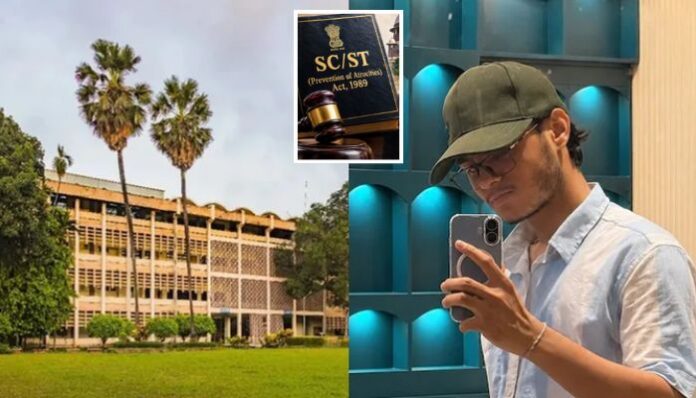
The death of a second-year student at the Indian Institute of Technology (IIT) Bombay has triggered massive late-night student protests on campus. The student, Sahil Wakode, committed suicide hours after he was caught using a mobile phone to solve a question paper and get answers via ChatGPT during an examination. Professor Suryanarayan Doolla, who was on invigilation duty, asked Sahil to leave the examination hall, and hours later, Sahil was found dead in his hostel room.
Following the incident, Sahil’s parents alleged that he was subjected to relentless caste discrimination by the IIT Bombay administration. Based on the father’s complaint, an FIR was lodged by the Mumbai Police on Saturday, 19th September, naming Professor Suryanarayan Doolla and others under charges of abetment of suicide alongside sections of the Scheduled Castes and Scheduled Tribes (Prevention of Atrocities) Act.
The parents claimed that Sahil had earlier informed them about facing discrimination and difficulties on campus. In his complaint, the father stated that Professor Doolla had been targeting his son with casteist remarks for three months on the instructions of IIT Bombay Director, Professor Shireesh B Kedare. The father stated in his complaint, “He had come to the college on his own merit, and everything went fine in the First Year. Things changed in the Second Year when the Director, Shireesh B Kedare, instructed faculty member Suryanarayan Doolla to do caste-based discrimination… Doolla was passing casteist remarks for the past three months and had threatened to implicate him in a wrong manner before the incident took place.”
Mumbai, Maharashtra: Ravindra Wakode, father of deceased IIT Bombay student Sahil Wakode, says, "I appeal for a thorough investigation into those who pushed him toward suicide through torture and caste discrimination. I urge the government to ensure justice for my child by… pic.twitter.com/EolHVj83ud
— IANS (@ians_india) September 19, 2026
In response, Director Kedare firmly denied the allegations, stating that no caste discrimination exists on the IIT Bombay campus and that student caste data is completely hidden and unavailable to anyone. The institute’s SC/ST Students and Staff Cell also confirmed that no formal complaint of caste-based discrimination had ever been filed by the student.
Social media outcry and the usual Ambedkarite narrative
As news of the incident spread, social media platforms saw an aggressive wave of reactions, particularly from Ambedkarite groups and online commentators, who claimed that General category students and faculty regularly abuse ‘marginalised students’ on premier campuses, driving them to suicide. One user wrote, “All the accused should be immediately arrested, and the Director should resign. These Savarna casteist faculty have been abusing students on campuses. They want to gatekeep these spaces from marginalised communities; Savarnas occupy more than 90% of faculty positions.”
All the accused should be immediately arrested and @iitbombay Director should resign. There savarna casteist faculties has been abusing students in campuses. They want to gatekeep these spaces from marginalized communities, savarnas occupy more than 90% of faculity positions https://t.co/dBNl40TUq5
— Cloudwalker (@13cloudwalker) September 19, 2026
Another user, @AmbedkarCircle_, posted about the massive late-night student protests on campus following the tragic death, emphasising parental allegations of institutional harassment and torture.
Massive student protest late night in campus after @iitbombay 2nd year Dalit student dies by suicide
— Ambedkarite Circle (@AmbedkarCircle_) September 19, 2026
Students Parents allege institutional harassment and torture #JusticeForSahilWakode pic.twitter.com/SMwjAua6sB
Other online voices used the tragedy to aggressively push for reservation mandates in faculty positions, arguing that while IIT Bombay students are smart enough to understand reservation, the faculty steps in to discriminate based on caste, making reservations in faculty positions an absolute necessity.
I guess in a place like iit bombay where students are smart enough to understand why reservation exists and don’t bully people from reservation, the faculty steps in to do caste based discrimination, RESERVATIONS IN FACULTY POSITIONS IS A MUST https://t.co/5UZvTuD2A7
— voltaire (@sekiroism) September 20, 2026
As is often the case, these online segments quickly shifted to their usual narrative, arguing that only SC/ST students commit suicide due to caste discrimination by General Category (GC) students and faculty, while expressing animosity and questioning why General Category students do not face similar outcomes. They continually challenge why unreserved students supposedly do not commit suicide in elite institutes like IITs and IIMs, pushing a rigid narrative that ignores broader empirical realities.
A reality check from Parliament: Ministry of Education data on student suicides
The persistent claims made on social media often stand in stark contrast to official government data. To provide clarity and a reality check against these sweeping narratives, the Ministry of Education presented comprehensive data in the Lok Sabha, replying to Unstarred Question No. 4233 on 27th March, 2023.
The government revealed that 61 students had died by suicide across IITs, NITs, and IIMs during the preceding five years, which included 33 deaths in IITs, 24 in NITs, and 4 in IIMs. A closer look at the caste-based breakup of these 61 deaths dismantles the idea that suicides are exclusive to any single community.
Out of the total 61 deaths, General-category students accounted for 30 cases (17 in IITs, 10 in NITs, and 3 in IIMs). On the other hand, OBC students accounted for 18 deaths, SC students accounted for 10, ST students accounted for 2, and the remaining 1 was recorded under the EWS category.
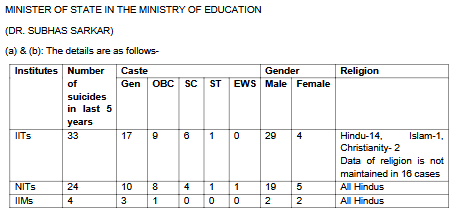
Put simply, the combined total for OBC, SC, and ST students stood at 30, exactly matching the 30 deaths recorded among General-category students. While this data does not rule out the possibility of discrimination playing a role in individual tragic cases, it firmly exposes the false claim that General-category students do not face similar mental health pressures or tragedies in premier institutions.
Rising SC/ST representation and the shaping of campus narratives
Alongside these suicide statistics, the central government has highlighted significant structural progress regarding the representation of marginalised communities in higher education.
The Modi Government not only presented transparency through parliamentary data on student suicides, but SC/ST representation has also risen substantially over the last decade. In IITs, representation has grown by roughly 60-70%, while in IIMs, it has surged by more than 100% over ten years. Furthermore, in response to UNSTARRED QUESTION No. 347 presented on 2nd February, 2026, the Ministry of Education detailed the steady growth of SC/ST student enrollment across central universities, IITs, IIMs, and IISc since 2014 based on the All India Survey on Higher Education (AISHE) data comparing 2014-15 with 2022-23.
In IITs, SC enrolment increased from 10,392 to 18,076, while ST enrolment rose from 4,546 to 7,408. In IIMs, SC enrolment increased from 983 to 2,537 and ST enrolment from 410 to 942.
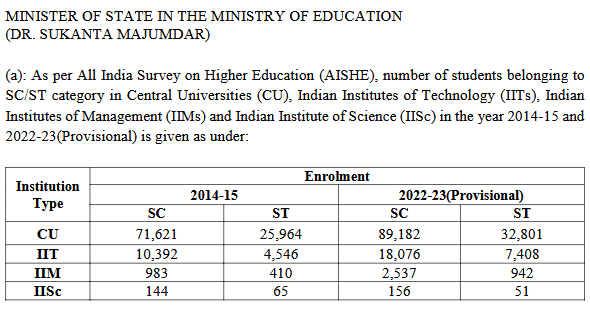
In Central Universities, SC enrolment grew from 71,621 in 2014-15 to 89,182 in 2022-23, while ST enrolment rose from 25,964 to 32,801.
From cheating case to caste-discrimination narrative
These steadily increasing numbers of SC/ST student enrollments strongly indicate that powerful narratives of systemic exclusion are frequently woven around routine or distinct crisis cases without looking at the actual facts.
In Sahil’s case, what initially appeared to be a straightforward situation of a student taking a drastic step out of panic and fear after being caught cheating during an exam was swiftly transformed into an institutional caste battle. The faculty member who caught him was booked under the stringent SC/ST Atrocities Act simply because the mechanism exists to easily spin a narrative.
Sahil’s father claimed that “under instructions from the IIT Director”, faculty member Suryanarayan Doolla had been targeting his son with casteist slurs for a long time, an explosive revelation that conveniently surfaced only after the tragedy took place, demonstrating how quickly complex personal tragedies can be reframed to fit pre-existing political narratives.


