

On Tuesday (4th August), US Republican Congressman Riley Moore attempted to peddle mass hysteria and panic about India’s Foreign Contribution (Regulation) Amendment Bill, 2026.
He claimed that the Modi government is eyeing to persecute Christians by taking over the Churches and religious charities.
The MAGA Christian nationalist brazened out, “India’s Parliament is considering amending Foreign Contribution Regulation Amendment (FCRA) rules to permit government takeovers of churches and religious charities.” He continued, “This is a clear attack against Christians. If this bill proceeds in this way, it would be a point of major concern in our bilateral relationship with India.”
Christians have been in India since St. Thomas the Apostle traveled to the Malabar Coast just decades after the resurrection of our Lord Jesus Christ.
— Rep. Riley M. Moore (@RepRileyMoore) August 4, 2026
But despite this long Christian history, India’s Parliament is considering amending Foreign Contribution Regulation Amendment…
While it was clear that the social media posturing was meant to placate a resentful MAGA voter base (given the state of affairs in the US and the ongoing war with Iran), his fearmongering has the potential to create chaos in India.
His statements misrepresent both the statutory text of the legislation and the broader regulatory objective of India’s Foreign Contribution (Regulation) Amendment Bill. In reality, it is religion-neutral and aims to improve accountability, financial transparency and prevent fund diversion by all NGOs operating in the country
Debunking the anti-Christian myth
The disinformation surrounding FCRA Amendment Bill is that it empowers the Indian government to arbitrarily takeover churches and religious institutions. A direct reading of the statutory text demonstrates that this narrative is factually inaccurate.
The proposed legislation explicitly protects all Places of Worship from government conversion, secularisation or repurposing.
“Notwithstanding anything contained in sub-section (6), the Designated authority shall, where any asset permanently vested in it or portion thereof is a place of worship, entrust the management or operation of such asset or portion thereof to such person, in such manner and on such terms and conditions as may be prescribed and ensure that the religious character of such place of worship is maintained.”
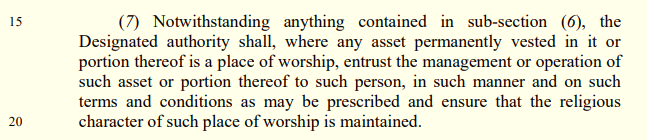
This clause ensures that even if a Church loses its foreign contribution license, its physical place of worship cannot be dismantled or closed. Religious practice will remain completely unaffected.
The role of the Designated Authority is strictly restricted to managing foreign-funded commercial or developmental assets when an FCRA registration is cancelled, surrendered, or allowed to expire. The objective is to ensure continuity of public services.
Moreover, any order passed by the Designated Authority remains subject to administrative review and judicial appeal before a District Judge.
At the same time, state-level agencies are barred from initiating local prosecutions without prior approval from the Cente. This provides safeguard against arbitrary local action.
Setting the record straight
It is clear from the reading of the proposed law that it does not prohibit foreign funding for any religion including Christianity. As such, churches and other places of Worship such as temples, mosques and gurudwaras can continue to receive foreign donations for genuine religious work.
It is only when the funds recieved from abroad are not utilised in the manner that it was declared in the first place can an organisation lose its FCRA registration. But even if such a case, the organisation’s place of worship cannot be taken over or used for any other purpose.
A legal recourse is also available in the court of law. An organisation whose FCRA licence is cancelled can challenge the decision of the Union government in the court. This applies to those involved in religious and charitable work.
Even if an organisation which ran a Church loses its licence, the locals can continue to pray at the Church without any government intervention (which basically punctures the lies being peddled about FCRA Amendment Bill being anti-minority).
Assurance by the Modi govt
The Modi government has actively engaged with all stakeholders to address concerns and reaffirm that the bill applies uniformly without religious bias.
In July this year, Union Home Minister Amit Shah met the Meghalaya Chief Minister Conrad K. Sangma and a delegation of senior church representatives such as the Presbyterian Church of India, the Garo Baptist Convention, and the Roman Catholic Church.
In the same month, the Union Home Minister met representatives from the Catholic Bishops’ Conference of India (CBCI) and informed them that the FCRA Amendment Bill will not affect the operations of law-abiding Christian organisations receiving foreign funds.
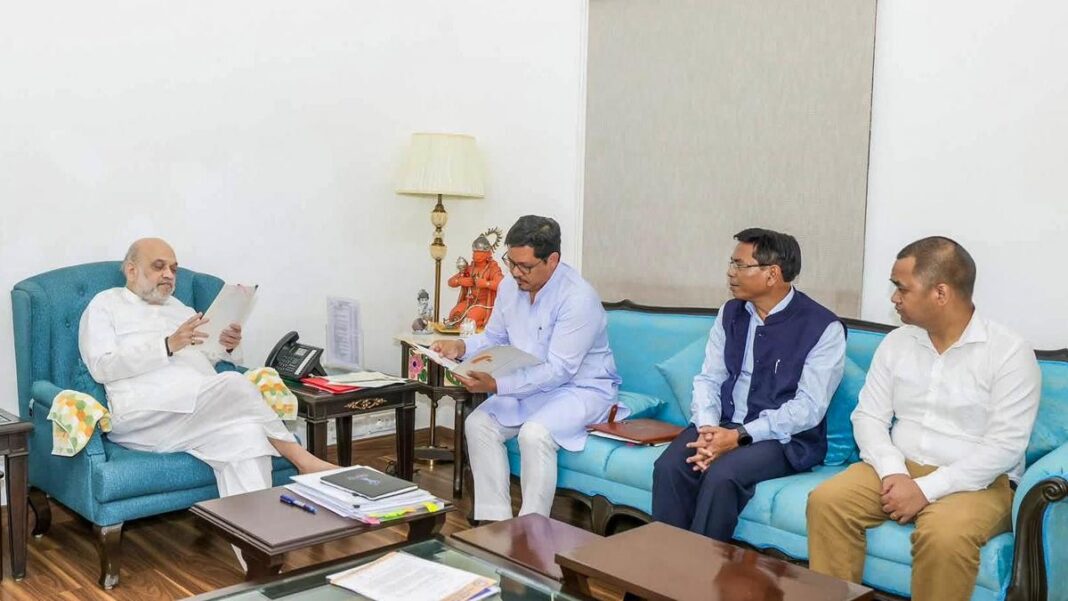
It was also assured that the proposed legislation is non-discrimantory in nature and cannot be applied retrospectively. Union Minister for Minority Affairs Kiren Rijiju has highlighted in March this year that the FCRA Amendment Bill will not affect any religious organisation.
He had stated, “There are rumours being spread by the Congress Party and the Communist Party in Kerala that the Government of India is bringing changes to the FCRA to curb the activities of various religious organisations. This is completely false, fabricated, and misleading.”
Rijiju added, “Certain funds enter the country illegally and are used against the national interest. Therefore, this legislation is aimed at safeguarding national interest and security by ensuring proper regulation of foreign funds.”
Congress had earlier supported FCRA
It is interesting to note that the Congress party during the UPA era had supported the implementation of FCRA.
In 2012, former PM Manmohan Singh had said, “There are NGOs, often funded from the United States and Scandinavian countries, which are not fully appreciative of the development challenges that our country faces…”
“The atomic energy programme has run into difficulties because these NGOs… don’t appreciate the need for our country to increase energy supply,” he had added.
Even ex-Home Minister P. Chidambaram had made similar statements during the Kudankulam anti-nuclear protests:“Investigation reveals that there appears to be diversion of funds. Therefore, under the Foreign Contribution Act, we have decided to register cases.”
Interesingly, the UPA govt revoked licenses of 4000 NGOs during its tenure.
Conclusion
While the US is attempting to interfere in India’s internal affairs and fearmongering about the plight of Indian Christians, it must be noted that the North American nation also regulates foreign contributions to ensure transparency. The United States enforces the Foreign Agents Registration Act (FARA), which requires individuals and organisations representing foreign interests to disclose political activities and funding sources.
The FCRA Amendment Bill is crucial to maintaining Indian sovreignity and integrity. It mandates the preservation of places of worship, reduces criminal penalties, establishes clear judicial recourse, and enforces uniform transparency across all non-governmental entities.


