
On 20th August (Thursday), the Supreme Court declared that hurling alleged casteist slurs in private settings does not fulfill the legal criteria to be classified as an offense under the Scheduled Castes and the Scheduled Tribes Prevention of Atrocities (SC/ST) Act. The judgement was pronounced in a case against a school manager. He was accused of attacking and subjecting the father of two students to caste-based abuses.
However, the proceedings were quashed as the court dismissed the case. The court highlighted that purported statements did not meet the necessary statutory criterion as the occurrence transpired inside a closed space that was not accessible to the public.
The decision was delivered by a bench of Justice Vikram Nath and Justice Sandeep Mehta. They were considering an appeal against a 2023 verdict announced by the Allahabad High Court, which had rejected the appellant’s plea pertaining to section 14A(1) of the Act.
The incident took place in January 2020. The respondent’s (R2) sons attended the school where the appellant was the manager. After his son was wounded during a fight with other students, he went up to the appellant, who was accused of using derogatory casteist terms against him. The latter also claimed to be assaulted by him and the school authorities.
A First Information Report (FIR) was submitted against the appellant under sections 3(1)(r) and 3(1)(s) of the SC/ST Act and sections 147, 323, 342, and 504 of the Indian Penal Code, which are sections 191, 115 and 352 of the Bharatiya Nyaya Sanhita. This led to a chargesheet which was lodged in March and the matter reached the Special Judge, SC/ST Act.
Notably, a counter FIR was filed that same day by the appellant’s wife. She charged that the respondent had assaulted and abused her in the school office. Furthermore, her spouse was also targeted upon intervening. As a result, a chargesheet was also submitted against the respondent and cognisance was taken.
“Having considered the rival submissions and the material on record, we find merit in the submissions advanced on behalf of the appellant,” the court declared. It outlined that sections 3(1)(r) and 3(1)(s) of the Act specifically mention that such an offence has to take place within “public view.” The bench even cited its earlier ruling to emphasise the point.
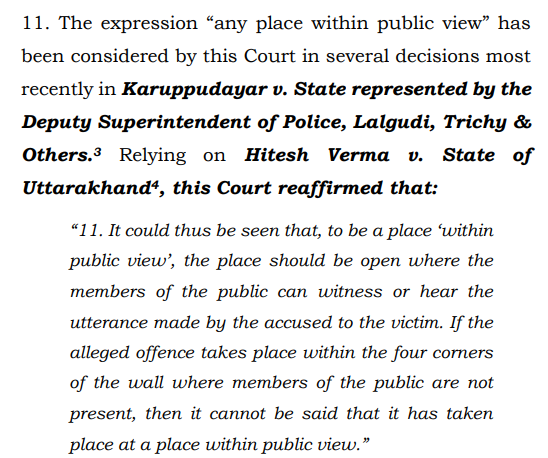
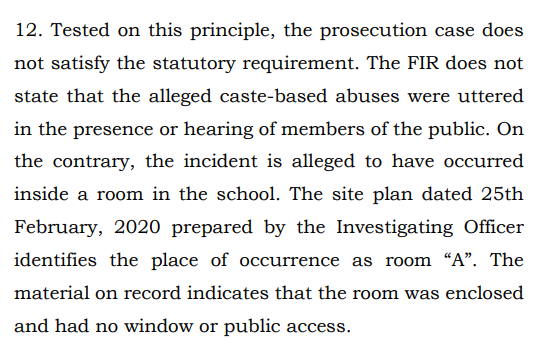
“Tested on this principle, the prosecution case does not satisfy the statutory requirement. The FIR does not state that the alleged caste-based abuses were uttered in the presence or hearing of members of the public. On the contrary, the incident is alleged to have occurred inside a room in the school,” the court conveyed. It stated that the room was enclosed and lacked a window or public access based on the documented details.
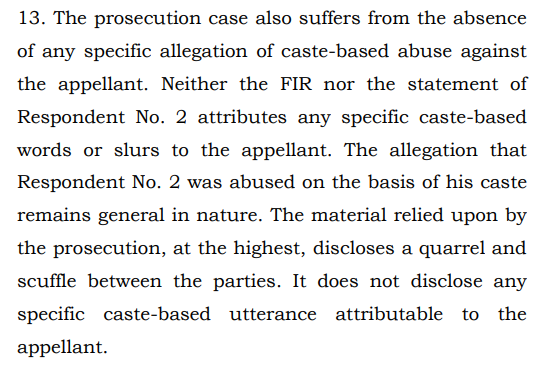
The court mentioned that the absence of a particular accusation related to caste-based abuse against the appellant further undermined the prosecution’s case. It added that the appellant is not charged with using any such specific language or insulting remarks in either the FIR or the respondent’s testimony, referring to the claim as “general in nature.”
“The material relied upon by the prosecution, at the highest, discloses a quarrel and scuffle between the parties. It does not disclose any specific caste-based utterance attributable to the appellant,” the bench expressed.
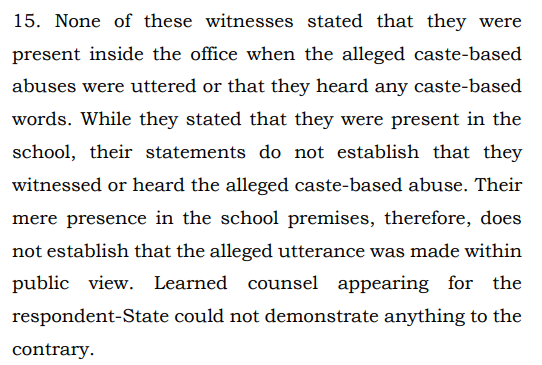
According to the judges, the four private witnesses who are teachers at the school reported a quarrel and scuffle, as their statements were taken under section 161 of the Code of Criminal Procedure during the probe. However, none of them asserted to have been in the office at the time of the supposed abuses or to have heard any such comments.
“While they stated that they were present in the school, their statements do not establish that they witnessed or heard the alleged caste-based abuse. Their mere presence in the school premises, therefore, does not establish that the alleged utterance was made within public view,” it noted, remarking that the respondent failed to prove otherwise.
The bench determined that the evidence presented to the court must reveal the fundamental elements of the offence. However, the evidence in this instance does not support the key requirement that the purported caste-based slander or intimidation took place in a location that was exposed to the public.
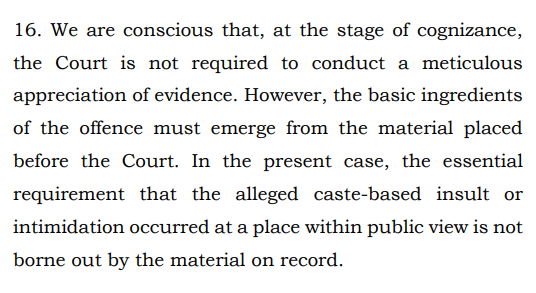
The judges pointed out that the facts presented on the record did not support the high court’s conclusion that the incident happened in public view. They underscored that the necessity for public view hinges on whether the utterances were made in conditions where members of the public could observe or hear them. “The mere fact that the occurrence took place within the premises of a school does not, by itself, satisfy this requirement,” the court announced.
It reiterated that both the FIR and the site plan suggested that the incident unfolded within an enclosed space, while the witness accounts do not substantiate their presence in the room or that they heard any caste-based remarks. “The material on record, therefore, does not establish that the alleged utterances were made in the presence or hearing of members of the public. The essential requirement of public view is consequently not satisfied,” the bench reaffirmed
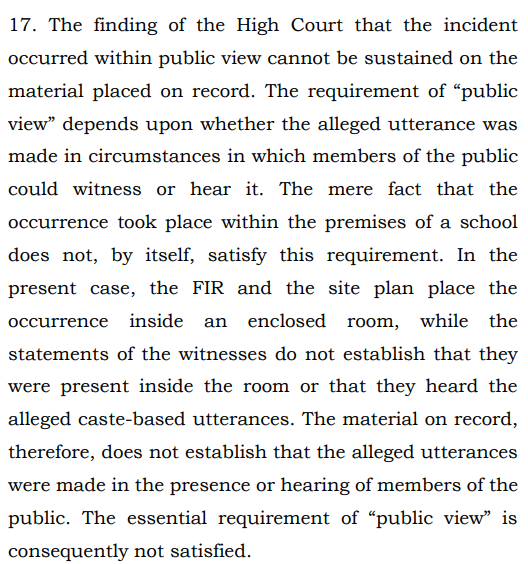
Therefore, the court indicated that the charges under sections 3(2)(r) and 3(1)(s) of the Act are not established prima facie against the appellant. It stated, “The summoning order dated 8th August 2022, insofar as it relates to the aforesaid offences, therefore cannot be sustained.”
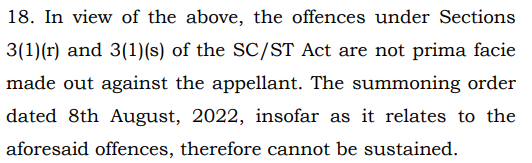
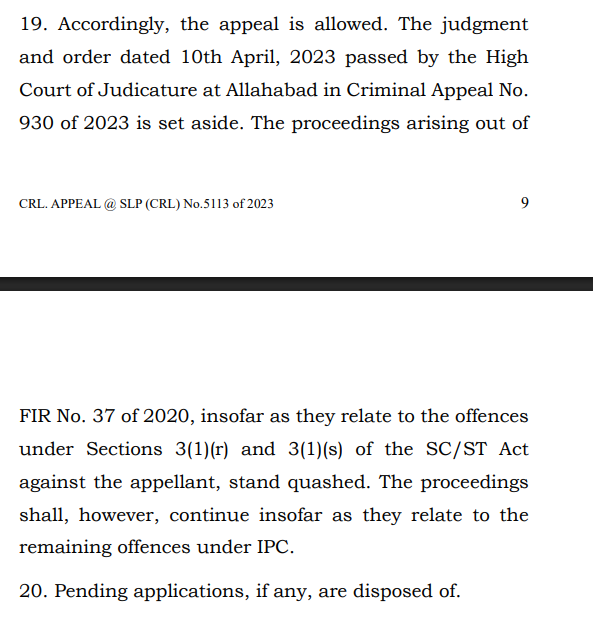
The high court’s order was “set aside,” allowing the appeal. “The proceedings arising out of FIR No. 37 of 2020, insofar as they relate to the offences under Sections 3(1)(r) and 3(1)(s) of the SC/ST Act against the appellant, stand quashed. The proceedings shall, however, continue insofar as they relate to the remaining offences under IPC. 20. Pending applications, if any, are disposed of,” the court declared.
The Allahabad High Court rejected the appellant’s petition against the Special Judge’s summons, deciding that a prima facie case had been established based on the available proof. It added that the fact that the current case was a counterblast could not be grounds for quashing on its own. Hence, the appellant went to the Supreme Court to challenge the verdict, which ruled in his favour.
The apex court has clarified that allegations alone cannot lead to a conviction, and it is mandatory to produce proper evidence (public view in this case) in compliance with the Act to substantiate a case.