

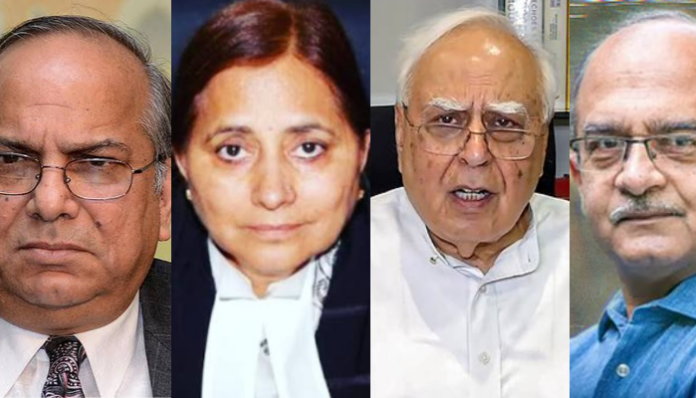
On 2nd October (Friday), an “independent commission” of former judges was announced to look into the validity and impact of the Special Intensive Revision (SIR) exercise conducted by the Election Commission of India (ECI). Retired Supreme Court judge Madan Bhimarao Lokur is going to head the five-member panel alongside former judges AK Patnaik (Supreme Court), Rekha Sharma (Delhi High Court), Anjana Prakash (Patna High Court) and Badar Durrez Ahmed (ex-Chief Justice, Jammu and Kashmir High Court).
It is created by a body of private lawyers called the Lawyers Association for Constitution (LAFC). Senior lawyers Kapil Sibal, Prashant Bhushan, CU Singh, PC Sen, Raju Ramachandran, Rebecca M. John, Warisha Farasat, and Vrinda Grover will assist the commission.
Former Supreme Court judge AK Patnaik
OpIndia has already reported on Lokur, who will be joined by former Supreme Court judge AK Patnaik. The latter was appointed to the apex court in 2009 and served for five years. Notably, he was a part of the two-member bench that acquitted all six defendants in the 2002 Akshardham temple attack in Ahmedabad.
The Prevention of Terrorism Act (POTA) court convicted and sentenced them, but the apex court released them in 2014 for lack of evidence. One accused who had been absconding was later arrested by the Anti-Terror Squad (ATS) in Jammu and Kashmir in 2019.
30 pilgrims, one police officer, and a commando were killed during the attack. Another commando suffered severe injuries and eventually passed away in the hospital after fighting for his life for two years.
Furthermore, Patnaik was also a member of the two-member bench which overturned the death sentences awarded to Aftab Ansari and Jamulludin Nasir, the masterminds of the American Centre attack in Kolkata in 2002. Both the trial court and the Calcutta High Court found them guilty of the terror strike and sentenced them to death.
However, the Supreme Court refused to equate this case with the 26/11 Mumbai terror attack convict Ajmal Kasab or the Parliament attack perpetrator Afzal Guru, both of whom were granted the death sentence and killed and changed the punishment to life sentences in 2014. 5 people were killed, while nearly 20 were injured, including cops and guards, during the assault.
Additionally, Patnaik has backed the Central Bureau of Investigation (CBI) Director Alok Verma, who was removed from his position due to corruption allegations by a high-powered committee that included Prime Minister Narendra Modi and Congressman Mallikarjun Kharge.
The Central Vigilance Commission (CVC) investigated the complaint against Verma and delivered a report in January 2019. Patnaik argued, “The high-powered committee should not have taken a hasty decision. There should have been more deliberation,” at the time.
Former Delhi High Court judge Rekha Sharma
Justice Rekha Sharma, another member of the panel, was appointed as an Additional Judge of the Delhi High Court in February 2005. She was elevated as a permanent judge the following year and retired in July 2011. She has often been seen on the propaganda website “The Wire,” using the platform to attack former Chief Justices of India Ranjan Gogoi and Dhananjaya Yeshwant Chandrachud over the Ayodhya Ram Mandir judgment.
In October 2024, Sharma reported being “dumbfounded” by Chandrachud’s statement that he had sought God’s help during the crucial Ram Janmabhoomi case, in an interview with Karan Thapar.
She claimed that it cast a question mark over the judgment and undermined its credibility. She further tried to twist his words and declared it a “conflict of interest,” mocking that the deity was a petitioner in the case and then offered a solution to the issue.
Sharma alleged that Chandrachud’s remark “surely brought down the halo around the Supreme Court” and that the verdict “has crossed all levels.” Referring to him as a “disappointment,” she contended that the office of the CJI had been “damaged.”
She even added, “If judges turn to God, why do we have courts at all? Go to priests. They have better communication with God,” remarking that Chandrachud had committed a “terrible mistake.”
Sharma also objected to his invitation to PM Modi to his residence for Ganpati puja, performing the aarti in his presence and allowing the meeting to be filmed and broadcast. She then asserted that any post-retirement appointment for him would appear “suspicious” and cast aspersions on his rulings. She also claimed that Chandrachud had effectively acknowledged that he was the author of the Ayodhya judgment due to his remark.
A few months earlier, in July, she had similarly cast aspersions on Ranjan Gogoi, who headed the five-judge Constitution Bench that delivered the landmark Ram Mandir judgement. The charges were made during a speech at a seminar which The Wire and LiveLaw had organised along with the Campaign for Judicial Accountability and Reforms (CAJR).
Sharma stated that the issue is not confined to the roster of judges, but “who assigns the case and who decides the matter,” in a clear reference to bench-fixing.
She claimed that there were three advantages to it, stating, “Number one, the master of the roster can constitute a bench of his own choice and himself preside over it even in a very personal matter. Number two, by intelligently making use of that power, he can assure himself even after his retirement, a cosy job like a seat in Rajya Sabha or governorship in some state. Number three, by intelligently using his power, he can equally benefit his very worthy and dearest colleagues too,” in an indirect attack on Gogoi.
Sharma also spoke in favour of Bhima Koregaon violence accused Stan Swamy and anti-Hindu Delhi riots accused Umar Khalid, arguing that their incarceration violated Article 21 of the Constitution. She has shared similarly sympathetic sentiments about GN Saibaba. She has also called for the Unlawful Activities (Prevention) Act (UAPA) to be struck down in her columns.
On the other hand, Sharma has been a harsh detractor of former Bharatiya Janata Party (BJP) spokesperson Nupur Sharma, praising the Supreme Court for holding her responsible for the unrest on the streets rather than the Islamists.
She has also written in support of Aam Aadmi Party leaders Arvind Kejriwal and Manish Sisodia, who were jailed in connection with corruption and money-laundering allegations linked to Delhi’s now-scrapped excise policy.
Former Patna High Court judge Anjana Prakash
Justice Anjana Prakash, who has also been included in the panel, was appointed as a judge of the Patna High Court in June 2009 and retired in July 2016. She wrote a piece for The Wire titled, “Justice in India Requires Inspiration from the Tricolour, Not Temple Dhwajas,” expressing her displeasure with the Aydhya judgement, protesting about a simple photograph of the five-judge panel, claiming that they were “celebrating.”
“For the first question which comes to mind when looking at that photograph is this – What was there to celebrate about? Was it a personal victory for the five judges as final arbiters of a long-pending dispute? Surely for a judge, every order is a celebration of her or his judicial acumen. So the Ayodhya judgment – no matter how politically important for some – should have been seen as just another judgment,” she wrote for The Wire.
Prakash even had an issue with the orange kurta, which she labelled “as a colour chosen to promote the interests of a dominant political party,” adding that his choice might have been “deliberately or accidentally.”
Furthermore, she lashed out at the judiciary for jailing Kannada actor Chetan Kumar, whose OCI (Overseas Citizenship of India) card was revoked by the Union government for indulging in anti-national activities and for derogating judges. Interestingly, she has also been a regular contributor to The Wire, where she has been given a platform to express her views.
Prakash also served on a Citizens Inquiry Committee into the 2020 Delhi unrest, which blamed the media for covering the “controversial Citizenship Amendment Act” in a prejudicial manner and creating suspicion against the Muslim community.
“The unbalanced (read biased) non-application of provisions of the Indian Penal Code (IPC) against powerful hate offenders on the one hand (these include the notorious Kapil Mishra, Ragini Tiwari and Yati Narsinghanand among others) and failure to prosecute was matched by the unfair and selective application of the dreaded UA(P)A against young protesters, concludes the report. The absence of setting up an independent Commission of Inquiry has also been commented upon,” their alleged finding stated.
Kapil Sibal, Prashant Bhushan, Vrinda Grover and more: The lawyers assisting the commission
Lawyers, including Kapil Sibal, Prashant Bhushan and Vrinda Grover, who are likewise part of the opposition ecosystem, are also set to assist the aforementioned judges.
Sibal, a former Congressman, was recently caught while he attempted bench-fixing for his client Umar Khalid. He has also supported allowing infiltrators into the country and even approached the Supreme Court against the Assam government over action taken against him. He has also described the CAA as unconstitutional.
Moreover, Sibal donated Rs 5 lakh to Tarun Tejpal to help Tehelka launch its print edition. He has also described Justice Yashwant Varma, who was embroiled in the infamous cash-at-home scandal, as the best judge.
Former AAP leader and an ardent supporter of Umar Khalid, Prashant Bhushan has also been involved in a relentless campaign against the Election Commission of India. Notably, his name has also surfaced in connection with the anti-Hindu riots in Delhi, while he was also associated with pro-Hidma protests which took place in support of the slain Naxalite in the national capital in November last year. Bhushan has also advocated for illegal Rohingyas, even attacking CJI Surya Kant for allegedly failing to protect them.
Advocate CU Singh is another member of this group, has declared that the Delhi riots conspiracy and Bhima Koregaon charges are “hollow and will crash,” adding that the judges are also aware of it. He alleged that there was a dearth of credible evidence in these cases.
Singh has also regularly written for The Wire, including a column in which he blamed the organisers for attacks on religious processions. He has also dismissed the concept of “love jihad” outright while attacking laws enacted by BJP governments to address the issue. He even accused the Supreme Court of acting as a”mute spectator” during the COVID-19 pandemic.
The next lawyer on the list, PC Sen, has been against the abrogation of Article 370, tying it to supposed anti-majoritarianism.
Raju Ramachandran, also named to assist the judges on the panel, writes for The Wire and has been a vocal opponent of the abrogation of Article 370. In one of his columns, he also questioned the judiciary over the demolition of the disputed structure in Ayodhya.
Furthermore, he was independently appointed by the Supreme Court as Amicus Curiae to examine the Special Investigation Team (SIT) reports concerning the complaint filed by Zakia Jafri in the 2002 Gujarat riots case. However, he differed with the SIT’s recommendation to close the case and instead recommended that then Gujarat Chief Minister Narendra Modi be put on trial.
Advocate Rebecca M. John, another part of this clique, is also against UAPA. She represented accused Vernon Gonsalves and Arun Ferreira in the Bhima Koregaon case. She also represented Kanhiya Kumar when he was booked for sedition in 2016.
Notably, the action was taken after anti-India slogans were raised on the Jawaharlal Nehru University campus and an event was held to mark the executions of terrorists Afzal Guru and Maqbool Bhat
Warisha Farasat, who is also set to aid the panel, attacked the Centre over the Foreign Contribution Regulation Act (FCRA) rules in 2019, claiming that the alleged NGO “Lawyers Collective,” founded by Indira Jaising and Anand Grover, was being targeted. The NGO was found to be violating the FCRA rules, after which the CBI initiated raids.
Vrinda Grover, another Umar Khalid supporter known for representing the likes of Rana Ayyub and Alt News co-founder Mohammad Zubair, is another lawyer on the list. She has faced allegations of proximity to the former West Bengal Chief Minister after she stopped representing the family of the RG Kar Medical College rape and murder victim.
Grover has also opposed the UAPA and the Armed Forces (Special Powers) Act (AFSPA), charging that it offered unbridled power to the Indian Army in Jammu and Kashmir. She claimed that they were committing human rights violations in the valley with “absolute impunity.”
She previously represented former Delhi University professor SAR Geelani, one of the main accused in the 2001 Parliament attack case, who was initially sentenced to death but later acquitted due to lack of evidence.
P.V. Dinesh enters the picture
Interestingly, another senior lawyer, P.V. Dinesh, who co-founded LiveLaw with MA Rashid, presented the newly launched LAFC website to the audience. He has also attacked the government over restrictions on internet access in Jammu and Kashmir implemented to prevent any untoward incident during the abrogation of Article 370. He was also the Delhi State President of the All India Lawyers Union (AILU), a left-leaning group and is deeply connected to the Communist Party of India (Marxist).
LiveLaw has already been caught distorting or misrepresenting facts. Last March, it portrayed Muslim rioters as innocent men who had allegedly been falsely implicated by the police in a report related to the Delhi unrest.
LiveLaw also misrepresented a hearing involving UAPA accused Sharjeel Imam, referring to him as a “student activist.” However, the hearing was neither a bail hearing nor related to the larger conspiracy case concerning the Delhi riots. Instead, it pertained to a 2020 plea filed by Imam after his arrest over seditious speeches.
A similar episode unfolded in one of its reports concerning the Gyanvapi case. “The report of LawLive is not correct with regard to today’s hearing before the Allahabad High Court. Many aspects and observations by the court have been missed. Also, the submissions made by me have not been reported, and incomplete reporting has been done,” advocate Vishnu Shankar Jain wrote on social media.
LiveLaw also pushed a pro-hijab narrative while trying to discredit the Karnataka High Court’s verdict. The managing editor of the platform, Manu Sebastian, even wanted foreign interference in the matter.
Furthermore, the media coordinator of LAFC, Subhash Chandran, is reported to be an active Marxist leader.
2. Subhash Chandran is an active Marxist leader, not some independent person. pic.twitter.com/tW76kbat9U
— Office Of Vijay Patel (@VijayGajeraO) October 2, 2026
What is Lawyers Association For Constitution (LAFC)
The “independent commission” has been constituted by the Lawyers Association for Constitution, which is a private body of lawyers, claiming to be “non-partisan, secular, and non-casteist.”
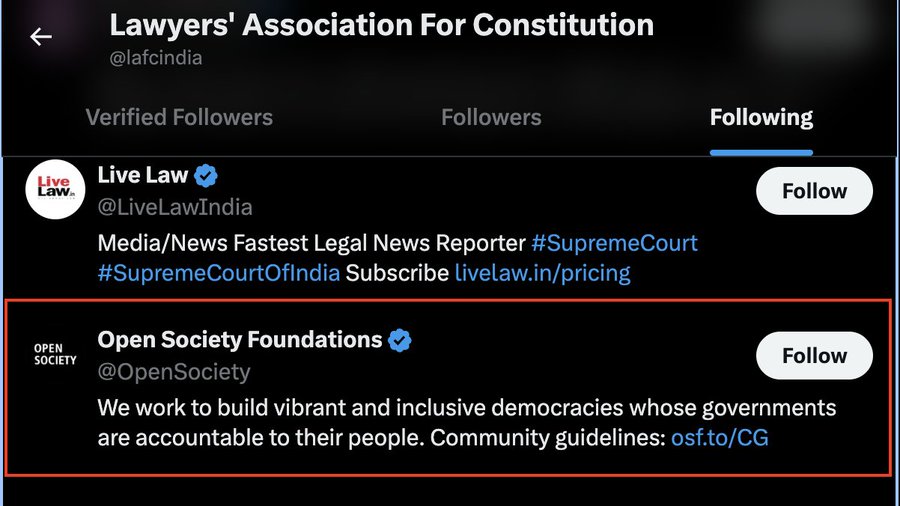
It is even more interesting that LAFC was found to be following the “Open Society Foundations” of anti-India regime-change enthusiast George Soros on X, but was removed as soon as it was exposed.
The association was officially launched on August 15, 2026, at Kerala House, New Delhi, and its membership is open to advocates and law students who subscribe to its objectives. Lokur attended the launch of the association.


