

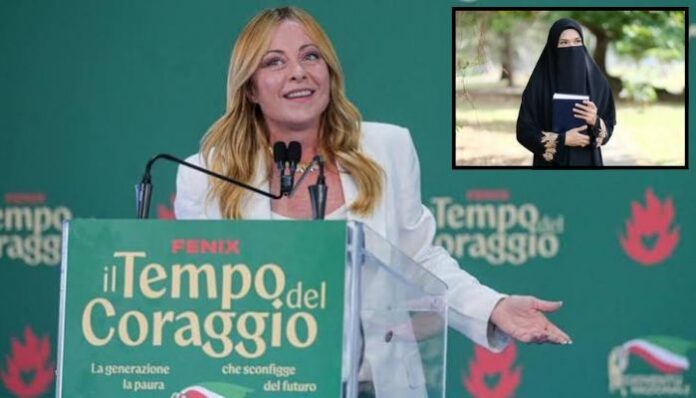
On Sunday, 20th September, Italy’s Prime Minister Giorgia Meloni announced plans to ban burqas and niqabs in Italian schools, saying students should attend classes with their faces uncovered. The proposal is part of a wider government measure that will also seek to limit the number of foreign students in classrooms.
Italian PM Meloni:
— Clash Report (@clashreport) September 20, 2026
The proposed measure will introduce an obligation for the parents of foreign students with serious school-integration problems to learn Italian, and it will introduce a ban on the burqa and niqab at school.
In Italy, nobody, in the name of a real or supposed… pic.twitter.com/zYm54QCYBD
Meloni announced the plan while addressing a youth event organised by her Brothers of Italy party in Rome. She said the measure would soon be presented to the Cabinet.
Burqa, niqab to be banned
Under the proposed measure, students would not be allowed to wear face coverings such as the burqa and niqab in schools. A burqa covers the body and face, while a niqab covers the face but leaves the eyes visible.
Meloni said that in Italy, nobody should be able to decide, “in the name of a real or supposed tradition”, that a young woman must hide her face. She also said that people coming to Italy and wanting to build their future there must learn Italian, understand the country’s culture and follow its rules.
Once approved by the government, the measure will require parliamentary approval within 60 days to become law.
Foreign students also in focus
The proposed measure will also introduce a maximum number of foreign students allowed in each classroom. However, Meloni has not yet given details about what the limit would be.
She said the government would also require parents of foreign students facing serious difficulties in integrating into the school system to take Italian language lessons.
Meloni said that when only one child in a class does not understand Italian, teachers and classmates can help the student learn and adjust. But she argued that if the number of students unable to speak Italian becomes large, or even a majority, it can make integration more difficult.
She also said Italian children should not feel like a minority in their own classrooms.
Immigration remains a major issue
Italy’s position in the central Mediterranean has made it one of the European countries most exposed to migrant arrivals. Immigration has remained a major political and social issue for successive governments.
The integration of migrants, particularly those from Muslim-majority countries, continues to be debated in Italy. Issues such as religious symbols, cultural integration, citizenship rules and immigration policy have often divided public opinion.
According to Fondazione ISMU, a research institution cited by Reuters, students who do not hold Italian citizenship account for 11.6% of total school enrolment in Italy, or around 12 out of every 100 students.
Meloni’s government has yet to announce the exact classroom limit for foreign students. The proposed face-covering ban and other measures will first have to go through the government and then Parliament before becoming law.
